

Overview of Common Stains
Full overview of the most common stains, including how to identify them and treat them
Want your ad spend to deliver more profit? Focus on Customer Lifetime Value (CLV).
Most digital marketing for home service providers prioritizes short-term metrics like Cost Per Click (CPC) or Return on Ad Spend (ROAS). But these metrics often miss the bigger picture: the long-term value of each customer. By shifting to CLV, you can identify which campaigns bring in repeat customers, referrals, and higher profits over time.
Here’s why CLV matters:
The key is using CLV insights to refine ad strategies, target the right audience, and optimize budgets for long-term growth. This approach ensures every dollar spent works harder for your business.
Let’s dive into Customer Lifetime Value (CLV) - what it is and how to calculate it. This concept plays a crucial role in understanding the long-term potential of your customers.
Customer Lifetime Value (CLV) is the total revenue you can expect to earn from a single customer throughout your relationship with them. For home service providers, this includes everything from routine maintenance to emergency repairs and eventual system replacements.
Think of it this way: a $200 drain cleaning might seem like a small transaction. But that one service could lead to seasonal check-ups, water heater repairs, and even full system replacements over the next decade. CLV bundles all those future earnings into one comprehensive metric.
To calculate CLV, use this simple formula:
CLV = Average Transaction Value × Transactions Per Year × Customer Lifespan
For instance, if an HVAC company typically charges $300 per service call, sees customers twice a year, and retains them for 10 years, the CLV would be $6,000 ($300 × 2 × 10). If acquiring a customer costs $150, that’s a 40x return on ad spend (ROAS) over their lifetime.
Metrics like immediate ROAS focus on the value of a single purchase - say, a $99 drain cleaning. CLV, on the other hand, takes a long-term view, factoring in repeat services, system upgrades, and annual maintenance plans.
This broader perspective is essential when evaluating ad campaigns. As Ashley Valadez from HubSpot explains:
"Acquiring a new customer costs 5 to 25 times more than keeping an existing one. So, CLV is the key to long-term revenue growth and lower churn".
For example, a campaign might initially show a disappointing 0.49 ROAS for a first-time purchase. But when you factor in four years of repeat business, that lifetime ROAS could jump to 23.5.
Up next, we’ll explore how to apply these CLV insights to your paid ad strategies for smarter, more effective campaigns.

LTV:CAC Ratio Guide for Sustainable Business Growth
Use CLV to transform your ad spend into lasting profitability.
The 80/20 rule is a game-changer for understanding your customer base: around 20% of your customers typically account for 80% of your total lifetime value. Prioritize quality over sheer volume.
Platforms like Google Ads and Meta make this easier with Value-Based Lookalike Audiences. By uploading a customer list that includes their lifetime values, these tools can identify prospects who closely resemble your most profitable customers - not just anyone likely to convert. For example, in 2024, Turkish retailer Boyner adopted Google’s AI-powered "new customer acquisition goal" in high-value mode. The results? A 310% increase in customer lifetime value, 240% more new customers, and a 20% drop in acquisition costs.
For home service providers, this could mean identifying what sets a $6,000 HVAC customer apart from a $200 one-time repair client. It could be factors like specific zip codes, certain property types, or customers who sign up for maintenance plans. Targeting these high-value traits allows you to bid more aggressively on similar prospects. Zeroing in on these segments helps justify spending more on acquisition, knowing the long-term payoff will be worth it.
Spending more to attract high-value customers can lead to greater profitability.
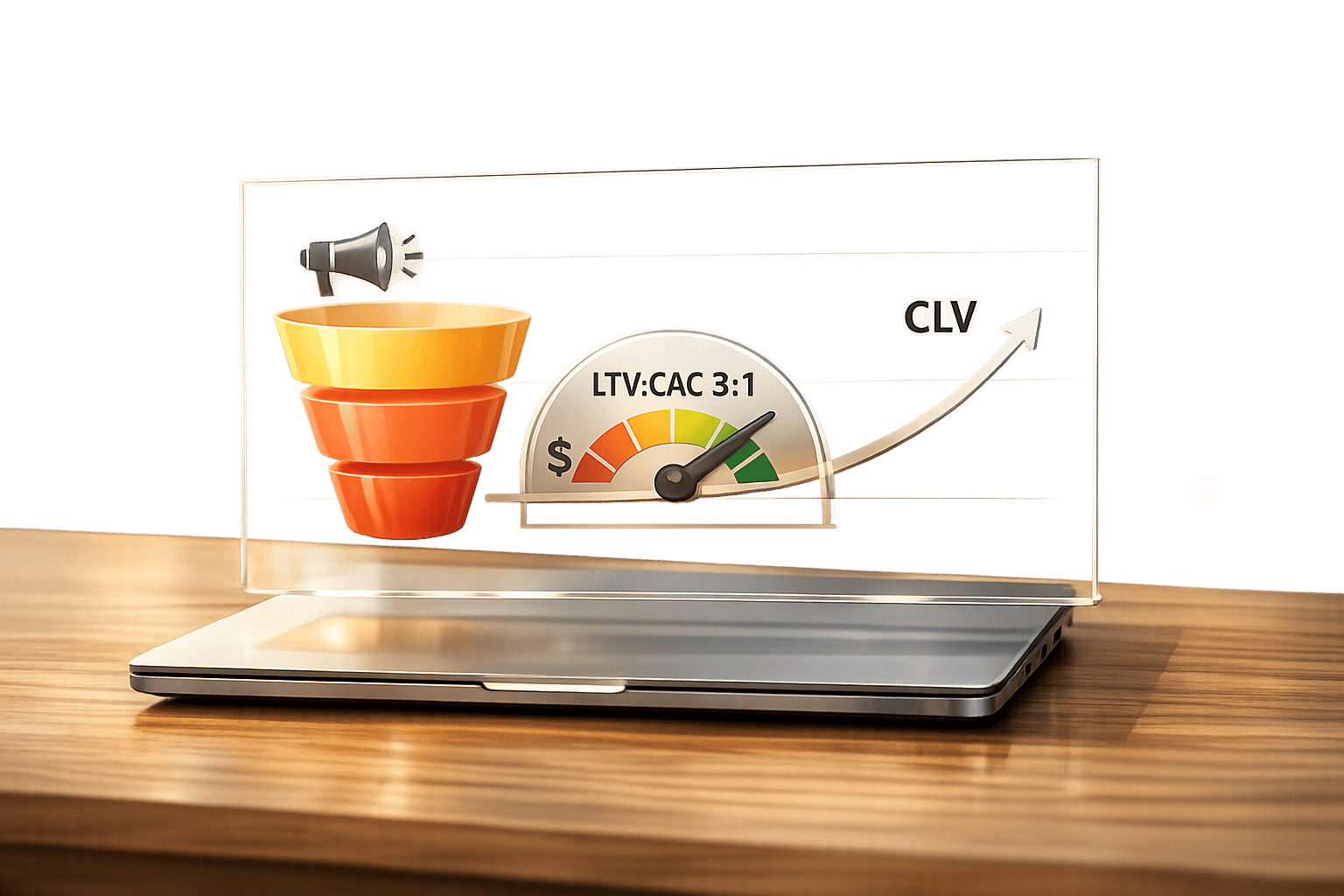
If your CLV analysis shows a customer is worth $6,000 over their lifetime, spending up to $2,000 to acquire them is a smart move. This results in a 3:1 LTV:CAC ratio, which is the gold standard for sustainable growth. On the flip side, chasing discount-driven leads that cost only $50 to acquire often results in customers with 50% lower lifetime value.
Here’s a quick guide to understanding your LTV:CAC ratio:
| LTV:CAC Ratio | What It Means | Your Next Move |
|---|---|---|
| < 1:1 | Losing money on every customer | Rethink your strategy immediately |
| 1:1 - 2:1 | Barely breaking even | Focus on better targeting and retention |
| 3:1 | Healthy growth | Maintain and scale |
| 5:1+ | High profitability | Consider boosting ad spend to grow faster |
As the 2026 AdBid Guide puts it:
"Stop asking 'how cheaply can we acquire customers?' Start asking 'how can we acquire customers worth acquiring?'"
Higher upfront costs are justified when backed by strong CLV data, reinforcing the idea that long-term value matters more than short-term savings.
Once you’ve identified your valuable segments and justified their acquisition costs, it’s time to refine your campaign strategy.
Tracking CLV by acquisition channel can reveal surprising insights. For instance, Meta ads might generate lower-cost leads ($27.66), but Google Search often attracts higher-intent customers, making its higher cost ($70.11) worthwhile.
Adjust your budgets based on which channels deliver the most profitable results. At the same time, use negative targeting to filter out low-value segments - like serial discount shoppers or one-time emergency callers who never return.
Businesses that focus on CLV instead of short-term revenue often see a 25% boost in profitability. This shift turns campaign planning into a data-driven process, ensuring every dollar spent aligns with long-term customer value.
To refine your ad strategy with a focus on customer lifetime value (CLV), start by leveraging the insights you already have. By analyzing your data, segmenting your audience, and using tools to automate processes, you can create campaigns that prioritize high-value customers.
Dive into your sales data to separate high-value customers from one-time buyers. To calculate CLV, focus on three key metrics: Average Order Value (AOV), Purchase Frequency, and Average Customer Lifespan. These numbers are essential for understanding which customers contribute most to your bottom line.
Segment your audience using RFM analysis (Recency, Frequency, Monetary). For example, in home services, you might discover that customers with annual maintenance contracts have a 3.2x higher lifetime value compared to those who only use your services for emergencies.
Next, perform a cohort analysis by grouping customers based on when they were acquired. If newer customer groups show lower retention rates, it could indicate that recent campaigns are attracting less loyal buyers. Further, divide your customers into tiers - Top 20%, Regular (21-70%), and Discount Seekers (Bottom 30%) - to identify the characteristics of your most profitable groups.
These insights will help you adjust your campaigns to target the right audience.
Once you’ve identified high-value customer segments, integrate that information into your ad platforms. For instance, Google's Conversion Value Rules allow you to assign higher conversion values to customers who display high-CLV traits. If mobile app users have 2.4x higher lifetime value, you can increase their conversion value by 50% or more.
On Meta, you can create value-based lookalike audiences by uploading your top 20% customer list, complete with their lifetime values. This helps Meta’s algorithm find prospects similar to your best customers, rather than just those likely to make a single purchase. Adjust your Target CPA goals accordingly - allocate higher bids for premium prospects and lower bids for discount-driven customers.
Tailor your ad creatives to resonate with high-CLV customers. For instance, emphasizing brand storytelling and using quality imagery can boost lifetime value by 20-25% and 15-20%, respectively. On the flip side, relying too heavily on discounts can reduce lifetime value by 30-50%. Shift your focus from first purchases to predictive actions like account creation (1.8x higher LTV) or adding items to a wishlist (2.1x higher LTV).
Tracking CLV manually isn’t practical. Use a CRM system like Estatehub to automate data collection and monitor customer lifecycle events. For home service providers, Estatehub integrates with HighLevel CRM to track everything from initial service calls to repeat bookings and maintenance renewals. This data can be fed directly into platforms like Google Ads and Meta via API connections, enabling their algorithms to optimize campaigns for long-term profitability instead of short-term conversions.
Set up automated triggers based on RFM scores to re-engage high-value customers before they churn. Keep an eye on your LTV:CAC ratio - a healthy target is 3:1 for sustainable growth. Also, monitor your payback period (how long it takes to recoup acquisition costs), aiming for 3-6 months for most home service businesses. Automating these processes ensures that your campaigns remain profitable and data-driven.
Metrics like ROAS and CPA only tell part of the story - they focus on immediate transactions and ignore the bigger picture of long-term customer value. For example, a campaign spending $50 to acquire a customer for a $10 product might seem wasteful at first glance. But if that customer generates $240 over two years, the ROAS jumps to 4.8:1. Without factoring in CLV, you risk pulling the plug on campaigns that are actually profitable in the long run.
To get a clearer picture, measure net CLV, which is the total revenue a customer brings in minus retention costs like customer support, loyalty programs, and remarketing efforts. Keep an eye on your LTV:CAC ratio - a 3:1 ratio is a strong indicator of sustainable growth, while anything below 1:1 means you're losing money on every customer. A great example of this approach is FlixBus, which increased its social media ROAS by 233% by using CLV attribution. This allowed them to shift their budget toward channels that delivered long-term revenue.
These long-term metrics provide a solid framework for refining and improving your campaign strategies over time.
Once you're tracking long-term metrics, regular CLV monitoring can help identify which channels bring in the most valuable customers. For instance, a cohort analysis might show that customers acquired through organic search have a 12:1 LTV:CAC ratio, while those from paid search only hit 1.5:1. Armed with this knowledge, you can adjust your budget to focus on the most effective channels without completely abandoning others.
Another key metric to track is your payback period - the time it takes to recover your customer acquisition costs. For industries like home services, aiming for a payback period of 3 to 6 months is a good benchmark. By integrating this data with ad platforms through your CRM, you can enable algorithms to prioritize high-value users instead of just chasing high-volume conversions.
Focusing on CLV can have a major impact on your bottom line. Studies show that optimizing for CLV can increase profitability by about 25%, and even a modest 5% boost in retention can drive profits up by 25–95%.
Integrating Customer Lifetime Value (CLV) into your ad strategy can completely change the game for home service providers. Instead of focusing solely on the cheapest leads or the fastest returns, CLV encourages you to think long-term - investing in customers who bring consistent value through repeat business, seasonal services, and referrals.
Here’s the impact: optimizing for CLV can boost profitability by 25%, and improving retention by just 5% can increase profits by a staggering 25%–95%. By targeting high-value customer segments and maintaining a healthy 3:1 LTV:CAC ratio, you’re not just filling your pipeline with leads - you’re building a growth engine that’s designed to last.
"The businesses that win in 2026 won't be the ones acquiring the most customers. They'll be the ones acquiring the right customers - those whose lifetime value far exceeds acquisition cost." – AdBid
For home service providers, the question is no longer, "How cheaply can we acquire a customer?" Instead, it’s, "Which customers are worth acquiring?" Use your CRM to identify and segment your audience, leverage value-based bidding on platforms like Google Ads and Meta, and track metrics like payback period and LTV:CAC ratio to fine-tune your campaigns for long-term profitability.
Start by calculating CLV, segmenting your customers, and aligning your budget with long-term value. This approach ensures sustained growth and profitability.
At Estatehub, we apply these CLV-driven strategies to help home service providers achieve lasting success. With the right tools and insights, your business can maximize its potential and thrive in a competitive market.
If you don’t have years of data to calculate Customer Lifetime Value (CLV), you can still make projections by analyzing early customer behavior and purchase trends. For example, you can use initial purchase data, retention rates, or average transaction values to estimate CLV over a shorter timeframe, such as a few months or a year. Another option is to leverage predictive models or refer to industry benchmarks to create informed estimates, even with limited data.
To get the most out of your paid ad campaigns, focus on sending high-CLV (Customer Lifetime Value) signals to platforms like Google Ads and Meta. On Google Ads, take advantage of value rules to fine-tune bids for your most profitable customer segments, helping to improve smart bidding strategies. Over on Meta, you can apply value rules to prioritize high-CLV audiences and use CLTV-based lookalike targeting to find users with similar traits. These tactics help ensure your ads are shown to the customers who matter most, boosting ROI and overall campaign results.
To determine your CPA or budget using the LTV:CAC ratio, start by calculating your Customer Lifetime Value (LTV) and Customer Acquisition Cost (CAC). Aiming for a 3:1 ratio is a solid benchmark for maintaining profitability.
To find your CAC, divide your total paid media spend by the number of new customers acquired. For LTV, analyze customer data to estimate the total revenue a customer will generate over their lifetime. Once you have these figures, adjust your budget to ensure CAC stays proportionate to LTV. This approach helps safeguard long-term profitability while focusing on acquiring higher-value customers.
Sign up for the newsletter and be the first to read our articles.


Every single person on our agency team has spent a lot of time in the field either running their own business or working for larger marketing agencies. We have all put in the time responding to leads, helping customers, scheduling and doing services. This gives us a massive advantage when making decisions.
One thing that has always been very special to us, is the fact that (excluding spam / people that never used our services) we do not have any bad reviews. This absolutely does not mean we have never had unhappy clients, but if it happens, we make it right, and stand behind our promises.
We have seen, time and time again, other agencies using strategies and structuring campaigns the way that they are technically supposed to. Most of these "best practices" that are taught in our industry, simply do not transfer into local lead gen. This is partially because we do have a much different target audience, and are typically spending less, however optimizing for website traffic does not work here.
We have been there, jumping into starting a home service business, struggling, and doing everything wrong. It's humbling. Our team has all felt the highs and lows, which is why we get so excited for our clients to win, we know how good it feels.

Estatehub is not a normal agency, we know "clicks" don't get you sales. Let us show you how lead gen experts do it.

