Upselling isn’t about finding new customers - it’s about identifying the right moment to offer more to the ones you already have. CRM tools make this easier by analyzing customer data to find opportunities you might overlook.
Key takeaways:
- Upselling drives revenue: 70%-95% of revenue for B2B companies comes from upsells and renewals.
- Cost-effective: Selling to existing customers is 5x cheaper than acquiring new ones.
- Timing is critical: Use CRM data to act when customers are most likely to buy, like after solving a problem or nearing contract renewal.
- Personalization works: Tailored upsell offers can increase revenue by 39%.
CRM systems streamline this process by segmenting customers, tracking behavior, and automating follow-ups. When done right, they help you grow revenue while building stronger relationships with your customers.
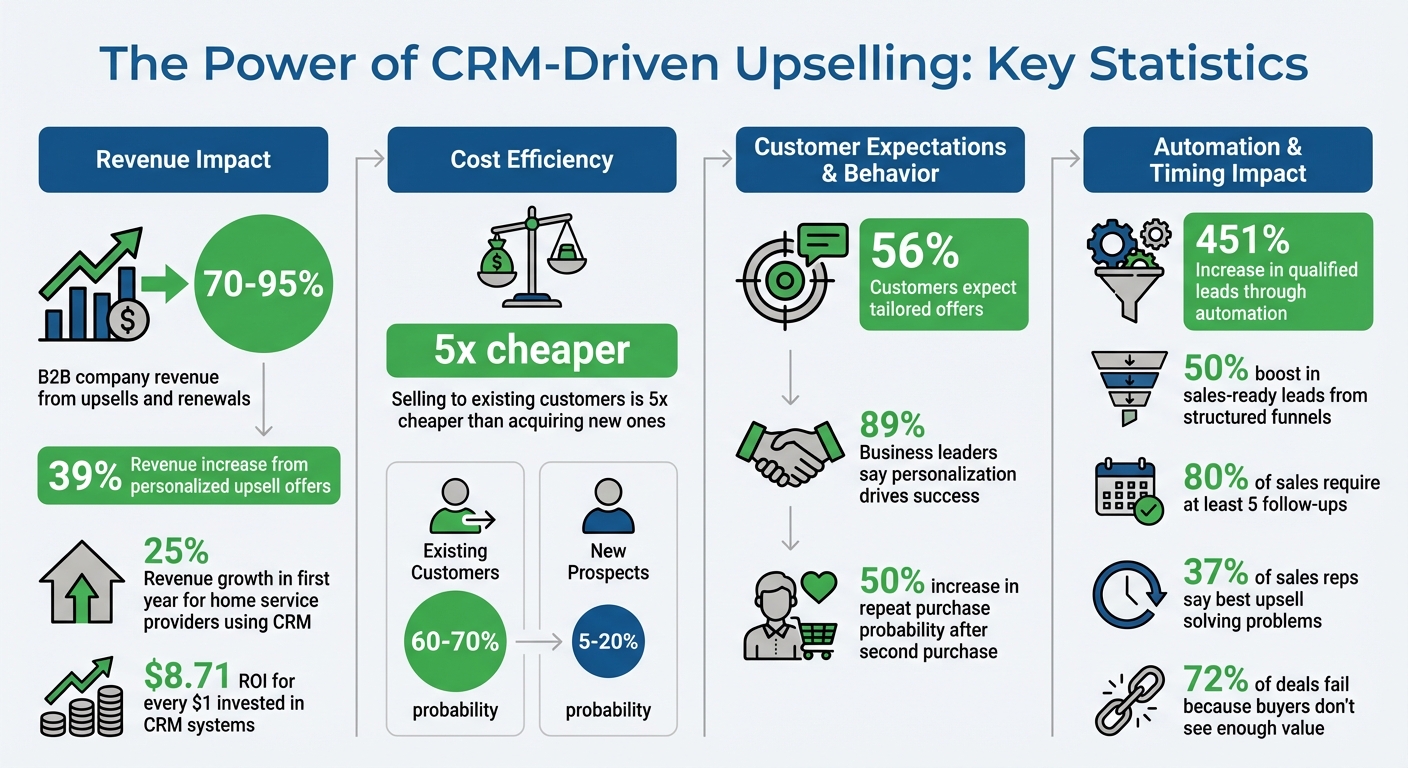
CRM Upselling Statistics: Revenue Impact and Customer Conversion Rates
What CRM Insights Are and How They Enable Upselling
Defining CRM Insights
CRM insights are the actionable takeaways drawn from everyday customer data - like purchase history, interaction logs, behaviors, and preferences. They provide a deeper understanding of not just what your customers are doing, but why they’re doing it.
These insights are built from a mix of data types, such as:
- Identity and demographic details: Includes names, contact information, and locations.
- Behavioral data: Tracks actions like website visits, email opens, or time spent on specific service pages.
- Interaction data: Covers call records, email threads, meeting notes, and support ticket histories.
- Quantitative data: Focuses on measurable metrics like transaction values, service frequency, or total lifetime spending.
- Qualitative data: Captures less tangible aspects, like recorded pain points, objections, or customer goals.
For businesses in home services, this could mean monitoring things like equipment age, recurring emergencies, or how often customers engage with energy-upgrade emails. Standardized data entry tools, like drop-down menus, make it easier to ensure the data is consistent and ready for analysis.
With this foundation, you can uncover the precise moments to offer upsells that make sense for your customers.
How CRM Data Reveals Upselling Opportunities
Once you understand customer behavior through CRM insights, the next step is using that data to pinpoint effective upselling opportunities. CRM data doesn’t just show who your customers are - it reveals patterns that help you act at the right time. For example, usage metrics might indicate when a customer has outgrown their current service plan or when frequent repairs suggest the need for an upgrade.
By tracking predictive trends or milestones - like aging equipment or upcoming contract renewals - you can time your upsell offers perfectly. Recurring service issues can also highlight opportunities for upgrades that save customers time and consolidate multiple service calls into a more streamlined, valuable solution.
"CRM data tells you which leads to call first, what messages will resonate, when to follow up, and which deals will actually close." – Artisan
Here’s a real-world example: In early 2023, Amazon used CRM data to boost net sales by 9%, achieving $127.4 billion in Q1 alone. While Amazon operates on a massive scale, the principle applies to home service businesses too. Properly analyzed data can reveal the perfect moment to approach a customer with an upgrade that feels natural and necessary.
These insights can also fuel automated, highly targeted upselling campaigns. Platforms like Estatehub help home service providers analyze data efficiently, enabling smarter, revenue-focused upsell strategies.
sbb-itb-2aa0348
Finding High-Value Customers Using CRM Data
Segmenting Customers for Upselling
Using insights from your CRM, you can segment customers to pinpoint those most likely to respond to upgrade offers. By organizing your customers based on value, behavior, and lifecycle stage, you can focus on the ones with the greatest potential for upsells.
- Value-based segmentation: This method ranks customers by their financial contribution to your business. Metrics like Lifetime Value (LTV), average order size, and profit margins help identify customers who are more likely to invest in premium services or upgrades.
- Behavioral segmentation: Here, customers are grouped based on their actions, such as purchasing habits, service usage, and engagement with your emails or website. For instance, a customer who regularly books HVAC tune-ups and interacts with your emails is a stronger upsell candidate than someone with minimal engagement over the years.
- Lifecycle segmentation: This approach categorizes customers based on their journey with your business. New customers might require education and onboarding, while long-time users who have seen results may be ready for an upgrade. In B2B home service contracts, tracking account managers, primary contacts, and contract renewal dates can further refine this segmentation.
The real magic happens when you combine these methods. Instead of just targeting "big spenders", you can zero in on high-value customers who frequently use your service and are nearing a contract renewal. Companies that personalize their upsell strategies often see a 40% boost in revenue from these efforts.
Identifying Customers Most Likely to Buy More
Once you've segmented your audience, the next step is identifying which accounts are primed for an upgrade.
- Usage-based signals: Customers nearing the limits of their current service plans or frequently visiting specific product or service pages without purchasing are clear indicators of upgrade potential.
- Engagement patterns: High levels of engagement - like opening emails, interacting with content, or regularly using your services - often signal a readiness to buy more.
- RFM model (Recency, Frequency, Monetary value): This scoring system helps rank customers based on how recently they've interacted, how often they engage, and how much they spend. High RFM scores (often called "Champions") point to ideal candidates for personalized outreach, while lower scores may need nurturing through automated campaigns.
"I discovered a subset of customers whose usage of service X far exceeded the average among my customer base... This prompted me to concentrate on these specific accounts and pitch service Y."
– Anmol Shukla, Salesforce
However, it’s equally important to watch for negative signals. Customers with unresolved support tickets, recent complaints, or low Net Promoter Scores (NPS) should not be targeted for upsells until their concerns are addressed. After all, 72% of deals fall through because buyers don’t see enough value in the offer. Timing matters just as much as targeting.
For home service providers, tools like Estatehub can simplify this process. By integrating CRM data, these platforms automatically track key signals, helping you identify upgrade opportunities without the hassle of manual analysis.
With these insights, you can craft personalized, automated upsell campaigns that hit the mark.
5 Strategies to Make Your CRM a Unified Source Driving Pipeline
Creating Personalized Upsell Offers with CRM Insights
Using customer segmentation as a foundation, personalized upsell offers align directly with individual needs. And they work - 56% of customers expect tailored offers from the companies they engage with.
Customizing Offers Based on Customer History
Your CRM is a goldmine when it comes to tailoring upsell offers. By analyzing purchase history and service patterns, you can craft recommendations that feel less like sales pitches and more like helpful solutions. For instance, if a customer has had multiple HVAC repairs in the past year, offering a discounted annual maintenance plan makes perfect sense. Similarly, a recent water heater replacement could be a great opportunity to suggest a bundled plumbing inspection before winter.
Recurring issues are another clue. If your CRM shows a homeowner frequently calling about the same problem - like a troublesome furnace - it’s the perfect time to recommend an upgraded service plan with perks like priority response and preventative maintenance. This shifts your approach from simply selling products to solving real problems, making your offer feel consultative rather than pushy.
The impact of personalization is undeniable: 89% of business leaders say it’s a key driver of success. Companies using CRM tools report an average 39% boost in upsell revenue. For home service providers, platforms like Estatehub’s CRM integration simplify this process by automatically identifying patterns and opportunities - no need to sift through endless spreadsheets.
One tip to keep in mind: pricing matters. The 25% rule suggests upsell offers should increase the total cost by no more than 25% of the original purchase. For example, a customer who just spent $300 on a repair is far more likely to accept a $375 annual plan than a $600 one.
"Upselling should function as a two-way street: customers gain added value in exchange for their loyalty and trust." – Salesforce
Timing Your Upsell Offers
Timing is just as important as the offer itself. Your CRM doesn’t just identify the right customers; it also helps pinpoint the best moment to present an upsell. The ideal time? Right after you’ve delivered results. In fact, 37% of sales reps say the most effective moment for upselling is immediately after showing customers you can solve their problems.
For home service businesses, this means acting when trust is at its peak. A technician who just fixed a major plumbing issue can suggest a whole-home water pressure regulator right then and there. Additionally, your CRM can trigger follow-up emails within 24 hours of service completion, when customer satisfaction is still fresh and maintenance is top of mind.
You can also automate reminders for contract renewals a few months in advance or use seasonal cues to align offers with customers’ maintenance needs.
Another effective strategy is monitoring usage-based signals in your CRM. If a customer is hitting the limits of their service plan or frequently requesting emergency calls, they are prime candidates for an upgrade. The numbers back this up: the probability of selling to an existing customer is 60%–70%, compared to just 5%–20% for new prospects. But timing is everything.
One crucial rule: avoid upselling if your CRM shows an unresolved support ticket or recent complaint. Addressing issues first is key to maintaining trust.
Automating Upsell Campaigns and Tracking Results
Relying on manual upselling just doesn’t work when you’re managing dozens - or even hundreds - of customers. It’s tough to catch every upsell opportunity at the right time. That’s where CRM automation comes into play. By handling repetitive follow-ups, it frees you up to focus on closing deals. Essentially, it turns CRM insights into a scalable upselling system, helping to drive revenue without missing a beat.
Building Automated Upsell Workflows
Estatehub’s CRM takes upselling to the next level with automated workflows triggered by customer activity. For instance, if a homeowner books their fifth service call in six months, the system can automatically send them an email offering an annual maintenance plan. Similarly, when a contract renewal date is approaching - let’s say 60 days out - the system can send an SMS reminder, all without you lifting a finger.
These workflows are powered by AI, allowing you to set specific triggers like pipeline stage changes or labeling a customer as "high-value." From there, the system builds the automation steps for you.
Here’s the kicker: automation delivers measurable results. Businesses using automation report a 451% increase in qualified leads, and structured sales funnels can boost sales-ready leads by 50%. Plus, considering that 80% of sales require at least five follow-ups - and nearly half of sales reps give up after just one attempt - automation fills this gap by handling those repetitive steps. It even adds a personal touch, using dynamic content to include details like the customer’s name, service history, or preferences.
But there’s one golden rule: pause automation when negative signals - like unresolved issues - appear. This ensures you’re not pushing upsells when the timing isn’t right.
For home service providers, Estatehub integrates CRM automation directly with your marketing tools, eliminating the hassle of juggling multiple systems. This seamless connection means customer data flows smoothly - from lead capture to service delivery and post-purchase engagement - all within one platform.
Once these workflows are in place, keeping an eye on performance metrics becomes essential.
Metrics to Track for Upselling Performance
With your workflows running, the next step is tracking key metrics to fine-tune your strategy. Start with your upsell conversion rate - the percentage of customers who accept a higher-tier offer. Well-timed, behavior-driven automation can make a big difference here.
Another important metric is revenue per lead, which shows the average value generated from each contact in your system. Automated campaigns like "bonus buys" or upgrade offers can help increase this figure. Don’t forget to monitor your customer retention rate; automated post-purchase engagement keeps customers coming back.
Response time is another critical factor. AI-driven workflows and instant triggers significantly reduce the delay between a customer’s action and your response. This is crucial since conversion rates drop sharply after just a few hours. Lastly, track your volume of qualified leads - customers who meet your upselling criteria based on their behavior or service usage.
Here’s how CRM automation can reshape your metrics:
| Metric | Impact After CRM Implementation |
|---|---|
| Qualified Lead Volume | Up to 451% increase through automated nurturing |
| Revenue from Upsells (B2B) | 70%–95% of annual revenue driven by renewals and upgrades |
| Follow-up Consistency | Ensures consistent follow-ups for sales requiring five or more contacts |
| Top-Tier Funnel Conversion | Automated funnels exceed 5.31% conversion rates |
| Repeat Purchase Probability | Increases to 50% after the second purchase |
To keep things running smoothly, review your workflows every quarter. Update stale content and adjust triggers to reflect current customer behavior. If you notice drop-offs in your upsell funnel, tweak your messaging to address those points. The goal isn’t to "set it and forget it." Instead, aim to create a system that evolves and improves over time, using data to guide continuous refinements.
Conclusion
CRM data has reshaped upselling into a precise, data-driven strategy for home service providers. By centralizing customer history, tracking service patterns, and automating follow-ups, businesses can deliver personalized, timely offers that resonate. For example, companies using CRM systems report an average return of $8.71 for every $1 invested. Home service providers, in particular, have seen revenue grow by 25% within the first year of using these systems.
The secret lies in unifying all customer data. When technicians can view complete service histories on-site and systems automatically flag expiring contracts or unsold estimates, opportunities no longer slip through the cracks. This highlights the untapped revenue potential already present in your customer base.
Customer segmentation and automated workflows further enhance this process. Whether it’s proposing a maintenance plan after several service visits or recommending a premium upgrade when equipment nears the end of its lifecycle, well-timed, personalized offers can significantly impact results. This approach also allows for proactive tracking of customer signals, ensuring you’re always a step ahead.
Once offers are active, it’s essential to monitor customer reactions - both positive and negative. As Jetpack CRM aptly puts it, "Customer retention isn't just about repeat sales - it's about building relationships strong enough to weather every slow season and every new competitor". For instance, pausing upsell campaigns during customer issues can help preserve trust.
The takeaway? CRM insights don’t just help you sell more - they help you sell smarter. Use performance data to fine-tune your strategy, boosting both revenue and customer loyalty. Estatehub’s data-driven CRM solutions are designed to help you make the most of every upselling opportunity.
FAQs
How do CRM insights help with timing upsell offers?
CRM tools give businesses a powerful way to pinpoint the ideal time to present upsell offers. By analyzing real-time customer data - like purchase history, engagement habits, and behavior patterns - companies can identify moments when customers are most receptive. For instance, after a successful purchase or a positive interaction, customers are often more open to relevant suggestions, making these moments perfect for introducing an upsell.
Take this example: a CRM system might notice a customer actively using a product or service. This could indicate that they’re ready for an upgrade or a complementary product. By aligning upsell offers with the customer’s current needs, businesses not only improve their chances of success but also foster trust and loyalty. Using CRM insights in this way doesn’t just drive conversion rates - it also creates a smoother, more personalized experience for the customer.
How can I effectively segment customers to improve upselling?
To boost your upselling efforts, effective customer segmentation is a must. Start by diving into your customer data - think purchase history, preferences, and behaviors - and use it to group customers into meaningful categories. For example, pinpoint those who consistently buy premium products or those who tend to respond well to discounts. This approach allows you to tailor your offers to match their unique habits and preferences.
Take it a step further by blending internal data with external insights like market trends or demographic information. This combination provides a fuller understanding of your audience, helping you create personalized and well-timed upsell opportunities. Another smart move? Segment customers based on their lifecycle stage or how they've responded to previous upsell attempts. This ensures your offers feel relevant and resonate with their current needs.
By implementing these strategies, you can create offers that deliver real value, strengthen customer connections, and drive your upselling success.
How can CRM automation improve upselling strategies?
CRM automation takes upselling to the next level by leveraging customer data to deliver tailored offers at just the right moment. Through automated triggers, businesses can analyze buying habits, preferences, and specific needs, making it easier to present relevant upsell opportunities without hesitation.
This streamlined approach ensures that your offers are timely and aligned with what customers actually want. The result? A higher likelihood of successful upsells, coupled with a better customer experience that fosters trust and long-term loyalty.
Related Blog Posts

Sign up for the newsletter and be the first to read our articles.