

Overview of Common Stains
Full overview of the most common stains, including how to identify them and treat them
Email marketing can help lawn care businesses keep customers coming back. With an average ROI of $36 for every $1 spent, email campaigns are a cost-effective way to build stronger connections, promote seasonal services, and increase repeat bookings. By using automation and personalization, you can send timely reminders, tailored offers, and loyalty rewards that keep your business top of mind year-round.
Key tips include:
The right tools, such as CRM-integrated email platforms, simplify the process by automating workflows and tracking customer interactions. Start small, test strategies, and focus on delivering value to your audience to boost retention and revenue.

Email Marketing ROI and Performance Statistics for Lawn Care Businesses
Building long-term customer loyalty means offering more than just promotions. To keep your customers engaged between service visits, your emails should provide real value that positions your lawn care business as a trusted local expert - not just another service provider. These email ideas focus on keeping your audience informed, inspired, and connected.
Provide straightforward guides on lawn care practices. Share advice on topics like the ideal mowing height for different grass types, watering schedules during dry spells, or tips for identifying and managing common weeds before they spread. By offering this kind of information, you demonstrate that you care about your customers’ lawns beyond scheduled visits. Service-based businesses typically see email open rates between 18% and 22%, and educational content often performs on the higher end of that range.
Highlight recent transformations with before-and-after photos from properties in your service area. Showcase projects like patio installations or the revival of neglected yards to inspire customers to imagine what’s possible for their own lawns. These visual examples can drive action - about 35% of customers book additional services when prompted through email, adding $50–$100 per visit.
Go beyond project highlights by sharing personal stories that connect customers to your team. Introduce crew members, share your company’s mission, or spotlight local charity efforts. For example, feature a lead technician offering fall lawn prep tips or show your team volunteering in the community. These glimpses into your business create emotional connections, strengthening customer loyalty and fostering long-term relationships.
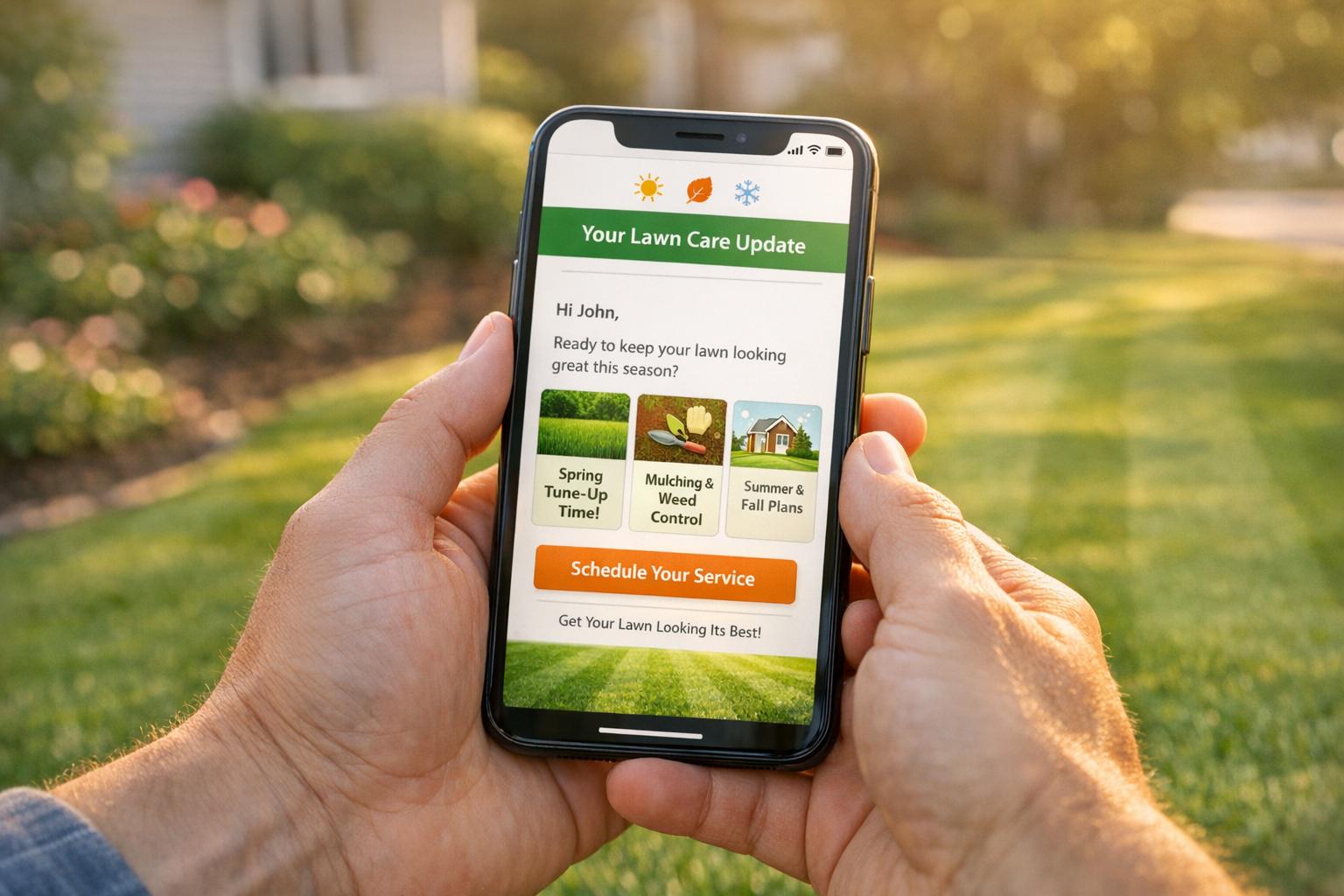
Timing your emails to align with seasonal lawn care needs ensures your services are top of mind when customers need them most. Instead of waiting for clients to reach out when issues arise, sending proactive seasonal reminders helps secure bookings early and highlights your expertise. For instance, in March 2025, a home service business emailed 300 past customers with a "Spring Garden Clean-Up" offer, including a 15% discount for bookings made by mid-March. The campaign saw a 24% open rate, resulting in 18 jobs and $4,500 in revenue. This seasonal strategy naturally transitions into other email themes, like loyalty rewards and reactivation campaigns.
Late February and early March are perfect for emails focusing on spring lawn care. Highlight services like fertilization, debris removal, and lawn renovation to help homeowners prepare for the season. Including services such as mulch installation, hedge trimming, and pre-season clean-up positions you as the go-to expert for "waking up" their lawns after winter. Adding a clear deadline - like "Book by March 15th" - creates urgency and helps fill your calendar before the busy season kicks in.
From June to August, focus your emails on summer lawn care essentials. Share tips on proper mowing heights, watering during heat waves, and irrigation system upkeep. Encourage customers to add extra services like weed treatments or patio cleaning to keep their lawns in top shape. Including local updates, like drought alerts or heat stress warnings, reinforces your role as a trusted community resource .
As September and October roll around, shift your messaging to fall services like leaf removal, aeration, overseeding, and gutter cleaning. For example, in October 2025, James, a landscaper based in Manchester, sent an "Autumn Leaf Removal" email to 450 customers. He offered a free gutter cleaning for packages booked before October 15th, which led to 32 bookings and $6,200 in revenue. As winter approaches, follow up with services like snow removal, de-icing, and frost protection to maintain engagement during the slower months.
These seasonal strategies not only boost retention but also set the foundation for building long-term customer loyalty.
Using email to reward repeat customers is a smart way to build engagement and reduce the chances of losing them. Loyalty programs are a practical tool for recognizing clients and encouraging them to stick around. In the landscaping world, retention rates typically hover between 80% and 85%, but top-performing companies can push beyond 90% with well-planned loyalty initiatives. These strategies work hand-in-hand with your broader email retention efforts, transforming customer satisfaction into lasting relationships.
A points-based reward system is a simple yet effective way to keep customers coming back. For every service visit, clients can earn points that they can later redeem for discounts or free services. For instance, after 10 visits, you could offer a free lawn mowing or a $50 service credit. Automated emails like "You're just 3 visits away from a free aeration!" keep the excitement alive and encourage continued engagement. Tools such as Jobber or HubSpot can streamline this process, making it easy to track and notify customers about their rewards.
Encourage your loyal customers to spread the word by offering enticing referral rewards. These could include cash bonuses, gift cards, or account credits for every successful referral. Email is a perfect channel to promote referral programs, especially during late spring when lawns are in peak condition. Include a direct link to a simple referral form and make the reward worth their effort - think along the lines of a $75 Visa gift card or a free service. As Aspire Software explains:
"A well-executed referral program becomes self-sustaining, continually attracting new customers at minimal cost and creating a cycle of ongoing referrals".
Show your most loyal customers how much you value them by offering exclusive perks they won’t find elsewhere. Use email to share benefits like early access to premium seasonal slots, surprise bonuses, or pre-payment discounts for annual plans. For clients who’ve stayed with you for years, consider sending a "VIP Customer Appreciation" email with special offers - such as 15% off their next service - or priority booking for spring fertilization. These VIP perks not only reward loyalty but also reinforce your position as their go-to lawn care expert.
Reaching out to inactive customers is often more cost-effective than finding brand-new ones. If someone hasn't engaged with your services for over six months, it's time to reconnect with a clear and enticing offer. A simple "We miss you" email combined with a 20% discount on their next service can help reignite their interest. This approach makes it easier for them to return while laying the groundwork for a successful win-back campaign.
Timing matters. Sending reactivation emails mid-morning from Tuesday to Thursday tends to yield the best open rates. Craft subject lines that feel personal and reference past services, like "Ready to bring your lawn back to life, [Name]?"
Plan a series of 3-4 emails to gently nudge them back. Start with a promotional offer, follow up with before-and-after photos of similar projects, and finish with a "last chance" reminder that includes an expiration date. Muhamad Eissa from NiceJob highlights the importance of staying on customers' radars:
"Customers rarely switch to a competitor because they were dissatisfied - they switch because they forgot about you".
It's also crucial to be selective. Exclude clients who left negative reviews from these campaigns. Instead, focus on those who simply lost touch. And don't forget to include a bold, clear call-to-action button like "[Reserve My Spot Now]" to make their next step obvious.
Reactivation emails, much like customer engagement and seasonal campaigns, thrive on personal touches. They’re a key part of building loyalty and keeping your customers coming back. This strategy fits seamlessly into a broader retention plan designed to keep your business top of mind.
Email marketing isn't just another item on your to-do list - it’s a revenue generator that transforms one-time buyers into loyal, repeat customers. On average, email campaigns deliver an ROI of $36 for every $1 spent. That’s 3 to 5 times higher than what social media offers, making email a powerhouse in your marketing toolkit.
The secret lies in personalization, timing, and consistency. By segmenting your audience based on their needs, sending timely seasonal reminders, and rewarding loyalty through referral programs, you’re doing more than filling your schedule - you’re building meaningful customer relationships. Automated workflows take this to the next level, managing tasks like welcome emails and win-back campaigns effortlessly. Without automation, scaling becomes a challenge, as noted by Halstead Media Group:
"Clients stay loyal when they feel confident, seen, and appreciated".
To simplify and supercharge your efforts, tools like Estatehub can make a big difference. They handle audience segmentation, real-time tracking, and campaign automation, all tailored for home service providers looking to turn email marketing into a steady source of income.
Start small - pick one or two strategies, test them, and refine based on what works best for your audience. By consistently applying these email ideas, you’ll build trust, strengthen customer relationships, and boost revenue. Remember, the lawn care businesses that succeed aren’t just the ones offering great services - they’re the ones that stay in their customers’ minds all year long.
To maintain your lawn care customers' interest without overloading their inboxes, stick to sending emails 2–3 times per month. This approach helps you stay relevant while minimizing the risk of causing email fatigue.
Automating lead nurturing and follow-up campaigns is a smart way to keep the lines of communication open with both leads and existing clients. Use this approach for tasks like service reminders, seasonal tips, or follow-up emails after providing estimates. These automated messages can play a big role in turning potential customers into paying ones, re-engaging past clients, and ensuring consistent communication. The result? Stronger engagement and better retention.
Breaking your email list into smaller, targeted groups can work wonders for keeping customers engaged. By focusing on specific segments, you can deliver content that speaks directly to their interests and needs.
For example, you can divide your contacts based on:
Once you've segmented your list, you can send personalized emails that feel more relevant - like seasonal tips for lawn care or exclusive discounts tailored to their preferences. This kind of targeted communication not only boosts engagement but also encourages customers to come back for more.
Sign up for the newsletter and be the first to read our articles.


Every single person on our agency team has spent a lot of time in the field either running their own business or working for larger marketing agencies. We have all put in the time responding to leads, helping customers, scheduling and doing services. This gives us a massive advantage when making decisions.
One thing that has always been very special to us, is the fact that (excluding spam / people that never used our services) we do not have any bad reviews. This absolutely does not mean we have never had unhappy clients, but if it happens, we make it right, and stand behind our promises.
We have seen, time and time again, other agencies using strategies and structuring campaigns the way that they are technically supposed to. Most of these "best practices" that are taught in our industry, simply do not transfer into local lead gen. This is partially because we do have a much different target audience, and are typically spending less, however optimizing for website traffic does not work here.
We have been there, jumping into starting a home service business, struggling, and doing everything wrong. It's humbling. Our team has all felt the highs and lows, which is why we get so excited for our clients to win, we know how good it feels.

Estatehub is not a normal agency, we know "clicks" don't get you sales. Let us show you how lead gen experts do it.

