For landscaping businesses, the choice between Google Ads and Facebook Ads depends on your goals:
- Google Ads: Targets users actively searching for landscaping services like "landscapers near me." It's ideal for quick, high-intent leads but comes with higher costs (average cost per lead: $87.80). Best for immediate results and ready-to-buy customers.
- Facebook Ads: Reaches users based on demographics, interests, and behaviors. Great for showcasing visuals (e.g., before-and-after landscaping photos) and building brand awareness. It's more affordable (average cost per lead: $30–$50) but requires nurturing leads over time.
Quick Comparison:
| Feature | Google Ads | Facebook Ads |
|---|---|---|
| Audience Intent | Actively searching | Passively browsing |
| Cost Per Lead | $87.80 (avg.) | $30–$50 (avg.) |
| Conversion Speed | Faster | Slower |
| Best For | Immediate leads | Brand awareness |
| Targeting | Keywords, location | Demographics, interests |
| Visual Appeal | Limited | High |
Key takeaway: Use Google Ads for capturing high-intent leads and Facebook Ads for building awareness and engaging a broader audience. Combining both can cover the entire customer journey effectively.
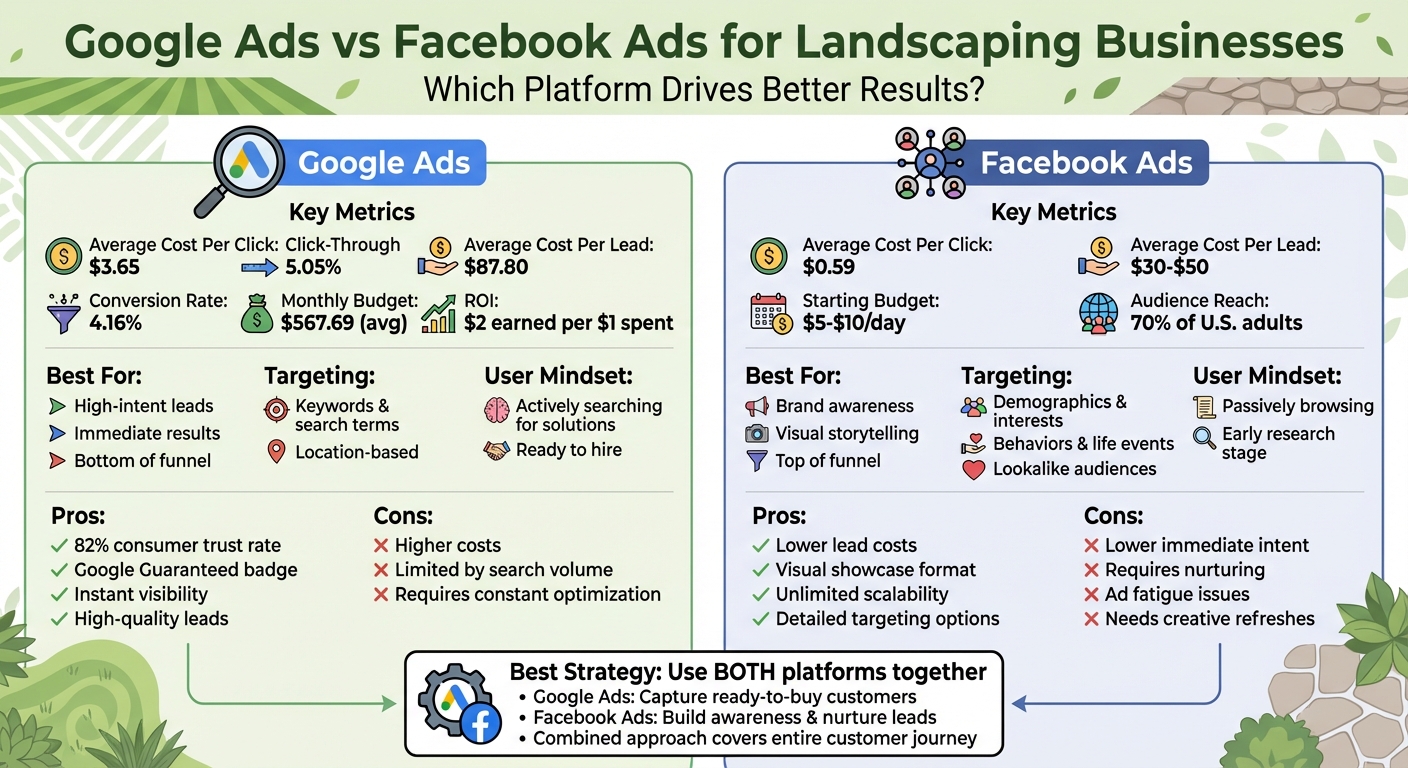
Google Ads vs Facebook Ads for Landscaping Businesses: Cost and Performance Comparison
The Battle of Ads: Facebook vs. Google for Landscaping Businesses
Google Ads for Landscaping Businesses
Google Ads puts your landscaping business right in front of people actively searching for services. For instance, when someone types "landscaping companies near me" or "patio installation near me" into Google, your ad appears above the organic search results. This type of intent-driven targeting ensures you're reaching individuals who are already looking to hire professionals.
The platform uses a pay-per-click (PPC) model, meaning you’re only charged when someone clicks on your ad. Placement is determined by an auction system that factors in your bid amount and a Quality Score, which evaluates things like ad relevance, click-through rate, and the quality of your landing page. For landscaping businesses, the average cost-per-click ranges from $3.65 to $5.47, while high-intent keywords such as "landscaping companies near me" can cost anywhere between $2.90 and $13.06 per click.
How Google Ads Works
Every time someone searches on Google, an auction takes place. You bid on specific keywords like "lawn care service", "hardscaping near me", or "spring yard cleanup." Google then decides which ads to display based on your bid and Quality Score. If you use Local Services Ads (LSAs), your listing gets a "Google Guaranteed" badge, and instead of paying per click, you pay per lead.
To make your ads even more effective, you can use ad extensions. These allow you to include extra details like your phone number, business address, or links to specific services such as "Hardscaping" or "Irrigation". These features can help landscapers attract high-intent customers quickly.
Why Google Ads Works for Landscaping
Google Ads is particularly effective at capturing leads who are ready to take action. For example, someone searching for "patio builders near me" is likely looking to hire soon. Research shows that 88% of people conducting a local search on their smartphone either call or visit a business within 24 hours. The platform also allows precise geographic targeting, enabling you to focus your budget on specific areas, whether by zip code or a set radius. With nearly half (46%) of all Google searches having a local focus, this level of targeting is crucial.
The results are immediate. Unlike SEO, which can take months to show progress, Google Ads puts your business on the first page of search results right away - where 90% of users stay. In 2023, the landscaping industry saw a 121% increase in click-through rates and a 47% jump in conversions, highlighting the platform's effectiveness. On average, businesses earn $2 for every $1 spent on Google Ads, making it a worthwhile investment.
Google Ads Drawbacks
While Google Ads offers many benefits, it does come with challenges. The cost is a significant concern, especially with competitive keywords. You may need at least $750 to $1,000 per month just to gather enough data for meaningful optimization. Some commercial landscaping keywords can cost as much as $50 per click, which can be tough for smaller businesses to manage.
Another hurdle is the ongoing maintenance required. Successful campaigns demand frequent bid adjustments, the addition of negative keywords (like "DIY", "jobs", or "free"), and continuous testing of ad copy and targeting. Without regular oversight, your budget can quickly be drained by irrelevant clicks. With the average cost-per-lead in landscaping hovering around $87.80, every click matters.
Seasonal trends also add complexity. Search demand for landscaping services typically peaks in the spring and drops off significantly during the winter months. To avoid overspending during slower seasons, you’ll need to adjust your budget throughout the year. These fluctuations make it essential to carefully monitor and adapt your campaigns to match the ebb and flow of demand.
Facebook Ads for Landscaping Businesses
Facebook Ads stand out because they appear directly in users' feeds, catching their attention even when they're not actively searching for services. This makes them a great tool for showcasing your landscaping work. You can target specific groups of people based on factors like location, age, income, or interests such as Landscaping, Garden Design, or Patio Furniture. For example, you can narrow your audience to a 10–15 mile radius, focus on homeowners, or even target new movers who are likely to need landscaping services.
How Facebook Ads Work
Unlike Google Ads, which rely on keyword bidding, Facebook Ads use audience-based filters to reach potential customers. You can fine-tune your targeting with layered filters, such as:
- Geographic: Focus on specific cities, ZIP codes, or set a radius around your business.
- Demographic: Target homeowners aged 35–65+.
- Interest-Based: Reach people interested in topics like gardening, outdoor design, or home improvement.
You can also upload your existing customer email list to create a Lookalike Audience. This tool helps Facebook identify people with traits similar to your best clients. Additionally, the Meta Pixel lets you retarget website visitors, ensuring you stay on their radar.
Facebook Ads are built for visual impact. Formats like carousel ads allow you to show multiple angles of a backyard makeover, slideshow ads provide quick before-and-after transformations, and instant experience ads create immersive, full-screen showcases. With 70% of U.S. adults on Facebook - including 74% of rural residents and 70% of suburban users - the platform offers a broad audience.
Why Facebook Ads Work for Landscaping
One of the biggest perks? Affordability. The average cost-per-click is just $0.59, and you can start with daily budgets as low as $5–$10. On average, the cost per lead ranges between $30 and $50.
Facebook’s visual nature perfectly suits landscaping businesses. High-quality images and videos showcasing your work - like the lush green of a freshly laid lawn or the intricate details of a stone patio - can make a big impact. Before-and-after photos, in particular, outperform generic stock images because they let potential customers see the tangible results of your work.
Facebook Ads also help build brand recognition. As Matt Thibeau, Founder of Savant Marketing, explains:
"many landscapers we've worked with tend to become 'local celebrities' in their city as a by-product of their lead generation campaign, due to repeated exposure to their market on Facebook".
This consistent exposure ensures your business remains top of mind when homeowners eventually need landscaping services. However, while Facebook Ads excel at raising awareness, they also come with challenges.
Facebook Ads Drawbacks
One downside is that Facebook users aren’t actively searching for landscaping services while scrolling through their feeds. This passive browsing means leads often take longer to convert. Facebook tends to capture prospects at the very start of their 79-day buying journey, while platforms like Google focus on those closer to making a decision.
Another challenge is standing out in a crowded feed filled with family photos, news updates, and entertainment posts. Reusing the same images too often can lead to ad fatigue. Once your ad frequency score hits 3–4, it’s time to refresh your visuals to keep engagement high. To succeed, invest in professional-grade photos, short 15-second timelapse videos, or clips of your team in action. Without eye-catching visuals, your ads risk being overlooked - something smaller businesses may find particularly challenging.
Targeting and Audience Intent Differences
The main difference between Google Ads and Facebook Ads lies in when they connect with potential customers. Google focuses on people actively searching for solutions, while Facebook presents ads to users scrolling through their feeds - users who match your ideal customer profile but may not be actively looking for landscaping services at that moment.
Search Intent vs. Interest Targeting
Each platform approaches targeting differently, reflecting their distinct mechanics and strategies.
Google operates using pull marketing, capturing existing demand. For example, if someone searches for "emergency storm cleanup" or "lawn care in [your city]", they're already at the bottom of the sales funnel, actively seeking services and ready to take action. In fact, 82% of consumers are likely to use a local service they find advertised on Google. Google Ads focus on bidding for specific keywords, ensuring your ad is shown to users with high intent.
Facebook, on the other hand, uses push marketing to create demand. It introduces your business to potential customers based on demographics, interests (e.g., "Garden Design" or "Patio Furniture"), and behaviors (like "recently moved"). While Facebook engages customers earlier in their journey, conversions often require a longer nurturing process. Essentially, Facebook excels at building awareness early on, while Google captures customers with peak intent later in the process.
Here's a quick comparison of their key features:
| Feature | Google Ads (Search) | Facebook Ads |
|---|---|---|
| User Mindset | Actively searching for a solution | Passively browsing social media |
| Targeting Basis | Keywords and search terms | Demographics, interests, and behaviors |
| Funnel Stage | Bottom (Ready to hire) | Top to Middle (Research/Awareness) |
| Primary Goal | Capture demand (Sales) | Generate demand (Awareness) |
| Conversion Speed | Faster (High intent) | Slower (Requires nurturing) |
Local Targeting for Landscaping Leads
Both Google and Facebook allow you to target specific areas, such as zip codes or a radius around your business. However, each platform delivers results in distinct ways.
Google is highly effective at capturing local customers who need your services immediately. For instance, if someone searches "best landscaping service near me", your ad can appear instantly through Google Local Service Ads. These ads feature a "Google Guaranteed" badge and display your proximity to the user. Notably, 70% of mobile users call a business directly from a mobile ad with a linked phone number.
Facebook, meanwhile, is better suited for building long-term brand visibility in your target neighborhoods. By combining geographic targeting with factors like high-income zip codes and homeownership status, you can position your business in affluent areas ideal for high-end landscaping projects. While Google Local Service Ads often generate higher-quality leads due to clear user intent, their reach depends on how many people in your area are actively searching for landscaping services. Facebook, on the other hand, can reach a broader audience - including those who haven’t actively searched for your services - ensuring your business stays top of mind.
sbb-itb-2aa0348
Cost and Performance Comparison
Cost Per Click and Return on Investment
When it comes to cost per click (CPC) and return on investment (ROI), Google Ads tend to be pricier than Facebook Ads. But there's a reason for the higher costs: the traffic quality is often superior. In 2024, Evergrow Marketing analyzed 61 landscaping and lawn care accounts with a combined spend of $225,000. Their findings? The average CPC was $3.65, and the average cost per lead came in at $87.80.
Facebook Ads, on the other hand, offer much lower lead costs, typically ranging between $30 and $50 per lead. However, these leads often need more follow-up and nurturing before they convert. Somewhere in the middle are Google Local Service Ads, with lead costs ranging from $20 to over $120, depending on how competitive your local market is.
"Google Ads get you in front of customers when they're ready to buy, and that's why you'll pay a premium. But the return on investment (ROI)? Often way higher." - Fernflo
In terms of spending patterns, the average landscaping business allocated $567.69 per month to Google Ads in 2024. But this amount fluctuates significantly throughout the year. For instance, April sees a peak monthly spend of $1,070.25, while January drops to just $314.79. This seasonal variation highlights the importance of having a flexible budget that aligns with demand cycles.
Conversion Rates and Lead Quality
Cost is just one piece of the puzzle - conversion rates and lead quality are where the platforms really differ. Google Ads consistently deliver higher-quality leads because users are actively searching for services. The average click-through rate (CTR) for Google Ads in the landscaping industry is 5.05%, with an average conversion rate of 4.16%. Interestingly, conversion rates tend to spike during the off-season. For example, February saw a 7.82% conversion rate, as searchers were more serious about booking services, while April's busy season saw rates dip slightly to 4.59% due to increased competition.
In contrast, Facebook leads take longer to convert. Since users encounter ads passively while scrolling, they’re not actively looking to hire. This makes Facebook a better tool for building brand awareness and filling your future sales pipeline. As Matt Thibeau, Founder of Savant Marketing, puts it: "Facebook delivers consistent, scalable brand exposure and cost-effective leads, while Google LSA efficiently captures highly motivated, ready-to-buy customers".
In short, Facebook excels at generating awareness and planting seeds for future business, while Google is better at capturing customers who are ready to act immediately.
| Metric | Google Ads | Facebook Ads |
|---|---|---|
| Average Cost Per Click | $3.65 | Generally lower |
| Average Cost Per Lead | $87.80 | $30–$50 |
| Average CTR | 5.05% | Varies widely |
| Average Conversion Rate | 4.16% | Lower (requires nurturing) |
| Lead Quality | High (ready to buy) | Variable (top of funnel) |
| Scalability | Limited by search volume | High (unlimited reach) |
Up next, we’ll dive into the pros and cons of these platforms for landscaping businesses.
Pros and Cons for Landscaping Businesses
This breakdown highlights the strengths and weaknesses of each advertising platform to help you make informed decisions for your landscaping business.
Google Ads: Pros and Cons
Google Ads is a powerful tool for capturing high-intent leads. When someone searches for "landscapers near me", they’re actively looking for services, which often leads to better-quality leads and quicker conversions. Thanks to Google’s Quality Score system, even smaller landscaping businesses with well-optimized ads and landing pages can compete with larger companies, leveling the playing field.
That said, Google Ads has its challenges. Your ability to scale is limited by the local search volume - once you’ve reached everyone searching for landscaping services in your area, spending more won’t necessarily bring in additional leads. The platform also demands constant attention, from managing keywords to optimizing landing pages. And in highly competitive markets, the cost per click can quickly eat into your budget.
| Google Ads Pros | Google Ads Cons |
|---|---|
| Attracts high-intent leads ready to buy | High cost per lead in competitive markets |
| 82% of consumers trust services advertised on Google | Limited by local search volume |
| "Google Guaranteed" badge and reviews boost credibility | Requires ongoing keyword and landing page optimization |
| Instant visibility - leads can start flowing within days | Costs rise sharply in competitive areas |
| Seasonal flexibility to pause or adjust campaigns | Slow-loading pages cause 74% of users to leave |
While Google Ads is excellent for capturing ready-to-buy customers, Facebook Ads takes a different approach, focusing on brand awareness and long-term engagement.
Facebook Ads: Pros and Cons
Facebook Ads shine when it comes to visual storytelling and building your brand. The platform’s visual format is perfect for showcasing landscaping projects, helping you highlight transformations that establish trust and credibility. With its detailed targeting options, you can reach specific audiences like homeowners aged 30–65+, garden enthusiasts, or even new home buyers in particular ZIP codes. Plus, Facebook Ads tend to have lower lead costs - around $30 to $50 - and offer nearly unlimited scalability since they’re not limited by search volume.
However, there’s a trade-off. Facebook users aren’t actively looking for landscaping services - they’re scrolling through personal content. This means leads often require more nurturing and follow-up to convert. Additionally, ad fatigue can become an issue if users see the same ad multiple times, so you’ll need to refresh your creatives frequently. As Dave Orecchio from Bristol Strategy explains:
"When a business chooses an advertising strategy to drive traffic and leads, they are by default understanding that the growth of their business is 'coin operated,' which means that once they stop advertising, the leads also stop".
| Facebook Ads Pros | Facebook Ads Cons |
|---|---|
| Lower lead costs ($30–$50) | Leads have low immediate purchase intent |
| Visual format showcases projects effectively | Requires frequent creative updates to avoid fatigue |
| Detailed targeting by demographics, interests, and life events | Leads need more nurturing and follow-up |
| No scalability limits - audience expansion is possible | Ad fatigue occurs after 3–4 views |
| Great for brand awareness and staying top-of-mind | Costs can spike without daily monitoring |
| Can start with a small budget ($5–$10 daily) | Requires Meta Pixel and CRM integration for tracking |
Which Platform to Choose for Your Landscaping Business
Matching Platform to Business Goals
Selecting the right platform for your landscaping business depends heavily on your customers' buying stage and your business objectives. Are you looking for quick leads or aiming to build a long-term presence in your market? Each platform serves a unique purpose.
Google Ads is your go-to option for generating immediate leads. When potential customers search for terms like "patio installers near me" or "spring yard cleanup", they’re actively looking for services and are ready to make a decision. These users are at the bottom of the sales funnel, often converting within a few days. To get started, consider a daily budget of $25–$100. For a more straightforward setup that boosts trust, Google Local Service Ads is a fantastic choice.
On the other hand, Facebook Ads is ideal for building awareness and engaging potential customers earlier in their research process. If you’re a newer business or want to establish yourself as the top landscaper in specific ZIP codes, Facebook's visual ads are perfect. Use before-and-after photos or drone footage to showcase your work. Start small with a budget of $5–$10 per day and target homeowners or recent homebuyers in your area.
As Halstead Media Group explains:
"The question is not which to choose but how to leverage both to help you meet your business goals".
Using both platforms allows you to cover the entire customer journey. Adding a remarketing tool like Meta Pixel to your website can also re-engage visitors who found you through Google but didn’t convert immediately. This keeps your business top-of-mind as they move closer to making a decision. Estatehub takes this multi-platform approach and fine-tunes it to maximize your local reach.
How Estatehub Improves Campaign Results
Navigating the complexities of matching platforms to your business goals requires expertise, and that’s where Estatehub steps in. They specialize in helping landscaping businesses grow revenue with tailored strategies. Instead of a generic approach, Estatehub evaluates your specific goals, budget, and local market to recommend whether you should focus on Google Ads for high-intent leads, Facebook Ads for cost-effective brand building, or a combination of both.
Their services go beyond ad placements. Estatehub handles campaign setup and optimization across both platforms, builds high-converting websites, and integrates with HighLevel CRM to track which ads are driving paying customers. Their plans range from a Basic package, offering one campaign optimization per week, to a Premium package that includes unlimited optimizations and multi-source lead generation.
Conclusion
When it comes to promoting your landscaping business, both Google Ads and Facebook Ads bring unique strengths to the table. Google Ads shines at capturing high-intent leads - those actively searching for terms like "landscapers near me" or "spring yard cleanup." These are people ready to take action, and with 82% of consumers likely to use a local service advertised on Google, the platform is a powerful tool for driving quick conversions. On the other hand, Facebook Ads is ideal for building awareness and generating leads at a lower cost, typically between $30 and $50 per lead. Its visually engaging format is perfect for showcasing your work and staying on potential customers' radar.
Instead of choosing one over the other, an integrated strategy combines the strengths of both platforms, covering the entire customer journey. Use Google Ads to capture those ready-to-buy leads, and leverage Facebook Ads for remarketing and staying top-of-mind. As Halstead Media Group aptly puts it:
"The question is not which to choose but how to leverage both to help you meet your business goals".
To get started, consider allocating $25–$100 per day to Google Local Service Ads, taking advantage of its pay-per-lead model and trust-building features like the Google Guarantee badge. At the same time, invest $5–$10 per day in Facebook Ads to showcase compelling visuals, such as before-and-after photos, that resonate with your audience and build your brand over time.
For a seamless approach, Estatehub can help you execute this strategy effectively. They specialize in tailoring campaigns to suit your goals, budget, and local market. From setting up and optimizing ads on both platforms to developing high-converting websites and integrating HighLevel CRM for tracking results, Estatehub ensures your advertising dollars are maximized. With flexible plans - from Basic (one optimization per week) to Premium (unlimited optimizations) - they make it easy to grow your landscaping business while staying efficient and results-focused.
FAQs
How can landscaping businesses use Google Ads and Facebook Ads together effectively?
Landscaping businesses can see greater success by combining Google Ads and Facebook Ads, utilizing the unique strengths of each platform. Google Ads shine when it comes to capturing high-intent leads - those actively searching for landscaping services in their local area. These ads are particularly effective for driving immediate actions like phone calls, quote requests, or bookings.
Meanwhile, Facebook Ads excel at building brand awareness and connecting with potential customers who might not need landscaping services right now but could in the future. Facebook is also a powerful tool for remarketing, allowing businesses to reconnect with users who’ve already visited their website or shown interest. This approach keeps your business top of mind, increasing the chances of converting these leads later on.
By using Google Ads to meet immediate local demand and Facebook Ads to nurture long-term relationships with targeted content and remarketing, landscaping businesses can create a steady growth strategy. This combination ensures they capture both short-term opportunities and future prospects effectively.
How do I choose between Google Ads and Facebook Ads for my landscaping business?
Choosing between Google Ads and Facebook Ads for your landscaping business comes down to your specific goals and audience. If your aim is to connect with people actively searching for landscaping services, Google Ads is your go-to. It’s perfect for capturing high-quality leads from individuals ready to hire. Meanwhile, Facebook Ads shines when it comes to building brand awareness and sparking interest among those who might not yet be actively seeking services but could be drawn in by visually engaging, targeted campaigns.
Budget and priorities also play a key role. Google Ads can bring in leads with strong intent but often comes with fluctuating costs. On the other hand, Facebook Ads usually have more consistent and lower costs per lead, making them a solid choice for growing your brand over time. For many landscaping businesses, a balanced approach - leveraging both platforms - works best. This way, you can reach potential customers at various stages of their decision-making process.
How can Facebook Ads help landscaping businesses build their brand over time?
Facebook Ads offer an excellent way for landscaping businesses to grow their brand over time. The platform shines when it comes to building brand awareness, thanks to its ability to target specific audiences based on their interests, demographics, and behaviors. By consistently delivering your ads to the right people, you can create a strong and lasting brand image, ensuring your services stay top-of-mind when potential customers are ready to hire a landscaper.
On top of that, Facebook's remarketing tools make it easy to reconnect with people who’ve already shown interest in your business - whether they’ve visited your website or interacted with your posts. This repeated exposure helps build trust and familiarity, both of which are crucial in service-based industries like landscaping. Over time, these efforts can establish a loyal customer base and solidify your reputation within your community.
Related Blog Posts

Sign up for the newsletter and be the first to read our articles.