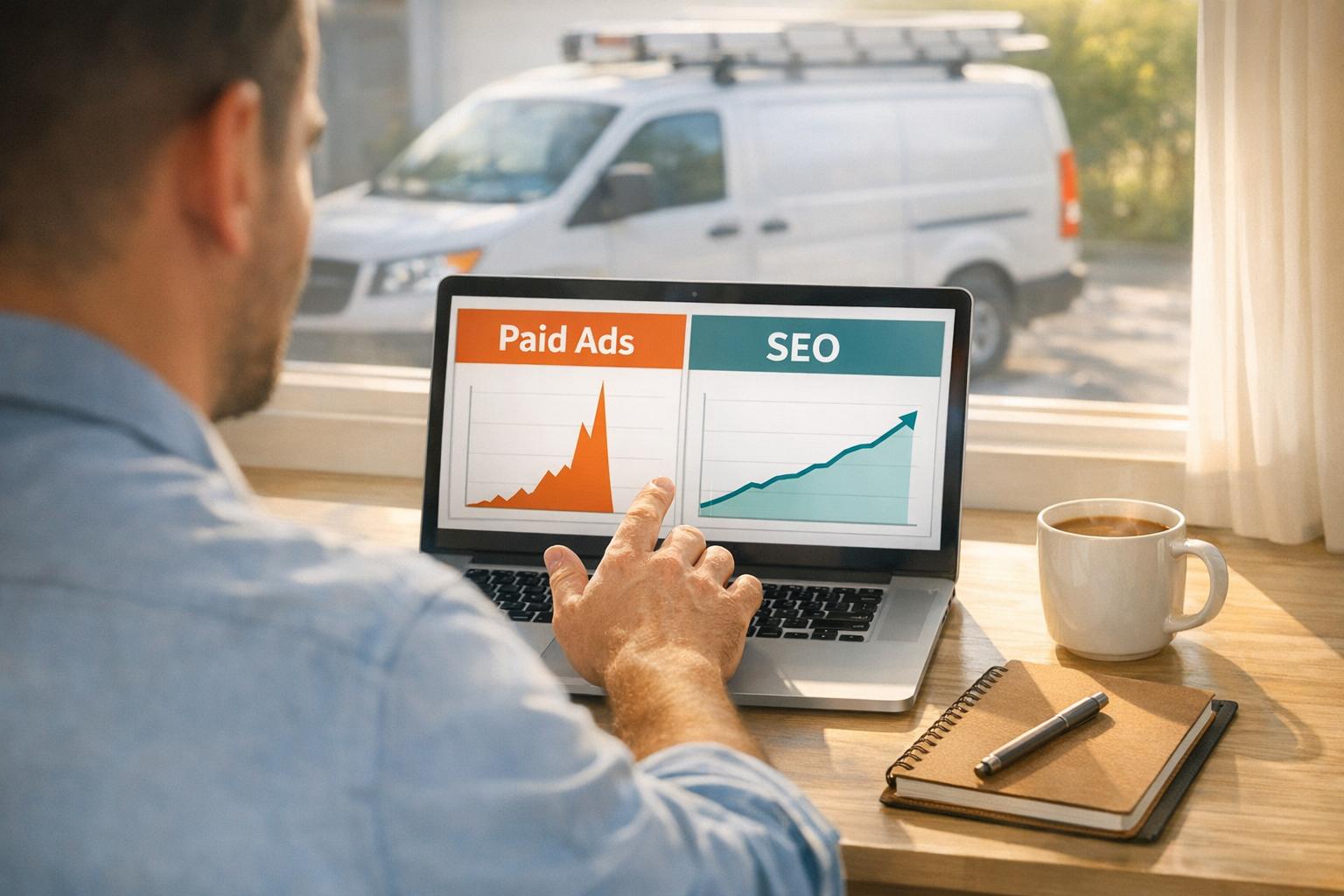
When deciding between paid ads and SEO, it boils down to your business goals and how quickly you need results. Comparing Facebook vs Google Ads shows that paid ads deliver instant visibility and leads, making them ideal for businesses needing quick customer acquisition. SEO, on the other hand, builds long-term value, offering a higher return on investment over time. Here’s the breakdown:
- Paid Ads: Immediate results, but costs stop generating leads once the budget runs out. In 2025, $2.27M spent on ads yielded $10.08M in revenue (4.4x ROI). Average cost per customer: $552.93.
- SEO: Slower to show results (3–6 months), but the benefits last indefinitely. $539K invested generated $10.75M in revenue (19.9x ROI). Average cost per customer: $126.09.
Quick Comparison:
| Aspect | Paid Ads | SEO |
|---|---|---|
| Speed | Immediate | 3–6 months |
| ROI | 4.4x | 19.9x |
| Cost per Customer | $552.93 | $126.09 |
| Visibility Duration | Ends when budget stops | Long-lasting |
For fast results, use paid ads. For sustained growth, invest in SEO. A balanced approach often works best: allocate 70% of your budget to your primary goal and 30% to the complementary strategy.

Paid Ads vs SEO: ROI, Cost Per Customer, and Timeline Comparison for Home Services
SEO vs Paid Ads: Which Brings Better Leads for Contractors?
How Paid Ads Work for Home Service Businesses
Paid ads offer a fast track to visibility for home service businesses, placing your company at the top of search results and social media feeds as soon as your campaign launches. Platforms like Google Ads and Facebook Ads allow you to bid on keywords or target specific demographics, ensuring your ads appear when potential customers search for terms like "emergency plumber near me" or "AC repair in your area." Unlike SEO, which can take months to show results, paid ads can start generating calls within hours.
You control the budget, select your target area (down to ZIP codes), and craft attention-grabbing ad copy. Google Local Services Ads (LSAs) operate on a pay-per-lead basis and feature a "Google Guaranteed" badge, which helps build trust with potential customers.
"LSAs are helping service-based businesses manage cost per lead volatility more effectively."
– Guy Philosoph, Head of Product Management, LocaliQ
Paid ads excel at capturing high-intent customers - those ready to book immediately. For instance, someone searching "emergency AC repair" late on a sweltering evening isn’t just browsing; they’re looking to hire. This is why search ads for home services boast an average conversion rate of 7.33% in 2025. With tools like negative keywords, you can filter out irrelevant searches (like "DIY" or services you don’t offer), ensuring your budget targets only qualified leads.
Another advantage? Flexibility. You can pause campaigns when your schedule is full, adjust bids for seasonal demand, or run ads only during business hours when you’re available to take calls. This makes paid ads perfect for testing new service areas, promoting seasonal offers, or filling gaps during slower periods - all without committing to long-term contracts.
Benefits of Paid Ads for Home Service Companies
The top benefit of paid ads is speed. While SEO takes time to build, paid ads deliver immediate results. In 2025, home service businesses saw an average click-through rate of 6.37% on search ads. This means about 6 out of every 100 people who saw the ad clicked to learn more. For businesses with urgent cash flow needs or those entering a new market, this instant visibility can be critical.
Precise targeting ensures you’re reaching the right audience. Ads can be tailored to specific neighborhoods, income levels, or even retarget people who didn’t complete a booking. For example, Facebook Ads let you layer filters like age, homeownership status, and interests. A landscaping company might focus on suburban homeowners aged 35–65, avoiding apartment renters or commercial properties.
Budget control is another key advantage. If a $1,000 monthly ad spend doesn’t deliver the expected $4,400 return (reflecting an average 4.4× ROAS for trades), you can adjust or stop the campaign immediately. This level of control isn’t possible with SEO.
Paid ads also make it easy to test different versions of your messaging. For example, you can run one ad highlighting price and another focusing on emergency availability, then track which generates more calls within days. This real-time feedback sharpens not just your ads but your broader marketing strategy.
"People are looking to buy on value right now. [For home services] value could be offering savings on bundles, or giving extra services for free in packages."
– Jeff Stein, Internet Marketing Consultant, LocaliQ
Lastly, paid ads provide measurable ROI. Every click, call, and conversion is tracked, so you know exactly how your budget is performing. In 2025, the average cost per lead for home services was $90.92, varying by trade - from $54.05 for handyman services to $228.15 for roofing and gutters.
Paid Ads Examples for Home Services
Let’s look at some real-world scenarios that highlight how paid ads work for home service businesses.
A plumbing company in Phoenix might run Google Ads targeting "emergency plumber Phoenix" during the summer, when AC-related pipe bursts are common. At $10.49 per click, a $500 monthly budget could generate around 48 clicks and 3–4 booked jobs, based on the industry average conversion rate of 7.33%. With plumbing jobs typically worth $300–$500, this approach ensures quick customer acquisition and a profitable campaign.
Landscaping companies often use Facebook Ads to target homeowners in specific neighborhoods where they already have crews working. By setting a 5-mile radius around current job sites and targeting homeowners aged 40–65, they can promote spring cleanup packages or lawn care subscriptions. With an average cost per lead of $117.92, these campaigns can generate qualified leads more efficiently than traditional canvassing.
HVAC companies rely on Google Local Services Ads during peak seasons. For instance, an air conditioning repair business in Houston might pay $127.74 per lead through LSAs during the summer. These ads, featuring the "Google Guaranteed" badge, appear at the top of search results and convert at higher rates than standard search ads. The pay-per-lead model also ensures you’re not paying for clicks from people who aren’t ready to book.
Electricians can use paid ads to capture emergency calls that SEO might miss. When someone searches "electrician near me" during a late-night power outage, they’re likely to call the first verified business they see. With an average cost per click of $12.18 and a cost per lead of $93.69, electricians can profitably bid on high-intent keywords.
How SEO Builds Customer Traffic Over Time
SEO isn’t like paid ads - it’s more of a marathon than a sprint. It’s a long-term investment that creates a lasting resource for your business. While paid ads can drive immediate results, SEO takes time to show its full potential. Typically, it begins to deliver noticeable results within 3 to 6 months, with the most significant benefits appearing after 6 to 12 months.
The real strength of SEO lies in its compounding effects. Every optimized service page, every blog post, and every customer review you gather continues to work for you over the long haul - sometimes for years. Research shows that SEO is nearly five times more efficient than paid ads in converting dollars into sustained revenue. This efficiency underscores SEO’s value as a strategy that not only generates traffic but also builds trust and reduces customer acquisition costs over time.
While paid ads can bring traffic quickly, SEO builds lasting credibility. In fact, around 70% of users bypass paid ads to click on organic search results. When your business ranks naturally on the first page of search results, it sends a strong signal to customers that you’re trustworthy and authoritative. The top organic result alone captures about 28% of all clicks, far outpacing any single ad placement. This visibility isn’t just about rankings - it’s a reflection of Google’s trust in your business, which resonates with potential customers and often leads to higher-quality leads at a lower cost over time.
"SEO is one of the only marketing investments that continues to work, compound, and pay off well into the future."
– CI Web Group
Another advantage of SEO is its diminishing costs over time. Once you’ve made the initial investment, the ongoing expenses are much lower compared to paid ads, which require a constant budget to maintain visibility. If you stop funding paid ads, your traffic disappears immediately. With SEO, the benefits stay with you, continuing to drive traffic and build trust long after the initial work is done.
Benefits of SEO for Home Service Providers
One of the biggest advantages of SEO is the ability to own your organic rankings. Unlike paid ads, which only provide temporary visibility as long as you're paying, organic rankings act like permanent digital real estate. The service pages, blog posts, and local listings you optimize today can continue to generate leads for years to come - without requiring you to pay for every click. This makes SEO a solid foundation for long-term, cost-effective growth.
The financial impact speaks for itself. Between January 1 and April 24, 2025, SEO delivered a 19.9x return compared to the 4.4x return from paid ads. Plus, the cost per paying customer was significantly lower - $126.09 for SEO versus $552.93 for paid ads.
When your plumbing or HVAC business ranks naturally on the first page of search results, potential customers perceive you as an established and trustworthy provider - not just another company paying for attention. This trust often translates into higher-quality leads that are more likely to become paying customers.
Another standout benefit is the steady, compounding traffic SEO brings. Once you've optimized your Google Business Profile, created service pages for each area you serve, and collected positive reviews, the results keep building over time. For instance, a blog post you wrote two years ago about furnace maintenance can still bring in calls every winter without any additional effort. These strong organic rankings act as a buffer against competition, offering a level of stability that paid ads can't replicate.
Local search prominence is another area where SEO shines. Every month, Google processes nearly 180,000 searches for "plumber near me" and 78,000 searches for "handyman" in the U.S.. By optimizing your Google Business Profile and creating location-specific content, you can tap into these high-intent searches and secure a spot in the "Local Pack" - those map results that appear at the top of local search queries. This kind of visibility works around the clock, delivering a consistent flow of leads at a fraction of the cost of paid advertising.
SEO Success Examples for Home Service Businesses
Let’s take a closer look at how Young Construction, a roofing company, turned their SEO efforts into a long-term success story. Their journey highlights the lasting advantages of a well-executed SEO strategy.
Over a 19-month period ending in early 2026, Young Construction partnered with Tim Brown at Hook Agency to completely revamp their online presence. By refining their website, clearly defining their geographic focus, and ensuring their Google Business Profile accurately represented their service areas, they saw impressive results: a 200% increase in local first-page rankings, a 39% improvement in overall keyword positions, and 176 confirmed inbound leads from 333 total contacts.
What made this work? Young Construction focused on creating a solid structure rather than obsessing over ranking first. As Tim Brown puts it:
"Ranking 'number one' does not save you anymore. Structure does".
They succeeded by clarifying their business categories, maintaining consistent service definitions, and ensuring their Google Business Profile matched their actual service areas. This approach aligned perfectly with Google’s 2026 algorithm updates, which prioritize accuracy and relevance, especially in the Map Pack.
The best part? Their efforts continue to pay off. Unlike paid ads that require constant spending, their optimized site and local profiles keep generating leads without additional per-click costs. The work they put in from 2024 to 2025 is still delivering results in 2026.
One key takeaway from their strategy is how they shifted their focus for local SEO. Instead of claiming service areas in 20+ cities, they concentrated on two or three regions, supported by real customer reviews and documented project history. This approach worked well with Google’s 2026 AI-driven filters, which penalize exaggerated geographic claims. By narrowing their focus, they not only avoided penalties but also maintained strong visibility.
Young Construction’s story shows how precise local targeting and a clear, structured approach can keep SEO effective for the long haul.
sbb-itb-2aa0348
Paid Ads vs SEO: Speed, Cost, and ROI Comparison
Speed to Customers: Paid Ads vs SEO
When it comes to how quickly you can start seeing results, paid ads and SEO operate on completely different timelines. Paid ads work almost instantly - your ad goes live, and within hours, leads start rolling in. SEO, however, requires patience, often taking anywhere from 3 to 8 months to show meaningful progress.
Think of paid ads as flipping a light switch: instant brightness. But as soon as you stop paying, the light goes out. As CI Web Group explains:
"The moment you stop paying, the leads stop coming. There's no slow decline. Your ads disappear immediately, and you're right back to where you started."
SEO, on the other hand, builds value over time. It’s like planting a tree - slow to start, but once it grows, it provides long-term benefits. In fact, about 70% of users skip paid ads entirely and go straight to organic search results.
For businesses offering emergency services like "24/7 AC repair" or "emergency plumber", paid ads are the clear winner for speed. But for customers in the research phase - think "best roofing company near me" - SEO tends to capture more high-intent leads. This difference in speed also plays a major role in cost and overall ROI, which we’ll dive into next.
Cost and ROI: Short-Term vs Long-Term Investment
Looking at the financial side, the numbers tell a compelling story. Between January 1 and April 24, 2025, CI Web Group analyzed home service businesses using their SearchLight dashboard. They found that $539,651 invested in SEO generated $10.75 million in closed revenue - a return of 19.9x. Meanwhile, $2.27 million spent on paid ads produced $10.08 million in revenue, equating to a 4.4x return. Simply put, SEO delivers nearly five times the return on investment compared to paid ads.
The cost per paying customer further highlights this gap: $126.09 for SEO versus $552.93 for paid ads. SEO leads are also generally more affordable, with costs averaging between $10 and $40 per lead, compared to $45 to $150+ for paid advertising.
SEO requires an upfront commitment, but over time, it lowers customer acquisition costs. Paid ads, while offering predictable and immediate cash flow, require ongoing spending to maintain visibility. Christine Athens from Previsible sums it up perfectly:
"Paid media is a treadmill; SEO is a flywheel. Once that momentum shifts, the compounding value becomes your greatest unfair advantage."
| Metric | SEO (Organic) | Paid Ads (PPC) |
|---|---|---|
| Time to Results | 3–8 months | Immediate (hours to days) |
| Cost Structure | Upfront investment; decreases over time | Ongoing spend required |
| Average ROAS | 19.9x | 4.4x |
| Cost per Customer | $126.09 | $552.93 |
| Visibility After Budget Ends | Continues indefinitely | Stops immediately |
The takeaway? Use paid ads for quick wins but invest in SEO for lasting growth. Many businesses find success with a balanced approach, allocating 70% of their budget to SEO and 30% to paid ads.
When to Use Paid Ads for Quick Customer Acquisition
Paid ads are your go-to solution when you need leads fast. Whether you're trying to fill last-minute schedule gaps or rolling out a new service, they can start generating responses within hours of launch.
They shine especially in emergency and seasonal situations. Think about HVAC tune-ups just before summer hits, emergency plumbing in the middle of the night, or gutter cleaning offers ahead of fall storms. These are times when customers are actively searching for immediate help. In fact, in 2025, home services search ads boasted an average conversion rate of 7.33%, with a cost per lead coming in at $90.92.
Paid ads are also a powerful tool for testing new markets. Maybe you're expanding into a new ZIP code or offering a service like EV charger installation for the first time. Running ads allows you to gauge demand in real time, skipping the long wait for organic search rankings. Plus, you can tweak or halt campaigns instantly based on how they're performing.
For even more targeted results, Google Local Services Ads (LSAs) are a game-changer. They charge you per lead instead of per click, making them cost-effective for high-intent searches. For instance, the average lead cost is $55.15 for Air Conditioning Services and $101.49 for Roofing & Gutters.
Paid ads are the perfect choice when speed matters more than cost efficiency. They’re ideal for addressing immediate needs, taking advantage of seasonal demand, or testing new offerings. However, keep in mind that once you stop running ads, the leads stop too. To ensure long-term success, pair paid campaigns with strategies that build a steady flow of organic leads over time.
When to Use SEO for Long-Term Growth
SEO is a smart choice for businesses that can afford to wait 3–6 months to see results while building a lead generation system that keeps working long after the initial effort. This approach is especially useful for small businesses on a tight budget, where every dollar counts. Unlike paid ads, which stop working the moment you stop paying, SEO creates a lasting asset that continues to generate leads over time. Industry data backs this up, showing that SEO delivers much better returns in the long run compared to paid advertising.
"SEO is like owning real estate - it takes time to build but provides continuous returns with minimal upkeep." – Clayton Patterson, Esq., CEO, Digital Space Marketing
Certain industries, like roofing, remodeling, and basement finishing, stand to gain the most from SEO. These high-ticket service providers thrive on trust and authority, which organic rankings help establish. Customers in these sectors often do thorough research before making decisions, and they tend to trust organic search results over paid ads. That trust can translate into winning more high-value projects.
SEO also complements existing referral and word-of-mouth channels, making it a great fit for businesses already generating leads through these methods but looking for a more consistent, scalable option. To expand your reach, focus on optimizing your Google Business Profile, creating content tailored to your location, and targeting "near me" keywords to attract local customers with high purchase intent. Local SEO services typically cost between $750 and $2,000 per month, which is far less than the $5,000+ monthly ad spend needed for similar visibility through paid ads.
Combining Paid Ads and SEO with Estatehub
The most successful home service businesses don’t rely on just one marketing approach - they combine paid ads and SEO to get the best of both worlds. Paid ads bring in immediate leads, while SEO builds a foundation for long-term customer relationships. Estatehub uses this combination to deliver quick results and sustainable growth.
Estatehub understands that businesses need both instant results and lasting impact. By blending paid ads and SEO, they create a strategy that’s both effective and efficient. With years of experience in the home service industry, their team focuses on what truly matters: booked jobs. They use paid ads - such as those on Facebook and Google - to generate quick leads and seasonal boosts. At the same time, they build a strong SEO foundation to lower your cost per lead over time. To ensure no lead slips through the cracks, they integrate HighLevel CRM, offering seamless lead tracking and follow-up.
"Estatehub knows that measurable results come from booked jobs, not just clicks."
Their approach goes further by using high-performing keywords from paid campaigns to inform your SEO strategy. This ensures you’re targeting search terms that actually drive paying customers. They also use retargeting ads to re-engage visitors who found your business organically but haven’t booked yet, creating multiple touchpoints throughout the customer journey.
To help you make the most of your efforts, Estatehub provides tools like a Facebook Ads Audit Template to refine your ad spend. With a focus on local lead generation, their campaigns zero in on specific neighborhoods, ensuring every marketing dollar works harder to attract the right customers.
Final Verdict: Balancing Speed and Long-Term Growth
Paid ads bring quick results, while SEO focuses on building growth that lasts. As we've seen, both approaches have unique strengths when it comes to speed and cost. If your priority is attracting customers right away - whether it's filling last-minute appointments or promoting a time-sensitive offer - paid ads provide instant visibility. On the other hand, if you’re aiming to create a business that thrives without constant ad spending, SEO lays the groundwork for that stability.
The real power comes from combining both strategies. Data shows that SEO delivers a 19.9x ROI and costs $126.09 per customer, compared to paid ads, which yield a 4.4x ROI at $552.93 per customer. The most successful businesses use paid ads to meet immediate demand while investing in SEO to lower their cost per lead over time. This balance helps you decide between quick customer acquisition and building sustainable growth.
"The most powerful digital marketing strategy isn't choosing between SEO and paid ads - it's understanding how to leverage each at the right moment in your business cycle to create compounding growth."
- Eric Siu, CEO, Single Grain
To make the most of these strategies, align your budget and timeline with your current business goals. For startups, it often makes sense to begin with paid ads and gradually shift focus to SEO as you aim for long-term growth. More established businesses with steady cash flow can invest in the 3–6 month ramp-up period of SEO while maintaining a paid ad budget to handle seasonal spikes. A good rule of thumb is the 70/30 approach: allocate 70% of your resources to your primary goal - whether that’s SEO for sustained growth or paid ads for rapid expansion - and 30% to the complementary channel.
FAQs
Should I invest in paid ads or SEO to grow my business?
Choosing between paid ads and SEO really comes down to your goals and how quickly you need results. If you're aiming for fast outcomes - like driving leads quickly or promoting a limited-time offer - paid ads, such as Google Ads or Facebook Ads, can be a smart choice. They provide instant visibility and traffic, making them perfect for short-term campaigns.
On the flip side, SEO is all about playing the long game. By optimizing your website for search engines, you can steadily build organic traffic over time. Once your SEO efforts gain traction, it becomes a cost-efficient way to attract visitors and enhances your credibility, especially for local searches.
The best strategy? Often, it’s a mix of both. Use paid ads for quick wins while investing in SEO to ensure a consistent, long-term flow of customers. Weigh your budget, timeline, and business goals to determine the right balance for your needs.
What are the long-term advantages of SEO compared to the quick results from paid ads?
SEO brings enduring advantages by generating consistent, organic traffic to your website without the need for continuous spending. Over time, it helps your business gain trust, build authority, and improve visibility in search results. Unlike paid ads, which stop driving traffic the moment your budget runs out, SEO provides a steady flow of visitors for the long haul.
If you're aiming to create a strong online presence and attract customers over time, SEO is both a cost-effective and dependable strategy. That said, if you’re looking for quick results - like promoting a time-sensitive offer or addressing an immediate need - paid ads can deliver faster, short-term outcomes.
Can using both paid ads and SEO improve your marketing results?
Combining paid ads and SEO can be a game-changer for your marketing efforts. Paid ads, like Google Ads or Facebook Ads, give you instant visibility and help you attract customers right away. On the other hand, SEO focuses on driving consistent, long-term traffic by improving your website’s organic search rankings.
When you combine the two, you create a strategy that balances immediate results with sustained growth. For instance, paid ads are perfect for reaching specific audiences or promoting limited-time offers, while SEO ensures your business stays visible to potential customers in the long run. Together, these approaches let you expand your reach and adjust strategies based on your business goals.
Related Blog Posts

Sign up for the newsletter and be the first to read our articles.