

Overview of Common Stains
Full overview of the most common stains, including how to identify them and treat them
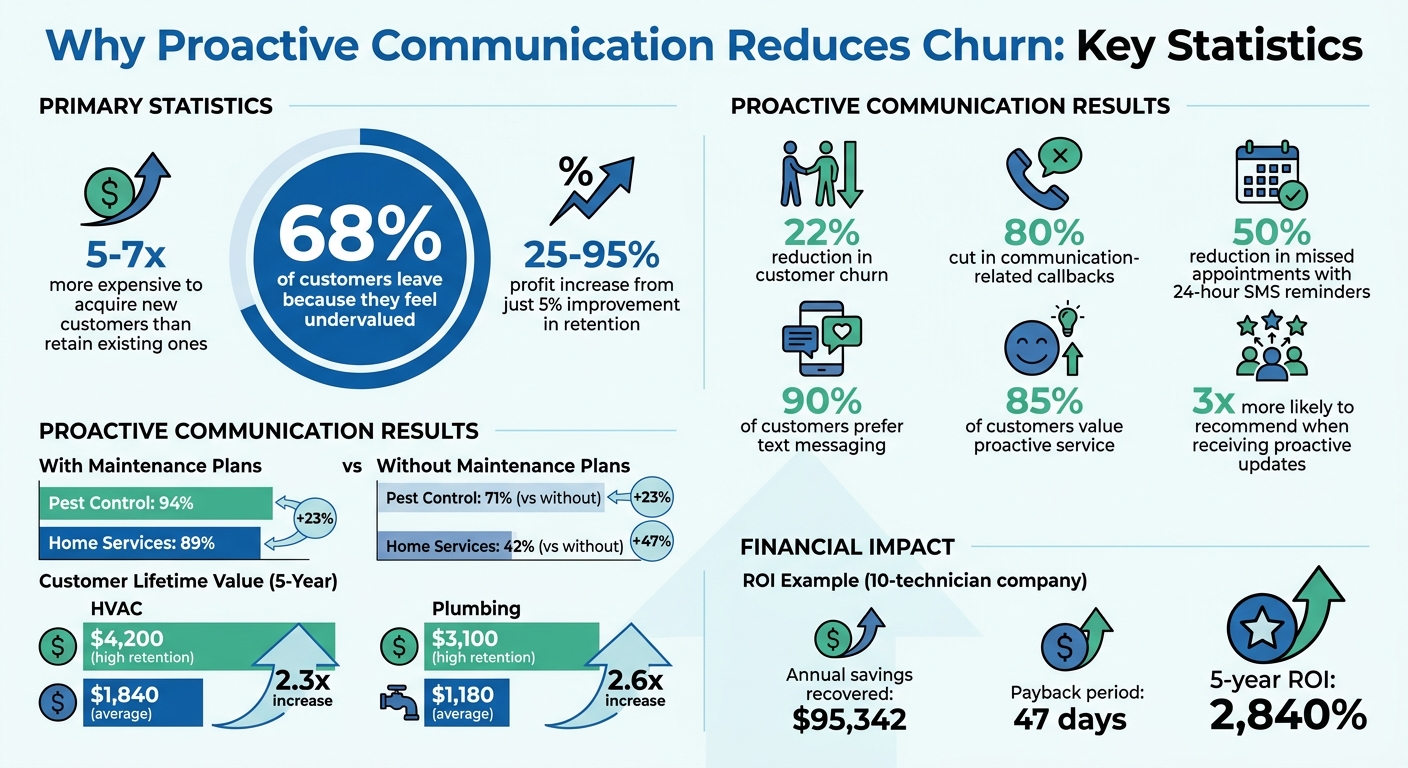
68% of customers leave service businesses because they feel undervalued. And while many are satisfied with the service they receive, they often forget who provided it or find another option when a new need arises. This is where proactive communication makes all the difference.
Here’s what you need to know:
By sending timely updates, reminders, and follow-ups, businesses can build trust, improve customer loyalty, and increase lifetime value. For example, home service companies with maintenance plans see retention rates as high as 89%, compared to 42% without.
The bottom line? Clear, timely communication isn’t just about customer satisfaction - it’s a smart financial strategy that drives long-term success.
Proactive Communication Impact on Customer Retention and Business ROI
Studies reveal that proactive, automated communication can reduce customer churn by 22% in the home services industry. Additionally, using automated tools for status tracking and documentation has been shown to cut communication-related callbacks by an impressive 80%.
Nearly seven in ten customers who leave a service business do so not because of price or quality, but because they felt like the company didn't care about them.
- George M. Espinoza Acosta
For a typical 10-technician home service company, communication automation can recover $95,342 out of $140,330 in annual losses. This translates to a payback period of just 47 days and a 5-year cumulative ROI of 2,840%. These savings directly contribute to better customer retention by addressing the communication gaps that often lead to customer dissatisfaction.
The data clearly highlights how improved communication strategies can have a measurable financial impact while fostering stronger customer relationships.
Reducing customer churn isn’t just about keeping people happy - it’s also a smart financial move. Research shows that acquiring a new customer costs 5 to 7 times more than retaining an existing one.
Retaining customers is far more cost-effective than constantly chasing new leads.
- Roland Ligtenberg, co-founder of Housecall Pro
Customer lifetime value (CLV) provides even more context. For example, HVAC companies with average retention rates see a 5-year CLV of $1,840, but top-performing companies achieve $4,200 - a 2.3x increase. Similarly, in the plumbing sector, businesses with high retention rates enjoy a 5-year CLV of $3,100 compared to $1,180 for the average performer - a 2.6x difference.
Maintenance plans also play a crucial role in boosting retention. In the pest control industry, retention rates jump from 71% to 94% when customers sign up for maintenance plans.
Garrett Mullins, Workflow Specialist at US Tech Automations, sums it up perfectly:
The question is not whether communication automation delivers ROI. The question is how much longer a company can afford the $68,400 annual cost of manual communication breakdowns.
When customers are informed ahead of time about delays or service changes, their reaction often shifts from frustration to appreciation. For instance, if a technician is running late, sending an early text update shows respect for the customer's time and helps avoid a negative experience. In fact, 85% of customers value proactive service, and they are three times more likely to recommend a company when they receive proactive updates. These trust-boosting notifications, particularly via SMS, make communication smoother and more effective.
With 90% of customers preferring text messaging, SMS is a powerful tool for keeping customers informed about appointments and billing. A simple 24-hour reminder can reduce missed appointments by 50%. Plus, since 72% to 80% of callers hang up without leaving a voicemail if their call isn’t answered, automated SMS updates fill this communication gap seamlessly. Sending details like the technician's name and photo before arrival adds a personal touch, building trust and easing any customer concerns. A follow-up "on my way" text with a real-time ETA not only demonstrates professionalism but also encourages repeat business.
The difference between reactive and proactive communication goes beyond philosophy - it directly impacts the bottom line. Let’s break it down:
| Feature | Reactive Communication | Proactive Communication |
|---|---|---|
| Trigger | Customer complaint or issue | Scheduled milestones or anticipated needs |
| Customer Perception | May seem indifferent if slow or absent | Reflects care, reliability, and professionalism |
| Churn Impact | High; 72–80% of callers hang up if unanswered | Low; reduces cancellations and fosters loyalty |
| Cost | High; constant problem-solving required | Lower; automated systems handle routine updates |
| Purpose | Resolving issues | Building relationships and trust |
Drake Q., Co-founder & CPO at Chatty, puts it perfectly:
Every issue addressed before the customer notices is a ticket that never gets created, compounding savings over time.
This comparison highlights the clear advantages of proactive communication. By addressing potential concerns before they arise, businesses can strengthen customer relationships and significantly improve retention. To implement these strategies for your business, you can book a call with our team.
Proactive communication has proven to deliver tangible results. Back in January 2014, OnProcess Technology implemented a proactive SMS solution for a major U.S. cable operator. The results? A 7.2% improvement in installation experiences, an 8.1% drop in rescheduled visits, and a 2.6% decrease in day-of-job failures. On top of that, the company saved over $100,000 in truck roll expenses.
Fast forward to 2023, Morris Furniture Company partnered with DispatchTrack to refine its communication strategy. By using tailored text and email alerts, customers were able to reschedule or update delivery details before dispatch. This reduced unplanned returns by 37% and gave a significant boost to the company’s Net Promoter Score.
These stories highlight how proactive communication strategies can seamlessly translate to home service providers.
Home service providers can take a page from these success stories. For instance, HVAC contractors can send automated appointment confirmations 24 hours before a scheduled visit, cutting down on no-shows. Similarly, if a landscaping crew encounters weather-related delays, a quick SMS at 7:00 AM can notify customers about the delay and provide a new date - keeping them informed and reassured.
Two-way messaging is another game-changer. Imagine a plumber sending a "route start" notification when leaving their previous job. This gives customers the chance to reply with important details like gate codes or parking instructions. It’s a strategy that aligns with the fact that 88% of customers value real-time updates as a key part of a positive experience. Gary Carlile from nShift puts it perfectly:
Uncertainty breeds anxiety, while information restores a sense of control. - Gary Carlile, nShift
Automation plays a key role in reducing churn and building customer trust. Start by mapping every interaction a customer has with your business - from their first contact to the final payment. This will help you identify where manual follow-ups can be replaced with automated processes. Focus on three key stages for automated notifications: pre-service (confirmations and reminders), during-service (progress updates like ETAs), and post-service (feedback requests and maintenance tips).
Since more than 70% of service requests come from mobile devices, prioritize SMS and mobile-friendly communication. Establish clear response time tiers: 15 minutes for emergencies, 1 hour for service inquiries, and 4 hours for general questions. For billing, use dunning management to automatically retry failed payments and send reminders about expiring cards, preventing involuntary churn before it becomes a problem. Diego Alamir from HubSpot explains:
Involuntary churn is a technical problem with a technical solution. Don't treat it like a relationship problem.
- Diego Alamir, HubSpot
At Trendy Butler, Alamir applied this approach to manage over 50,000 subscribers. By integrating Stripe with automated retry logic and proactive card-expiration reminders, the company recovered revenue that would have otherwise been lost to failed payments.
A centralized CRM system can take automated notifications to the next level by enabling personalized communication. Acting as a hub, it integrates email, SMS, and automated responses to ensure consistent messaging. With segmentation and trigger logic, you can tailor your outreach. For instance, separate your audience into leads, who need educational content and conversion-focused messages, and existing customers, who require retention-oriented communication.
Advanced workflows allow for even deeper personalization. For example, a high-value estimate (e.g., over $2,500) might trigger a personal follow-up from a manager, while recurring customers receive softer, value-driven messages. CRMs can also track actions like when an estimate is viewed but not acted upon, triggering a follow-up sequence. Estatehub's CRM (https://estatehub.io) offers tools to customize communication based on individual customer histories and preferences.
Consider building a health scoring system within your CRM. This system could factor in login frequency, support interactions, and payment history. If a customer's score drops into a "red zone", it can trigger a manual intervention, like a personal call from the business owner, to address potential issues before they result in churn.
To maximize the effectiveness of your communication strategy, you need to measure its performance. Start by tracking engagement rates to identify where customers drop off. For instance, in home services, follow-ups sent 24 hours after contact typically see a 22–28% response rate, while messages sent at 72 hours drop to 11–15%, and those sent at 7 days achieve only 6–9%. Most recovered jobs are secured on the second or third follow-up.
Additionally, monitor the performance of your communication channels. Businesses that automate follow-ups report a 41% reduction in time spent on manual phone calls, saving 8–12 hours per week.
Be sure to configure stop triggers in your CRM to prevent redundant messages after a customer has taken action, such as booking a service. Also, when customer feedback results in a service improvement, notify those who provided the input. This shows that their opinions matter and builds trust.
Research highlights a surprising insight: 68% of customers leave home service businesses not because of poor work or high prices, but because they feel undervalued. This issue stems from communication lapses rather than the quality of the service itself.
It's worth noting that acquiring a new customer costs 5–7 times more than retaining an existing one. Yet, retention rates across the industry remain disappointingly low. On the other hand, contractors who prioritize proactive communication see retention rates soar to 65–75%, significantly boosting a customer's five-year lifetime value from $1,840 to $4,200. These numbers emphasize the power of communication in driving loyalty and revenue.
The solution is clear and actionable:
These strategies directly address the communication breakdowns that push customers away.
"In the end, customer retention isn't just a metric - it's a culture of service. Make convenience and efficiency your north star, and you'll build the kind of loyalty that keeps customers coming back for years."
- Roland Ligtenberg, Co-founder of Housecall Pro
For home service providers looking to streamline this process, Estatehub (https://estatehub.io) offers automated CRM tools that turn proactive communication into a seamless, systematic advantage.
The evidence is clear: proactive communication works. The real question is, will you take action before your customers decide to go elsewhere?
To keep customers engaged and reduce churn, consider setting up automated follow-up messages after important touchpoints like estimates, appointments, or completed services. Here's a simple structure to follow:
These messages, delivered through SMS or email, can help recover unbooked estimates, reduce appointment no-shows, and even prompt customers to leave reviews. All of this works together to strengthen retention and keep your business top of mind.
Balancing automation with a personal touch involves using technology to handle routine tasks - like follow-ups, review requests, and reminders - while ensuring interactions still feel genuine. Tools like CRM triggers can simplify operations by automating workflows, but adding small personal touches, such as addressing customers by name or referencing specific services, keeps the communication meaningful. This strategy not only saves time and cuts down on manual work but also helps build stronger, more authentic connections with customers.
Proactive communication delivers measurable results, including a 40% drop in complaints and an 85% increase in customer satisfaction. It also supports better retention rates and boosts customer lifetime value. These outcomes underscore its role in strengthening customer relationships and minimizing churn, especially within the home services industry.
Sign up for the newsletter and be the first to read our articles.


Every single person on our agency team has spent a lot of time in the field either running their own business or working for larger marketing agencies. We have all put in the time responding to leads, helping customers, scheduling and doing services. This gives us a massive advantage when making decisions.
One thing that has always been very special to us, is the fact that (excluding spam / people that never used our services) we do not have any bad reviews. This absolutely does not mean we have never had unhappy clients, but if it happens, we make it right, and stand behind our promises.
We have seen, time and time again, other agencies using strategies and structuring campaigns the way that they are technically supposed to. Most of these "best practices" that are taught in our industry, simply do not transfer into local lead gen. This is partially because we do have a much different target audience, and are typically spending less, however optimizing for website traffic does not work here.
We have been there, jumping into starting a home service business, struggling, and doing everything wrong. It's humbling. Our team has all felt the highs and lows, which is why we get so excited for our clients to win, we know how good it feels.

Estatehub is not a normal agency, we know "clicks" don't get you sales. Let us show you how lead gen experts do it.

