


Overview of Common Stains
Full overview of the most common stains, including how to identify them and treat them
Running Facebook ads can be challenging for contractors. Common pitfalls include poor tracking, rapid budget increases, and ineffective audience targeting. These issues often lead to high costs, low conversions, and wasted budgets.
Here’s how to improve your ad performance:
The key is to focus on metrics that matter - cost per lead, conversion rates, and customer acquisition costs - while avoiding vanity metrics. By optimizing tracking, scaling carefully, and refining targeting, contractors can achieve better ROI from their Facebook ads.

5 Common Facebook Ad Problems and Solutions for Contractors
Accurate tracking is the backbone of effective measurement. When your tracking setup isn't functioning properly, you're left with incomplete or misleading data. For instance, contractors who depend solely on browser-based tracking only achieve about 40% attribution accuracy. That means more than half of your conversions may go unnoticed by Facebook. As a result, the algorithm ends up optimizing for the wrong signals - scaling ads that underperform and shutting down campaigns that are actually bringing in profits.
Tracking errors can create gaps that directly impact your ROI. Factors like iOS privacy updates and ad blockers further reduce tracking accuracy. Add to that the fact that 85% of consumers now use three or more devices, and it's easy to see how cross-device actions can lead to missed conversions. These gaps can quickly snowball into major issues.
Facebook’s default attribution settings (7-day click, 1-day view) can also skew your results. For high-frequency local campaigns, this setup might credit ads that were only seen instead of clicked. This leads to inflated performance metrics, making you believe an ad is working wonders when, in reality, it’s just taking credit for actions that would have happened anyway. Without precise attribution, optimizing your ad spend and achieving strong ROI becomes nearly impossible.
"If conversions are missing or delayed, it [the algorithm] learns the wrong patterns, scales the wrong ads, and shuts down campaigns that are actually profitable." - Tom van den Heuvel, CMO, wetracked.io
To fix these issues, start by implementing the Conversions API (CAPI) alongside your standard Pixel. Unlike browser-based tracking, CAPI sends data directly from your server to Meta, bypassing browser restrictions. This dual approach provides a much clearer and more complete picture of your conversions.
Next, configure custom events tailored to contractor-specific actions. For example, set up events like "Quote Request", "Phone Number Click", and "Schedule Estimate." Use Meta’s Aggregated Event Measurement to prioritize these events (e.g., 1. Lead, 2. View Content), ensuring that the most critical data is captured - even when iOS users opt out.
Finally, standardize your UTM parameters to verify Facebook data in Google Analytics. Consistent UTMs (e.g., utm_source=facebook&utm_medium=cpc&utm_campaign=kitchen-remodel-2026) help prevent revenue misclassification. If you notice a spike in Direct traffic, it often signals missing or inconsistent UTMs.
| UTM Parameter | Purpose | Contractor Example |
|---|---|---|
utm_source |
Identifies the platform | facebook |
utm_medium |
Identifies the traffic type | cpc |
utm_campaign |
Identifies the specific offer | kitchen-remodel-2026 |
utm_content |
Identifies the ad variant | video-testimonial-1 |
Once tracking is fixed, the next hurdle is scaling up without wrecking your ad performance. A common mistake contractors make is spotting a successful ad set and then doubling or tripling the budget, hoping the profits will follow suit. Unfortunately, this often backfires. The algorithm interprets the sudden budget hike as a brand-new campaign, forcing it to restart its learning phase. This interruption can derail performance, leaving you with disappointing results.
Facebook's algorithm thrives on consistency. When you increase your budget too quickly - by more than 20% in a single day - the system is forced to cast a much wider net. This triggers what's known as a "significant edit", which resets your ad set into the learning phase. The fallout? A performance dip that can last 3 to 5 days while the algorithm recalibrates. Even worse, these abrupt changes can land your ad set in "Learning Limited" status, where the algorithm struggles to gather enough data to optimize effectively. This often leads to higher costs and weaker results.
"The algorithm is suddenly told to spend twice as much money - and it has to find twice as many people, fast." – LeadEnforce
For contractors targeting local markets, the problem becomes even more pronounced. A high budget relative to a small audience can quickly lead to saturation. This drives up ad frequency, causing your return on ad spend (ROAS) to tank. On top of that, ad fatigue and poor scaling practices can increase your cost per acquisition by as much as 30–50%.
The key to scaling is patience. Stick to budget increases of just 10–20% every 48–72 hours. This allows the algorithm to adjust smoothly without resetting its learning phase. Before scaling, make sure your ad set has been stable for at least 3 to 5 days, with a consistent ROAS above your target and a frequency below 2.5.
Instead of solely increasing the budget on a single ad set (vertical scaling), consider horizontal scaling. This involves duplicating your winning ad set and testing it with a new lookalike audience or interest group. This approach helps maintain the performance of your original ad set while expanding your reach.
Another effective tactic is setting up automated rules. For example, you can program your campaign to increase the budget by 15–20% only if your ROAS stays at least 30% above your target for three consecutive days. For ongoing contractor campaigns, a "Slow Burn" strategy - where you increase the budget by just 1% daily - can help you find the optimal spend without triggering a reset. These gradual methods ensure your campaigns continue to perform while scaling up effectively.
| Scaling Method | Action | Best For |
|---|---|---|
| Vertical | Increase budget 10–20% every 48–72 hours | Proven, stable ad sets |
| Horizontal | Duplicate ad set to target a new audience | Expanding reach and avoiding fatigue |
| Slow Burn | Increase budget 1% daily | Evergreen lead generation campaigns |
| Rule-Based | Increase 15–20% if ROAS is above target for 3 days | Hands-off budget management |
Your ads won’t succeed if they’re reaching the wrong people. Getting your audience targeting right is just as critical as proper tracking and scaling. A common mistake contractors make is casting too wide a net, hoping to attract anyone who might need their services. But this approach often backfires. You end up spending money on clicks from renters, people outside your service area, or homeowners looking for services you don’t even offer. Imagine paying $40 per lead, only to find out that just 20% of those leads are qualified. That effectively means you’re spending $200 for every good lead.
While broad targeting might seem like a good idea, it can quickly drain your ad budget. For example, if your roofing ad pops up for someone renting a 12th-floor apartment, you’ve already lost that click. The same goes for HVAC ads shown to college students or restoration ads reaching people who live 50 miles outside your service area.
"If your roofing ad is showing up for someone renting a 12th-floor apartment, you've already lost." – Hamlet Azarian, Azarian Growth Agency
There are clear signs that your targeting is off. If you’re getting calls for services you don’t provide - like appliance repair inquiries when you’re a restoration company - that’s a red flag. Geographic mismatches are another issue, such as leads asking for work in areas you don’t serve. Keep an eye on your metrics: cost-per-click rates above $2.00 or click-through rates below 2% often indicate that your ads aren’t reaching the right audience. These numbers don’t lie - they show you’re paying for attention from people who are unlikely to become customers. To fix this, you need to adopt a more focused targeting strategy.
To avoid wasting your budget, start with precise demographic filters. For example, use Facebook’s "Homeownership status" filter to target homeowners specifically. Setting a minimum age of 30 or 35 can also help eliminate renters or younger users who are less likely to own property . A particularly effective tool for contractors is the "Recently moved" life event filter. New homeowners often need immediate services like duct cleaning or HVAC inspections, making them prime leads.
Lookalike audiences are another powerful tool for scaling your campaigns. By uploading a CRM list of at least 1,000 past customers, you can create a 1% lookalike audience. This allows Facebook to find new prospects who closely resemble your best customers. Contractors using lookalike audiences have reported 40–60% higher conversion rates compared to those relying only on interest-based targeting.
Geographic targeting is another area where precision matters. Instead of targeting entire zip codes, use drop-pin targeting to define your exact service area, even down to specific streets. This ensures your ads don’t waste money on neighborhoods you can’t efficiently serve. You can also layer homeownership with interests like "HGTV", "DIY", or "Home improvement" to zero in on homeowners actively thinking about projects. Finally, your ad copy can act as a filter. Phrases like "Own a home in [City]?" or "Proof of homeownership required" can discourage unqualified clicks before they cost you money.
| Targeting Method | Best Use Case | ROI Impact |
|---|---|---|
| Custom Audiences | Retargeting past leads/customers | High; uses first-party CRM data |
| Lookalike Audiences (1%) | Finding high-quality new prospects | High; mirrors best customer traits |
| Drop-Pin Geo-Targeting | Local service area precision | High; reduces waste on distant leads |
| Life Events | Targeting "Recently Moved" users | High; captures immediate intent |
Once you've nailed down your audience targeting, the next hurdle is keeping your ad content fresh and relevant. Even the best targeting won't save you if your ads become repetitive or if your messaging doesn't align with your landing page. This issue, known as creative fatigue, occurs when your audience sees the same ad too many times, eventually tuning it out. For contractors targeting smaller, local audiences, this problem can escalate quickly. In a single city or county, your potential customers might see your ad repeatedly, and after four or five views, they’ll start ignoring it. This fatigue directly impacts engagement and performance, as outlined below.
Refreshing your ads is just as crucial as accurate targeting and gradual scaling to maintain your ROI. Studies show that ad performance drops by 45% after people see the same ad about four times. Purchase intent also takes a hit, decreasing by around 16% after six or more views. For home service campaigns, performance typically begins to decline once ad frequency exceeds three. If your frequency reaches eight or nine views per person, you're no longer building brand awareness - you’re irritating your audience, many of whom have already decided whether they’re interested.
"Creative fatigue is the silent killer of profitable Facebook campaigns." – Cedric Yarish, AdManage
Meta’s algorithm doesn’t take kindly to creative fatigue, either. When it detects a drop in engagement, it may reduce your ad's impressions automatically. In Ads Manager, you’ll see warnings like "Creative Limited", which indicates your cost per result is above your historical average, or "Creative Fatigue", meaning costs are at least double your benchmark. High ad frequency can also lead to negative feedback, such as users hiding your ad or reporting it, which further damages your campaign's performance. In the worst cases, audience saturation can cause your click-through rate to plummet as low as 0.06%.
Addressing creative fatigue doesn’t require a complete overhaul - just consistent updates. For small local campaigns, refresh your ad creatives every 1–2 weeks and avoid running the same ad for more than three months without adjustments. Small changes can make a big difference. For instance, switching background colors, using a new job site photo, or updating your ad to reflect seasonal themes can reset the fatigue clock. Running multiple variations of an ad (different colors, images, or hooks) allows Facebook’s algorithm to rotate them, reducing the sense of repetition for your audience.
"Creative accounts for roughly 50% of Facebook ad performance. Targeting and bidding matter, but they can't save a stale ad." – Cedric Yarish, AdManage
Equally important is ensuring your ad copy aligns with your landing page. If your ad promotes a "Free Roof Inspection" but your landing page focuses on financing options, this disconnect can confuse potential customers and hurt conversions. Use the AIDA framework to guide your messaging: grab their Attention (mention their location and a relevant problem), spark Interest (address their pain points), create Desire (highlight your solution and its benefits), and drive Action (offer a clear next step). When refreshing a successful ad, reuse its "Post ID" to retain likes and comments, preserving social proof and trust.
| Warning Label | Meaning | Action Needed |
|---|---|---|
| Creative Limited | Cost per result is above historical average (but less than 2x) | Early warning; start planning a creative refresh |
| Creative Fatigue | Cost per result is at least double the historical benchmark | Critical; replace the creative immediately |
Many contractors make the mistake of directing their entire Facebook ad budget toward reaching cold audiences, expecting quick conversions. But here’s the reality: contracting services, like roofing or remodeling, aren’t impulse buys. Homeowners rarely hire a contractor after seeing just one ad. The decision-making process can take weeks or even months. Without a system to stay in front of these potential customers, your ad dollars may end up benefiting your competitors when those homeowners are finally ready to hire someone.
Facebook ads work differently than search ads. While search ads capture demand - like when someone actively searches for "plumber near me" - Facebook ads create demand by placing your business in front of people when they’re scrolling through their feed. If you’re not following up with retargeting campaigns, you’re essentially paying to create awareness while leaving the door open for competitors to swoop in later. One of the biggest reasons campaigns underperform is the lack of a system to nurture leads after that initial interaction.
Focusing solely on awareness campaigns leaves a lot of opportunity untapped. Most people who see your ad won’t take action right away. Contractors who target only new leads miss out on a significant audience - those who need multiple touchpoints before they’re ready to take the next step. High-value services like home improvement require trust, and a single ad doesn’t usually provide enough reassurance or information to overcome a homeowner’s hesitation.
To build trust and keep potential customers engaged, you need to provide more than just that initial ad. Share content like customer testimonials, project walkthroughs, or limited-time offers to keep your business top of mind. Without this nurturing process, you’re relying on homeowners to remember you when they’re finally ready to make a decision - a risky bet. Just as precise targeting is essential, so is having a complete funnel to guide leads from awareness to conversion.
The solution to awareness-only campaigns is adopting a full-funnel strategy. A complete funnel guides prospects through three stages: Awareness (introducing your brand), Consideration (engaging and educating them), and Decision (building trust to close the sale). Start by installing tools like the Meta Pixel and Conversions API (CAPI) on your website to track visitor behavior. Then, create two custom audiences: one for "Visitors" (people who have visited your site) and one for "Converters" (those who’ve already submitted a lead form). Use these audiences to retarget Visitors while excluding Converters, ensuring your budget focuses on the right people.
For the middle of the funnel, share educational content to keep prospects interested. This could include project walkthroughs or before-and-after photos to showcase your work. Later, move them into bottom-funnel retargeting campaigns with ads that feature customer testimonials or urgency-based offers like, "Book Your Free Estimate - Limited Slots This Month". To keep your ads fresh and engaging, use a mix of formats, such as video testimonials, behind-the-scenes clips, or special financing promotions.
"Facebook creates demand instead of just capturing it. Unlike search ads that rely on someone typing in 'plumber near me,' Facebook puts your message in front of them during their downtime." – Hook Agency
Timing is everything once a lead comes in. Studies show that contacting a lead within 5 minutes can result in a 21% conversion rate, but waiting over 24 hours drops that rate to just 4%. To act quickly, connect your Facebook Lead Ads directly to a CRM so you can respond immediately. By combining awareness, retargeting, and fast follow-up, contractors can avoid wasted ad spend and turn more leads into paying customers.
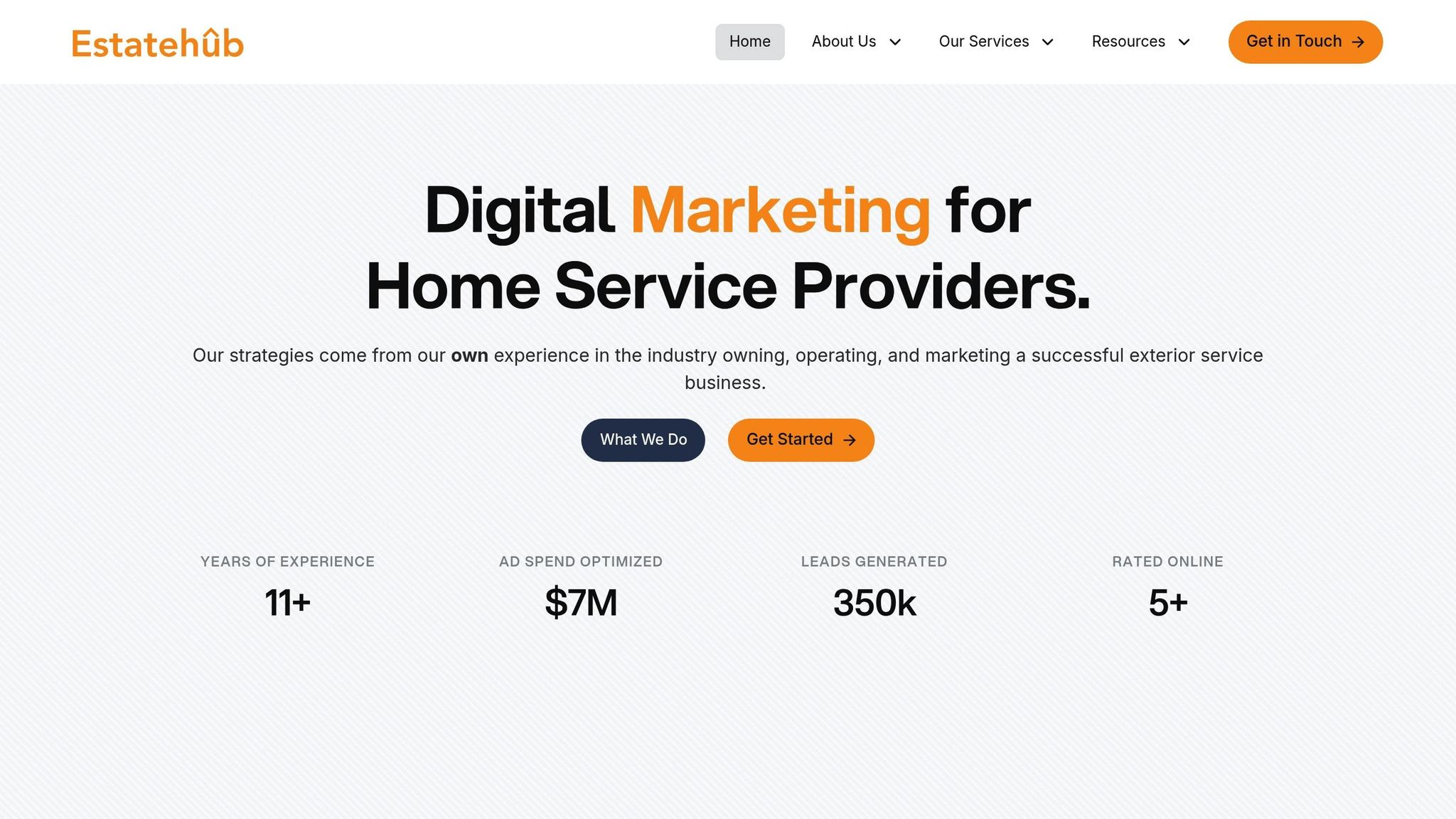
Estatehub tackles the common challenges contractors face when scaling Facebook ads by focusing on what truly matters: revenue. With over $7 million in ad spend optimized and 350,000+ contractor leads generated, their approach is all about results, not vanity metrics. A key part of their strategy is their "Beat the Winners" method, where accounts are reviewed every two days. This ensures that budgets are directed toward high-performing ads while underperforming ones are swiftly removed.
The process kicks off with multi-variant testing. Estatehub creates 10–20 different combinations of ads, targeting options, and offers to identify what works best in your market - often within the first 2–3 days. Unlike a "set it and forget it" approach, they optimize campaigns two to three times a week, focusing on ads that generate paid jobs, not just clicks. This constant refinement helps ensure your budget is spent on what delivers results, with weak ads eliminated and variables fine-tuned.
The results speak for themselves. Contractors like Zach Rollins saw nearly $3,000 in revenue in just one week. Korbin Reitz went from one or two jobs a month to almost 20 jobs in just 45 days. Johnny Eaton, meanwhile, cleared thousands in credit card debt within two months after his campaign was optimized in just two weeks. Estatehub’s proven methods are designed to deliver consistent growth through tailored campaign strategies.
Estatehub offers two plans - Growth and Premium - both of which include full management of ad creation, copywriting, content editing, and scaling. Additionally, you’ll gain access to a HighLevel CRM system, complete with coaching and templates to help you respond to leads and close deals effectively.
The service guarantees a minimum of 30 incoming leads per month, with the typical base spend generating 50–60 leads in the first month alone. To qualify, contractors must commit to a minimum ad spend of $50 per day. Estatehub operates on a flat monthly fee (separate from the ad spend) and offers a flexible, cancel-anytime policy.
The Premium plan includes unlimited optimizations and multi-source lead generation, while the Growth plan provides two weekly optimizations. With glowing reviews and a 5/5-star rating, clients frequently commend founders Chris and Will for their exceptional customer service and dedication to exceeding expectations. Estatehub positions itself as a reliable backend partner, ready to help your business grow.
Scaling Facebook ads effectively starts with getting the basics right. Before you even think about increasing your ad spend, make sure your tracking is rock-solid. Every form submission and "Thank You" page view should be accounted for - guesswork has no place here. On top of that, your offer needs to be irresistible. Even the biggest budget can't save a weak pitch.
"Nothing is more important to the success of your Facebook Ads than your offer." - Ben Levesque, Webrunner Media
When you're ready to scale, take it slow. Gradually increase your budget - no more than 20% at a time - to keep Facebook's algorithm in its sweet spot. Test different ad creatives and make use of Facebook's native lead forms to drive better results. And don’t underestimate the power of speed - reach out to leads within 5 minutes to boost conversions. These steps create a strong foundation for scaling, especially when combined with expert support from partners like Estatehub, who can help improve your ROI.
Once you've nailed the fundamentals, Estatehub steps in to make scaling smoother and more effective. They focus on what really matters - your revenue - not vanity metrics. Their approach includes rapid testing, constant optimization, and lightning-fast lead follow-up, all based on the core principles above.
Estatehub kicks things off by creating 10–20 ad combinations in the first few days to figure out what resonates most with your local audience. Then, they fine-tune campaigns two to three times a week to keep performance strong. Both their Growth and Premium plans offer full ad management, CRM coaching, and a guarantee of at least 30 leads per month. Most clients, however, see 50–60 leads in their first month alone. Estatehub becomes your behind-the-scenes partner, taking care of the technical side so you can focus on closing deals and scaling your business.
To improve the accuracy of Facebook ad tracking, the first step is setting up the Facebook Pixel properly on your website. This tool tracks user interactions on your site and provides crucial data about how your campaigns are performing. Pair this with Facebook Ads Manager to keep an eye on key metrics and ensure conversions are being attributed correctly.
When it comes to targeting, Facebook's Advantage+ audience tools can be a game-changer during the testing phase. These tools help narrow down your audience to the most relevant groups, giving you cleaner data to work with and making it easier to fine-tune your campaigns. Make it a habit to regularly review and adjust your tracking setup to stay aligned with any shifts in performance or audience behavior.
To avoid creative fatigue in your Facebook ads, it’s crucial to refresh and rotate your ad creatives regularly. Try mixing things up with new images, videos, or messages to keep your audience interested and engaged.
Another way to combat fatigue is by broadening your target audience. This helps reduce the risk of overexposure. Tools like frequency caps can also be a lifesaver, as they limit how often the same person sees your ad. On top of that, timing matters - strategically schedule your ads to appear during high-impact periods without overwhelming your viewers. These strategies can help keep your campaigns engaging and boost your return on investment (ROI).
Scaling your Facebook ads in small, steady steps is key to keeping your campaigns running smoothly. When you slowly increase your ad spend, you avoid throwing off the algorithm that fine-tunes your ads for the best performance. This way, your campaigns stay consistent and continue delivering results.
On the flip side, rapidly boosting your budget can disrupt the platform's learning phase, which often leads to erratic performance or wasted money. By scaling gradually, you can build on the insights and data from your existing campaigns, helping to improve your return on investment (ROI) over time.
Sign up for the newsletter and be the first to read our articles.


Every single person on our agency team has spent a lot of time in the field either running their own business or working for larger marketing agencies. We have all put in the time responding to leads, helping customers, scheduling and doing services. This gives us a massive advantage when making decisions.
One thing that has always been very special to us, is the fact that (excluding spam / people that never used our services) we do not have any bad reviews. This absolutely does not mean we have never had unhappy clients, but if it happens, we make it right, and stand behind our promises.
We have seen, time and time again, other agencies using strategies and structuring campaigns the way that they are technically supposed to. Most of these "best practices" that are taught in our industry, simply do not transfer into local lead gen. This is partially because we do have a much different target audience, and are typically spending less, however optimizing for website traffic does not work here.
We have been there, jumping into starting a home service business, struggling, and doing everything wrong. It's humbling. Our team has all felt the highs and lows, which is why we get so excited for our clients to win, we know how good it feels.

Estatehub is not a normal agency, we know "clicks" don't get you sales. Let us show you how lead gen experts do it.

