


Overview of Common Stains
Full overview of the most common stains, including how to identify them and treat them
When it comes to growing a scalable website that generates leads, focusing on local SEO, high-intent keywords, and a strong technical foundation is key. Here’s the gist:
SEO isn’t just about ranking - it’s about creating a system that consistently drives qualified leads. Whether you’re a plumber, HVAC contractor, or landscaper, these strategies help you stand out and grow your business.

SEO Keyword Types and Intent Levels for Home Service Businesses
If you want to generate leads from scalable websites, focusing on high-intent keywords is a must. These are the phrases that capture people ready to act, like "emergency water heater repair Denver", rather than broad terms like "plumbing." High-intent keywords typically fall into two categories: transactional (e.g., "emergency roof leak repair") for immediate needs and commercial (e.g., "best HVAC companies near me") for people comparing options.
Greg Gifford, VP of Search at Search Lab, emphasizes the importance of this:
The biggest mistake I see people making with keyword research is simply not doing it... Now that Google has evolved and is providing search results based on the intent of the search query, keyword research is more important than ever.
Here's a staggering fact: 46% of all Google searches have local intent, and over 99% of clicks happen on the first page of results.
Start with your core service - your "seed" keyword - and expand it with modifiers that match how customers search. For example, instead of just targeting "landscaping", a landscaping company could focus on terms like "fence installation Phoenix" or "patio pavers Scottsdale."
Address customer pain points with specific phrases like "AC blowing hot air" or "roof financing". Apollo Home has done this exceptionally well, ranking in the top three Google results for over 200 high-intent keywords. For instance, their guide on "How to winterize pipes" (250 monthly searches) directly tackles common customer concerns.
Another goldmine for keywords? Customer reviews. Check your Google Business Profile and competitor reviews to see how people describe their issues. The "Place Topics" section often highlights the exact services or problems that matter most to your audience.
Adding location modifiers to your keywords can turn generic searches into qualified leads. Think beyond city names - include neighborhoods, zip codes, landmarks, and "near me" phrases. For example, Bill Howe, a San Diego-based HVAC company, optimized its air conditioning service page for "San Diego AC repair services", seamlessly incorporating the term into titles, subheadings, and content.
There are two types of location-based keywords: explicit (e.g., "locksmith Chicago") and implicit (e.g., "locksmith", where the user's location is inferred). Explicit keywords often perform better because they reflect a searcher's already defined service area.
Need ideas? Use Google Autocomplete. Type your service and add "near" or a city name to see real-time suggestions based on user behavior. Also, check your Google Business Profile's "Searches Breakdown" to discover which keywords are already driving traffic to your listing. This strategy worked wonders for Kody Smith, who turned a pet waste removal side hustle into a $300,000-a-year business in 2024 - without spending a dime on ads.
Google Keyword Planner is a go-to tool for local search data, allowing you to filter by specific cities or regions. This is especially useful for home service providers, where local precision matters more than national averages. Similarly, Semrush Keyword Magic Tool offers filters for "Local Pack" features, helping you identify keywords with local intent.
Focus on keywords with manageable difficulty. As Andy Crestodina advises, ignoring keyword difficulty reduces your chances of ranking. For newer sites, aim for keywords with a difficulty score of 0-49% - these are more achievable while still driving targeted traffic.
Don't overlook zero-volume keywords. Even if tools don't show search data for small towns or niche services, terms like "fence repair [small town name]" can still be highly relevant. Google's "People Also Ask" boxes are another great resource for finding long-tail, question-based keywords that can boost your authority and capture voice search traffic. Remember, only about 20% of searches are for popular "fat head" terms; the other 80% are long-tail keywords that often convert better and bring higher-quality leads.
At Estatehub, we use these insights to craft SEO strategies tailored to home service providers, helping them grow their online presence and attract better leads.
| Keyword Type | Example | Intent Level | Ideal For |
|---|---|---|---|
| Transactional | "emergency furnace repair near me" | High (Immediate Hire) | Service pages, landing pages |
| Commercial | "top rated patio builders Phoenix" | Medium-High | Service pages with reviews |
| Informational | "how to tell if a fence post is rotted" | Low-Medium | Blog posts with CTAs |
| Seasonal | "spring lawn aeration service" | High (Cyclical Need) | Seasonal landing pages |
Once you've nailed your keyword strategy, the next step is ensuring your website's technical SEO can support it.
After diving into keyword research, it's time to ensure your site has the technical strength to support these strategies. Technical SEO is all about making sure search engines can properly crawl, index, and display your pages while delivering a fast, smooth experience for users. Without this solid base, even the most well-written content can struggle to rank or convert. A strong technical setup ensures your keyword strategies can deliver results at scale.
With over 60% of searches now happening on mobile devices, and projections showing that more than 75% of visitors will browse on mobile by 2026, having a mobile-friendly site is no longer optional. Google's mobile-first indexing means your mobile version is what gets ranked, even for desktop searches. A poor mobile experience could cost you rankings.
To ensure your site is mobile-ready:
Speed optimization requires focusing on Core Web Vitals, which measure user experience:
| Metric | Target for 2026 | What It Measures |
|---|---|---|
| Largest Contentful Paint (LCP) | Under 2.5 seconds | Speed of main content loading |
| Interaction to Next Paint (INP) | Under 200 ms | Responsiveness to user actions |
| Cumulative Layout Shift (CLS) | Under 0.1 | Visual stability (no unexpected shifts) |
As of 2025, Interaction to Next Paint (INP) has replaced First Input Delay (FID) as the key metric for responsiveness.
Image optimization is another critical factor. Use next-gen formats like AVIF or WebP, which can reduce file sizes by 40–80%. Implement the srcset attribute to serve device-appropriate image sizes and enable lazy loading (loading="lazy") for images below the fold.
Additional tips for speed:
Don’t forget mobile usability basics: configure the viewport meta tag (width=device-width, initial-scale=1), ensure buttons and links are large enough to tap (at least 44×44 pixels), and avoid intrusive pop-ups that block content.
"While page experience is important, Google still seeks to rank pages with the best information overall, even if the page experience is subpar. Great page experience doesn't override having great page content." – Google
As Ludwig Makhyan from Search Engine Land points out:
"If a site is slow, isn't responsive or accessible, and doesn't perform well on mobile, then it may not be the best result to deliver."
As your site grows, maintaining a logical and shallow hierarchy becomes crucial. Ideally, users and search engines should reach most pages within three to four clicks from the homepage. This "flat" structure makes it easier for search engines to crawl and index your content.
Your URL structure should reflect this hierarchy. Descriptive, keyword-rich URLs like /services/hvac-repair/furnace-installation are far more effective than vague ones like /page?id=12345. Keep URLs short (under 75 characters), use hyphens instead of underscores, and stick to lowercase to avoid duplicate content issues.
For larger sites, enforce best practices by optimizing page templates. Organize your content using a hub-and-spoke model: a central hub page (e.g., "HVAC Services") links to detailed spoke pages (e.g., "Furnace Repair", "AC Installation"). This approach strengthens your topical authority and helps search engines understand page relationships.
Internal linking is another critical piece. Use descriptive anchor text like "emergency plumbing services" instead of generic phrases like "click here." Regularly audit for orphan pages - valuable pages without incoming links - as these can be invisible to search engines.
For massive sites, split your XML sitemap into sections (e.g., sitemap-services.xml, sitemap-blog.xml) to monitor indexation more effectively. For key revenue-driving pages, consider using Server-Side Rendering (SSR) or Static Site Generation (SSG) to enhance performance.
A well-organized site not only avoids technical headaches but also amplifies your SEO efforts, setting the stage for scalable growth.
Even the best-built sites can run into technical issues that quietly undermine rankings. Start by ensuring crawlability. A misconfigured robots.txt file (e.g., Disallow: /) or misplaced noindex tags can block critical pages from being indexed.
Broken links and redirect chains waste crawl budgets and dilute link equity. In a study of 50,000 domains, over half had broken internal or external links. Simplify redirect chains (A→B→C) into single 301 redirects to preserve value.
Duplicate content is another common problem. The same study found that 27% of websites had both HTTP and HTTPS versions accessible simultaneously. Use canonical tags to signal the preferred version of a page, especially on parameter-heavy URLs or faceted navigation.
Mobile parity is essential. Google's John Mueller emphasizes that content hidden in tabs or accordions on mobile is treated as regular content. However, fully removing content on mobile that exists on desktop can hurt rankings under mobile-first indexing.
"What Google can't see on mobile, Google can't rank." – Crawl Compass
Security also plays a role. Sites without HTTPS - or with mixed content (HTTP resources on HTTPS pages) - can trigger browser warnings, eroding user trust and hurting conversions.
Finally, audit your Core Web Vitals. A study of 50,000 domains found that 96% had at least one page failing the Core Web Vitals test. Use tools like Google PageSpeed Insights or Search Console to identify problem pages and prioritize fixes based on traffic and conversion potential.
At Estatehub, we specialize in identifying and resolving these technical challenges, ensuring your site is ready to scale and drive leads effectively.
Once your technical setup is solid, the next step is creating content that aligns with your audience's needs and supports your SEO strategy. Modern search engines prioritize topical authority, meaning they favor websites that thoroughly cover a subject instead of scattering unrelated keyword-focused pages. This approach reinforces your keyword strategy while building on your site's technical foundation.
A great way to establish topical authority is by using the hub-and-spoke model, also called topic clusters. Here's how it works: you create a central pillar page that covers a broad topic in-depth, and link it to 10–20 cluster pages that explore specific subtopics. For example, a pillar page might focus on "Plumbing Services", while cluster pages tackle narrower topics like "Furnace Repair" or "Emergency Leak Detection."
This structure has proven results. Websites using topic clusters see about 30% more organic traffic and maintain search rankings 2.5× longer than those with standalone content. A real-world example? UK retailer Land of Rugs adopted this strategy in 2022, boosting blog page views by 119% and generating over $100,000 in revenue since January 2021.
To make this model work, align your content with search intent:
Use bidirectional internal linking to connect your pillar page with its cluster pages and vice versa. Be specific with anchor text - use phrases like "emergency plumbing services" instead of generic terms like "click here".
Additionally, audit your existing content. Repurpose high-performing pages and address unanswered customer questions by leveraging tools like "People Also Ask" sections or community forums. This approach not only drives organic traffic but also feeds into a more focused blog strategy.
Not all blog posts are created equal. To drive traffic and conversions, your blog content must align with the reader's stage in their journey:
For example, if someone searches "how to fix a leaky faucet", your post should go beyond simple steps. Include explanations of why leaks happen, tools required, when professional help is necessary, and a link to your emergency plumbing service.
"Text is not even close to being dead and is still the main driver of ranking on Google. I don't see that changing anytime soon." – Joy Hawkins, Owner, Sterling Sky
To maximize your blog's impact, create 10–20 focused cluster articles (800–1,500 words each) for every pillar page. These should address specific long-tail questions. Add lead magnets - like downloadable checklists, calculators, or free consultation offers - to convert informational traffic into leads. Service-based businesses using tools like diagnostic resources have seen conversion rates of 12–18%.
Pair your blog strategy with evergreen content to keep delivering results over time.
Evergreen content - like detailed guides, how-tos, and comprehensive resources - is an investment that pays off for years. Unlike paid ads, which stop working once your budget runs out, evergreen content can deliver up to 4× ROI compared to short-term keyword-focused posts. Websites with strong evergreen content clusters saw visibility improvements of 20–40% after core algorithm updates in late 2025.
However, even evergreen content needs maintenance. Check these pages quarterly for "content decay", such as outdated stats or broken links. Refresh them with updated information and internal links to keep rankings strong.
At Estatehub, we specialize in helping home service providers identify these opportunities, creating content strategies that turn casual searches into qualified leads.
Once your content is optimized, the next step is refining your pages to improve both search rankings and conversions. This involves fine-tuning search result elements, encouraging visitors to take action, and ensuring a seamless experience when they arrive on your site.
The first thing potential customers notice in search results is your title tag and meta description. While the title tag is the second most important on-page SEO factor, the meta description plays a key role in influencing click-through rates - even though it doesn’t directly impact rankings.
Here’s how to make yours stand out:
"Having optimized meta-titles and description is probably the #1 thing you can do to increase your website's traffic from Google." – Hook Agency
Every page should have a unique title and meta description. A study of 40,000 websites found that 71.11% were missing meta descriptions, and 64.6% had duplicate titles. For local businesses, add geographic terms like "Plumbing in Chicago" to emphasize relevance.
Once your search snippets are optimized, it’s time to focus on driving actions.
Strong calls-to-action (CTAs) are essential for turning visitors into customers. Use action verbs like "Get", "Start", or "Schedule" to make the desired action clear. For example, "Schedule Your Free Consultation" is more engaging than a generic "Submit".
Here are a few tips to maximize the impact of your CTAs:
For dedicated lead-gen pages, simplify navigation. Use a logo that links to the homepage but avoid complex menus or external links that might distract users. To keep engagement high post-conversion, offer a small bonus, like a downloadable guide, on the confirmation page.
A well-designed user experience (UX) can significantly boost both rankings and conversions. Technical performance matters - a 52% of users will abandon a site if it takes longer than three seconds to load. Google also uses metrics like Interaction to Next Paint (INP) to evaluate responsiveness.
Here’s how UX improvements have driven results for businesses:
To enhance your pages:
Finally, integrate social proof throughout your pages. Since 89% of people trust customer testimonials over brand claims, displaying reviews and success stories prominently can help build trust and encourage conversions.
Once your technical setup and content are in place, it's time to focus on building local authority to improve your site's visibility. Google evaluates local businesses using three primary factors: relevance (how well your profile matches a search query), distance (proximity to the searcher), and prominence (authority based on reviews, backlinks, and online presence). With nearly 46% of all Google searches having local intent - about 2.7 billion queries daily - getting these elements right can significantly increase your leads.
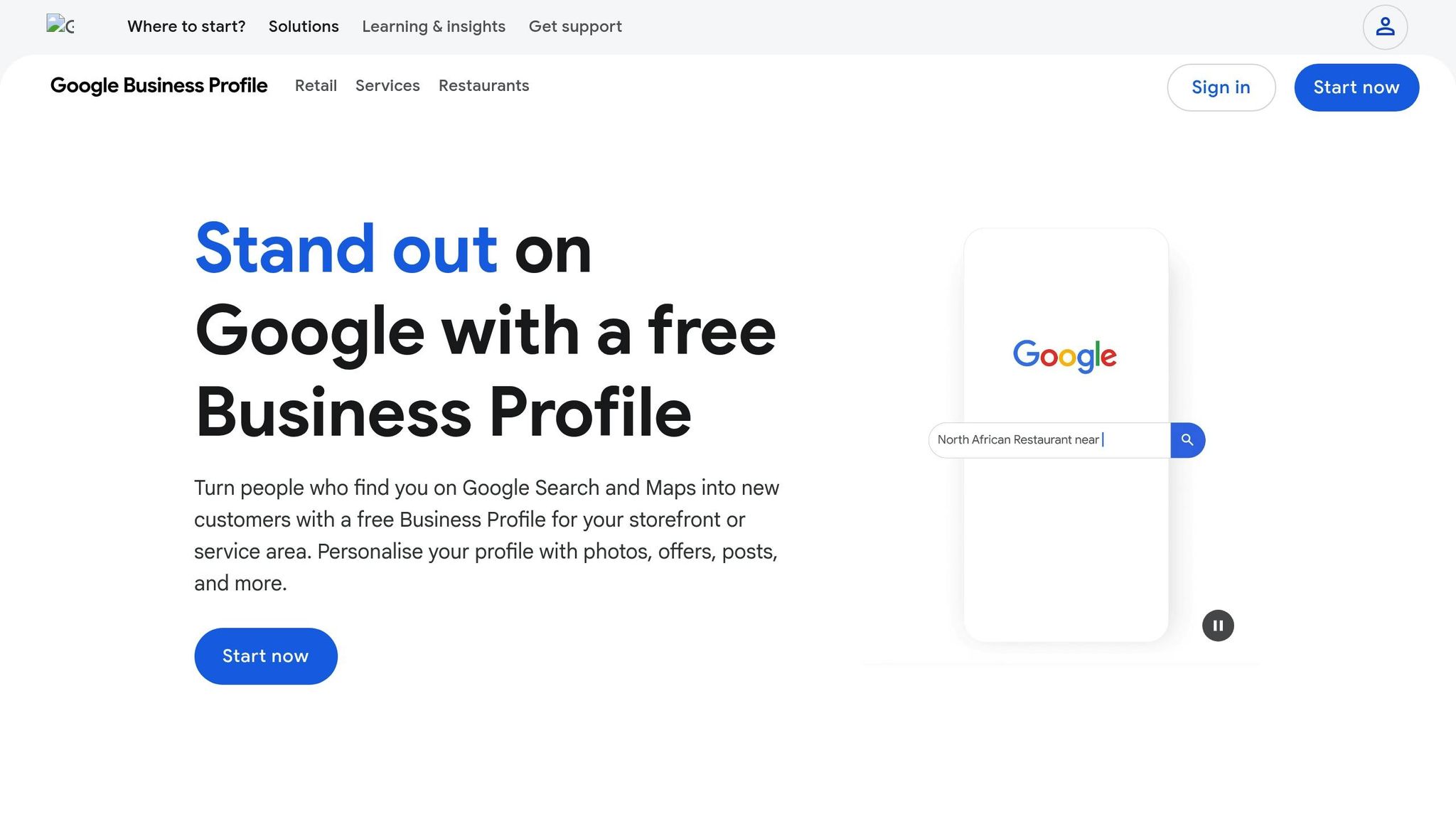
Your Google Business Profile (GBP) is essentially your online storefront for local search. It's the go-to tool for customers who find businesses through Google Maps, search results, and AI-powered answers.
"Think of your Google Business Profile (GBP) as your digital storefront for local search." – Miriam Ellis, Local SEO Subject Matter Expert, Moz
Start by selecting the right primary business category that aligns with your main service - like "Plumber" or "HVAC Contractor" - and add 2–3 secondary categories for specific offerings, such as "Water heater installation" or "Emergency plumbing service". If you operate without a physical storefront, hide your address and instead define service areas by city or ZIP code. Keep your service radius realistic, ideally within two hours of driving time. Also, ensure your business name matches your branding exactly, avoiding keyword stuffing like "Joe's Plumbing - Best Emergency Plumber".
Consistency is key for your Name, Address, and Phone (NAP) details across your website, GBP, and directories. Follow USPS Publication 28 standards for formatting. Regularly upload 3–5 fresh photos, such as branded vehicles, your team in action, or completed projects, to build trust and improve search engine signals. Posting updates weekly - featuring seasonal offers, helpful tips, or answers to common questions - further enhances your profile. Use the Q&A section to provide concise, location-specific responses that address potential customer concerns.
Google uses snippets from reviews and content to justify local rankings. For example, a listing might display: "Their website mentions 'emergency pipe repair'". Write your business description in a conversational tone that highlights your core services and service areas without sounding overly promotional. These efforts not only improve local rankings but also help potential customers find your most relevant services.
One roofing company saw a 200% boost in local rankings over 19 months by refining its website code, clarifying its geographic focus, and aligning its GBP with local citations. This resulted in 176 confirmed leads from 333 total calls and form submissions.
Backlinks from local websites show Google that your business is trusted and well-regarded in the community. For local SEO, geographic relevance often matters more than Domain Authority.
"The best local link you can get is from your competitor down the street... if you can't get a link from a direct competitor, look for local sites that serve your target audience in a different way, such as the local chamber of commerce." – Gyi Tsakalakis, Founder, AttorneySync
Local sponsorships are an excellent way to earn backlinks. Sponsor local sports teams, charity events, or nonprofits, and use search operators like inurl:sponsors paired with your city name to find opportunities. You could also offer your office space for local meetings or events, earning links from "venue" or "partner" pages.
"If you've got a conference room, or a lounge area, that you can let someone use, you can offer it to that group... You get a killer local link from the group's website." – Greg Gifford, Chief Operating Officer, SearchLab Digital
You can also contribute expert commentary to local news outlets or community blogs. For example, an HVAC company might write an article like "5 Tips for Saving Energy in [Town Name]" or share seasonal advice. Offering scholarships to local high school students is another way to secure high-authority backlinks from .edu domains and local news sites.
Mark Benzer, an insurance agent in Buffalo, Minnesota, built local authority by creating the "Buffalo Community Podcast." Through interviews with local business owners, educators, and officials - and sponsoring local sports teams - he established himself as a community leader, generating organic mentions and authority.
Partnering with complementary businesses can also drive backlinks. For instance, a wedding planner might link to a local florist, or a gym could recommend a nearby health cafe on a "recommended partners" page. Additionally, using SEO tools to identify and update outdated links to your site (link reclamation) can further strengthen your backlink profile.
Customer reviews are a critical factor in improving your visibility in Google's Local Pack and Maps results. About 50% of customers prefer businesses with a rating of 4 stars or higher, making reviews essential for both rankings and conversions.
Search algorithms now prioritize "review velocity" - the steady flow of new reviews over the past 90 days - over the total count of reviews. This means that consistently gathering fresh feedback is more effective than relying on older reviews.
Respond professionally to every review, whether positive or negative, and encourage customers to mention specific services like "emergency water heater repair" or "AC installation." These details can trigger "review justifications" in search results.
Make it easy for customers to leave reviews by including a direct link to your GBP review page in follow-up emails or texts after completing a job. However, avoid incentivizing reviews or filtering out negative feedback, as this could result in civil penalties under FTC guidelines.
Incorporate review requests into your CRM workflow immediately after service calls to maintain consistent review velocity. For businesses using Estatehub, this approach ensures feedback is sought while customer satisfaction is high, boosting your local authority and driving more qualified leads to your website.
Building local authority is just step one. To know if your SEO efforts are actually driving results - or just boosting vanity metrics - you need to track the right data. Google handles more than 8.5 billion searches daily, but climbing the rankings only matters if it leads to real business growth. Using analytics tools helps you dive deeper into performance and refine your strategy.
Focus on four main areas: Acquisition (traffic volume), Engagement (how users interact with your site), Conversion (leads and sales), and Revenue (the financial payoff). For home service providers, it's crucial to differentiate between informational searches (e.g., "how to fix a leaky faucet") and commercial searches (e.g., "emergency plumber near me"). Keep an eye on branded vs. non-branded traffic. A rise in non-branded traffic means you're reaching new audiences and expanding your market.
Also, track your organic conversion rate and identify pages driving the most lead submissions. Even a one-second delay in page load time can reduce conversions by 7%. Every second counts.
Platforms like Google Search Console and Google Analytics 4 (GA4) are essential for tracking SEO performance. In Search Console, look for keywords with high impressions but low click-through rates - these are opportunities to tweak your meta titles and descriptions. GA4's "Pages and Screens" report, filtered for organic traffic, helps spot pages with high visits but low engagement. Use the Attribution Paths feature to see how organic search fits into the customer journey.
For competitive insights, tools like Semrush or Moz can reveal keyword gaps - terms your competitors rank for, but you don’t. For example, Backlinko used analytics to grow its organic traffic to 645,000 sessions per month. To streamline reporting, combine data from Search Console and SEO tools into automated dashboards using Looker Studio. This makes it easier to spot trends and share progress with your team.
Once you’re tracking the right metrics, the next step is to test and tweak your strategies. Remember, SEO results can take three to six months to show. Set up a regular review schedule - weekly for quick updates and monthly or quarterly for deeper analysis. If organic traffic dips or your site health declines, dig into the data to figure out the cause.
Experiment with specific changes and measure their results. For instance, update a service page’s title tag and meta description, then check if click-through rates improve over 30 days. Use GA4 to track behaviors like users scrolling 90% of a page or clicking outbound links. Regularly audit your content to refresh or remove underperforming pages.
Focus on improvements that are "Not Urgent but Important" - like updating valuable content or fixing mid-level technical issues - rather than constantly reacting to minor problems. Compare performance month-over-month and year-over-year to account for seasonal trends in your industry.
For businesses using Estatehub’s CRM tools, linking organic traffic data to metrics like revenue and customer lifetime value proves ROI. This data-driven approach can help secure the resources you need to keep investing in SEO.
Scaling SEO for lead generation isn't about chasing shortcuts or focusing on vanity metrics. It's about creating systems that evolve alongside your business. Begin with a strong technical foundation, align your content with the buyer's journey, and zero in on high-intent keywords - those that mirror the questions and needs your sales team encounters daily. Consider this: SEO leads convert at an impressive 14.6%, compared to just 1.7% for cold calling. That difference isn’t random; it’s the result of showing up when your audience is actively searching for solutions.
"When we got our marketers to write blog posts that answered the same questions our sales team was hearing, we started getting visitors who were already halfway to a decision."
– Yarden Morgan, Director of Growth, Lusha
For home service providers, local SEO offers a direct path to attracting high-intent traffic. Focus on optimizing your Google Business Profile, consistently earning reviews, and creating location-specific content that resonates with your community. Keep your eye on the metrics that matter most - acquisition, engagement, conversion, and revenue - and make sure every effort connects back to pipeline growth. As Kimberly Anderson-Mutch, Director of Content at Go Fish Digital, wisely states:
"If a metric can't be tied to pipeline or revenue within two clicks, it doesn't belong on the primary dashboard."
Unlike paid ads, which stop working the moment your budget runs out, SEO builds lasting assets that grow in value over time. Organic search generates over 1,000% more traffic than organic social media. By setting up the right systems, you can scale your efforts without compromising on quality. If you're ready to move past manual optimizations and embrace a revenue-driven SEO strategy, Estatehub specializes in helping home service businesses generate leads through tailored SEO, content creation, and data-backed campaigns. Their expertise lies in addressing the specific challenges of local lead generation, delivering results that directly impact your bottom line.
Start tracking, keep testing, and build a scalable system that grows with you - not one you'll have to overhaul later.
Start by focusing on your homepage, contact page, and the pages that already draw the most traffic or attention. These are your best bets for generating leads quickly and efficiently. By prioritizing these key areas, you can make the most of your efforts right from the start.
When crafting content for different service areas, it's essential to make each page unique and tailored to its specific location. This means going beyond cookie-cutter templates and generic descriptions. Instead, focus on providing localized details that resonate with the audience in that area.
Here are some tips to make your content more location-specific:
Avoid reusing identical templates or copy-pasting content across multiple pages. Duplicate content not only hurts your search engine rankings but also makes your site feel impersonal to visitors. By ensuring each page provides unique value, you'll create a better experience for users and improve your site's performance in search results.
When it comes to evaluating the success of your SEO strategy, a few key metrics stand out. These metrics don’t just track traffic - they tie your organic performance directly to business outcomes like leads and revenue. Let’s break them down:
By focusing on these metrics, you can bridge the gap between SEO performance and tangible business growth, making sure your efforts lead to real, impactful results.
Sign up for the newsletter and be the first to read our articles.


Every single person on our agency team has spent a lot of time in the field either running their own business or working for larger marketing agencies. We have all put in the time responding to leads, helping customers, scheduling and doing services. This gives us a massive advantage when making decisions.
One thing that has always been very special to us, is the fact that (excluding spam / people that never used our services) we do not have any bad reviews. This absolutely does not mean we have never had unhappy clients, but if it happens, we make it right, and stand behind our promises.
We have seen, time and time again, other agencies using strategies and structuring campaigns the way that they are technically supposed to. Most of these "best practices" that are taught in our industry, simply do not transfer into local lead gen. This is partially because we do have a much different target audience, and are typically spending less, however optimizing for website traffic does not work here.
We have been there, jumping into starting a home service business, struggling, and doing everything wrong. It's humbling. Our team has all felt the highs and lows, which is why we get so excited for our clients to win, we know how good it feels.

Estatehub is not a normal agency, we know "clicks" don't get you sales. Let us show you how lead gen experts do it.

