


Overview of Common Stains
Full overview of the most common stains, including how to identify them and treat them
The fastest way to find link wins is to study the contractors already ranking in your city. If you compare 3 to 5 local SERP competitors, sort their links by type, and check which links point to service pages or city pages, you can build a short list of link targets that may help rankings, calls, and booked jobs. This kind of competitor link analysis is a core part of how Estatehub's SEO service approaches local link building.
This article shows you how to do four things in a simple order: pick the right ranking competitors, review their backlink patterns, find link gaps from chambers, supplier pages, trade groups, blogs, and local news, and send new links to the pages tied to your main services and cities. Getting that last part right depends on having service and city pages structured well in the first place, which is where a solid websites foundation matters. It also shows which numbers to track each month, such as rankings, organic sessions, leads, booked jobs, and revenue in $USD.
Before you read the full article, here's the core takeaway:
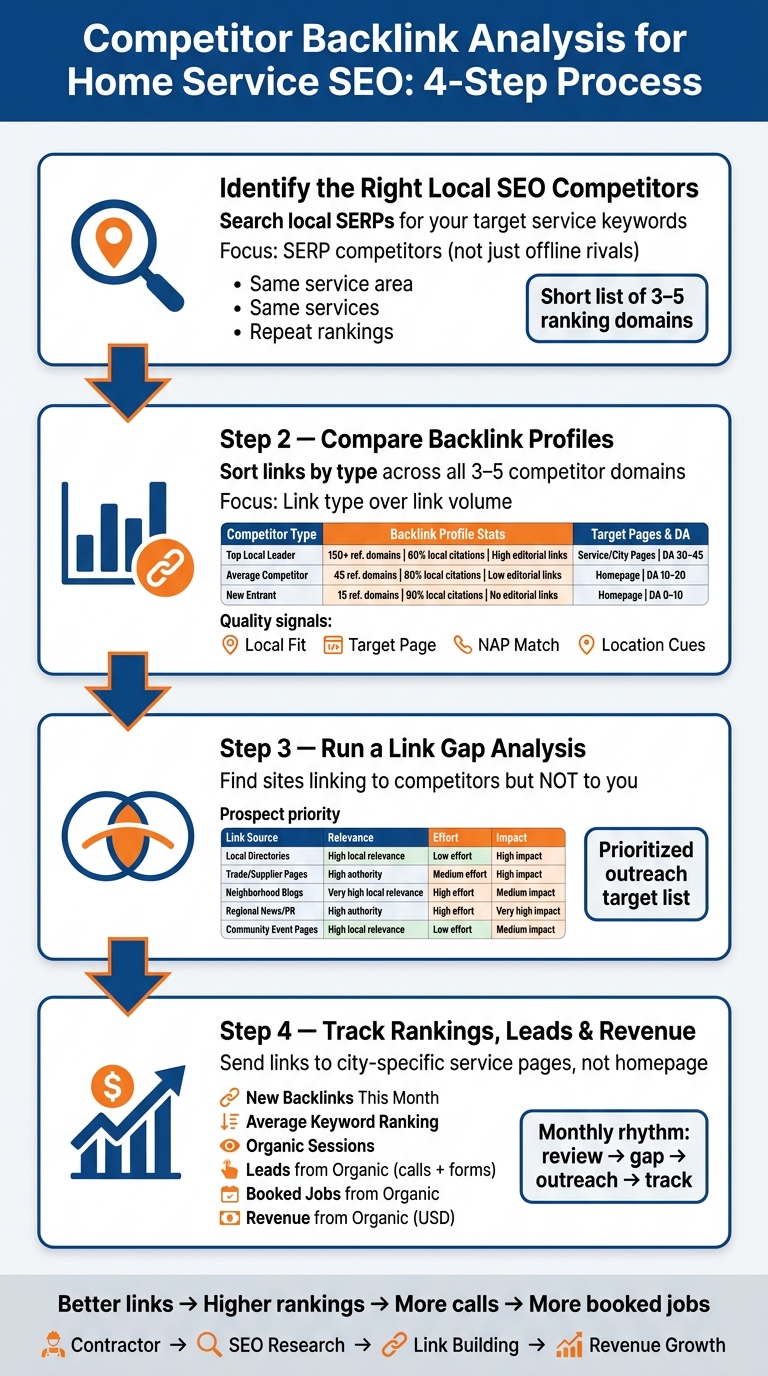
Competitor Backlink Analysis for Home Service SEO: 4-Step Process
| Step | What you check | What matters most | Main outcome |
|---|---|---|---|
| 1 | Local SEO competitors | Same service area, same services, repeat rankings | A short list of 3–5 domains |
| 2 | Backlink profiles | Link type, local fit, target page, NAP match | Clear link patterns |
| 3 | Link gaps | Sites linking to competitors but not to you | Outreach targets |
| 4 | Results | Rankings, traffic, leads, jobs, revenue | Proof that links affect business results |
If your goal is more than link counts, this process gives you a simple path from competitor research to local pages that can bring in leads.
A direct competitor sells the same service in your market. A SERP competitor is the site that ranks for that service in local search.
For backlink analysis, put your focus on the domains that Google already ranks for your target service. That’s the key difference. A business can be a real market competitor and still be a poor SEO benchmark if it doesn’t rank in your area.
Use that split to build a short list before you compare backlink profiles.
Once you pull the first round of search results, cut the list down right away. Keep only 3 to 5 domains that:
A smaller list makes link patterns much easier to spot. That short list becomes your baseline for Step 2.
Once you’ve locked in your 3 to 5 domains, look at the link types behind each site that ranks. Pull backlink data for each one, then sort those links by type. For contractors, link type usually matters more than sheer link volume.
Pay close attention to local citations, trade and association links, local news mentions, and supplier pages. Each one sends a different trust signal. Also, check where those links go. A link to the homepage is fine, but links pointing to service pages and city pages often tell you a lot more.
As you go through the links, focus on quality signals instead of just tallying totals:
This matters because two contractors can have a similar number of referring domains, but one profile can be far stronger. Why? The better profile usually has links that make local sense and support the pages that bring in calls.
The table below shows how local contractors’ backlink profiles often differ:
| Competitor | Total Ref. Domains | Local Citation % | Editorial Links | Top-Linked Page Type | Domain Authority (DA) |
|---|---|---|---|---|---|
| Top Local Leader | 150+ | 60% | High (Local News) | Service/City Pages | 30–45 |
| Average Competitor | 45 | 80% | Low (Directories only) | Homepage | 10–20 |
| New Entrant | 15 | 90% | None | Homepage | 0–10 |
The strongest profiles don’t rely on citations alone. They mix citations with editorial links, trade links, and supplier links. Just as important, they send authority to the pages that drive calls and quote requests.
Those gaps? That’s your outreach list in Step 3.
A link gap analysis helps you spot local sites that already link to your competitors, but not to you.
Start with the gaps you found in Step 2. Then review competitor backlink profiles and look for domains that link to multiple home service contractors in your market. That pattern matters. If a site already links to several businesses like yours, there's a good chance you can get listed there too.
Common targets include:
If a supplier or directory already lists several contractors in your area, getting added is a realistic move with strong upside.
Not every gap deserves your time.
Before outreach, sort prospects by three things: local relevance, authority level, and effort. This keeps you from burning hours on links that look nice on paper but do little for rankings or leads.
Put search-driven sites near the top of the list. Local directories, trade association pages, and supplier listings usually send higher-intent traffic.
Working through a gap list without a simple system is a time sink. Use the table below to sort prospects before you send a single email:
| Prospect Type | Local Relevance | Authority Level | Effort | SEO/Lead Impact |
|---|---|---|---|---|
| Local Directories (Yelp, Chamber of Commerce) | High | Medium | Low | High (Trust & Local Pack) |
| Trade/Supplier Pages (Manufacturer "Find a Pro") | Medium | High | Medium | High (Authority & SEO) |
| Neighborhood Blogs | Very High | Low/Medium | High | Medium (Referral Traffic) |
| Regional News/PR | High | High | High | Very High (Brand Signals) |
| Community Event Pages | High | Medium | Low | Medium (Local Entity Signal) |
Start with low-effort, high-impact prospects like local directories and community event pages. After that, move to supplier pages and regional news/PR.
That way, you're not just building links at random. You're building links that back the service and city pages you want to rank.
Use the strongest link gaps from Step 3 to build links to the pages that bring in calls.
Send each link to a city-specific service page, not your homepage. That matters more than many teams think. A link to a generic home page can help a little, but a link to the exact page you want to rank is usually the smarter move.
Let’s say your competitor review shows that local blogs and business directories help patio installers rank in Austin. In that case, create a dedicated Austin patio page and pitch those sites with local content. Keep each outreach push tied to the pattern you found in Step 2, then act on it right away.
Track everything in one sheet so nothing slips through the cracks:
Once your page targets are locked in, watch what happens next. Are rankings moving up? Are more leads coming in? That’s the part that counts.
Rankings are a signal, not the end goal. What matters is whether better rankings lead to calls, quote requests, and booked jobs.
Set up a simple monthly dashboard for each priority page and track the numbers below:
| Metric | What to Track |
|---|---|
| Page/City-Specific Service | The priority service and location page |
| Target Keywords | Primary service + city search terms |
| New Backlinks This Month | Number and brief notes on source type such as local blog, supplier, or citation |
| Average Ranking | Weekly position checks for primary keywords |
| Organic Sessions | Visits from organic search to each page |
| Leads from Organic | Calls and form submissions tagged as organic |
| Booked Jobs from Organic | Jobs sourced from organic leads |
| Revenue from Organic (USD) | Sum of job values from those jobs |
The goal isn't to get more links just to pad the numbers. The goal is to get better links that move rankings and booked jobs.
At its core, this process is pretty simple. Pick the right competitors to study, compare backlink profiles for signals that matter, run a link gap review to spot local opportunities you can actually win, and tie each new link to a city-specific service page built to rank and convert. This is the same rhythm Estatehub follows through its SEO service, where competitor link research feeds directly into monthly outreach.
Put local relevance first, especially for the pages that drive calls and quote requests. Those pages only convert well if the underlying site is built for it, which is why link building and a solid websites foundation tend to work best together rather than in isolation.
Then turn the process into a monthly rhythm: review competitor links, spot new gaps, create one or two local content assets, do outreach, and track results. That's how backlink research stops being a one-time task and starts driving rankings, leads, and revenue month after month.
Treat backlink analysis as a recurring habit, not a one-time task. Competitor moves and search trends can shift fast, so review your backlink profile and the competitive landscape at least quarterly or twice a year.
That rhythm helps you spot new link-building chances, react to changes in your local market, and stay on track with local search and lead generation goals.
For home service SEO, tools like Ahrefs, Semrush, and Moz work well for finding competitors and backlink openings. Semrush’s Keyword Gap tool is especially handy when you want to spot keywords your competitors rank for but you don’t, or places where your rankings are weak.
For Local Map Pack visibility, tools like LocalFalcon, Whitespark, BrightLocal, and Moz Local help you compare nearby competitors and see where you show up well and where you don’t. Estatehub takes it a step further by connecting those findings with SEO, lead, and CRM data.
For home service businesses, local backlinks can help with early ranking lifts or local visibility in just a few weeks.
But if you're looking for noticeable lead generation, that usually takes 3 to 6 months.
The big thing to know: steady results come from steady SEO work over time.
Sign up for the newsletter and be the first to read our articles.


Every single person on our agency team has spent a lot of time in the field either running their own business or working for larger marketing agencies. We have all put in the time responding to leads, helping customers, scheduling and doing services. This gives us a massive advantage when making decisions.
One thing that has always been very special to us, is the fact that (excluding spam / people that never used our services) we do not have any bad reviews. This absolutely does not mean we have never had unhappy clients, but if it happens, we make it right, and stand behind our promises.
We have seen, time and time again, other agencies using strategies and structuring campaigns the way that they are technically supposed to. Most of these "best practices" that are taught in our industry, simply do not transfer into local lead gen. This is partially because we do have a much different target audience, and are typically spending less, however optimizing for website traffic does not work here.
We have been there, jumping into starting a home service business, struggling, and doing everything wrong. It's humbling. Our team has all felt the highs and lows, which is why we get so excited for our clients to win, we know how good it feels.

Estatehub is not a normal agency, we know "clicks" don't get you sales. Let us show you how lead gen experts do it.

