
Content marketing can deliver 3x more leads per dollar than paid ads for home service providers. Yet, many businesses struggle to track its impact effectively. This guide explains how to measure, improve, and maximize ROI from content like blogs, videos, and service pages.
Key Takeaways:
- Why ROI Tracking Matters: The average cost per lead in home services hit $90.92 in 2025. Tracking helps identify which efforts drive revenue and cut waste.
- Content That Converts: Local service pages convert at 12–18%, while educational blogs help attract top-of-funnel traffic.
- Long-Term Gains: By Year 2, organic content often delivers a 3–4x ROI, outperforming paid ads on cost-per-lead.
- Metrics to Watch: Focus on Customer Lifetime Value, Cost Per Booked Job, and Lead-to-Customer Conversion Rate.
- Tools to Use: CRMs, call tracking, and Google Analytics bridge the gap between clicks and revenue.
Content marketing isn’t a quick fix - it’s a long-term investment. But with the right strategy and consistent effort, it can generate leads that close at 14.6%, far outpacing outbound methods. Let’s dive into how to make it work for your business.
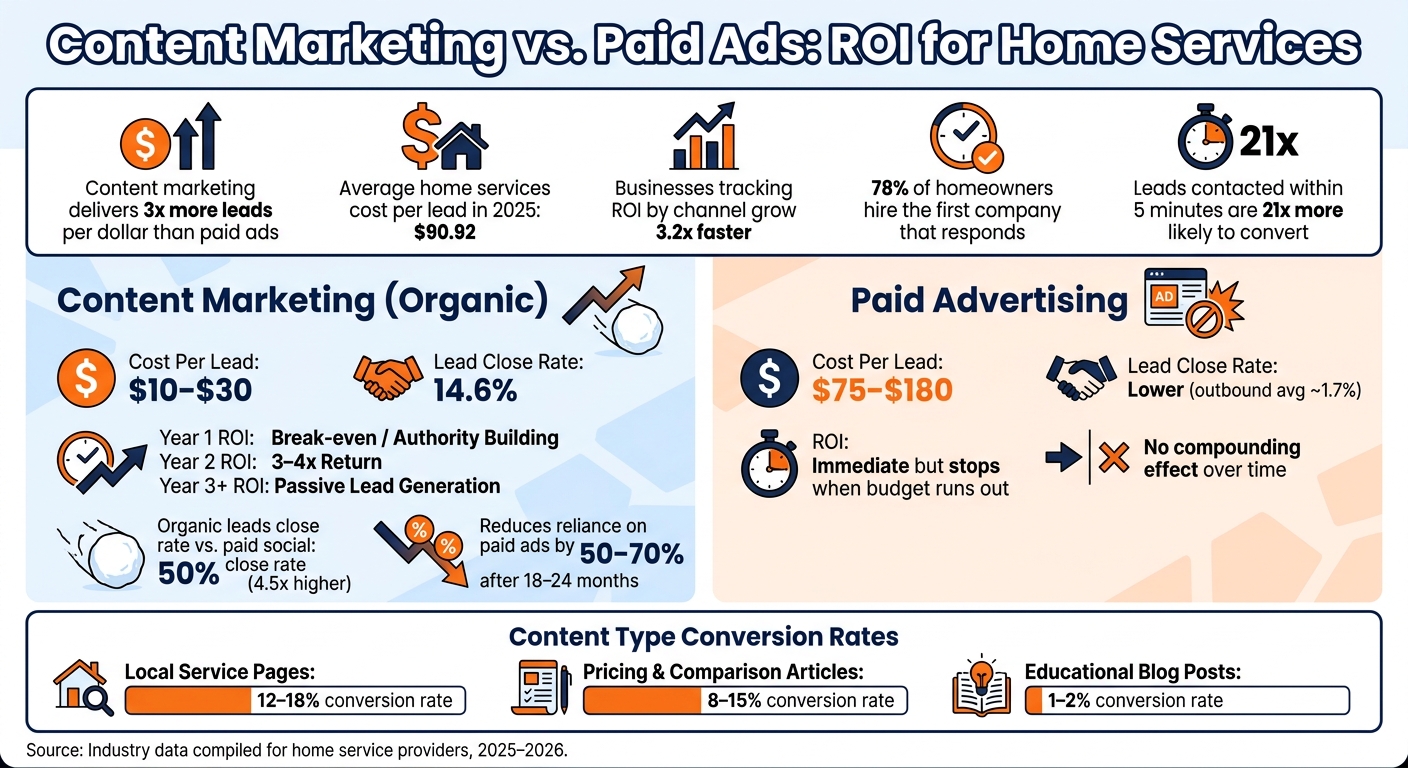
Content Marketing vs. Paid Ads: ROI for Home Services
How To Track ROI Like a Pro ft. Searchlight Digital
As a lead generation agency specializing in home services, Searchlight Digital provides expert insights into these tracking methods.
sbb-itb-2aa0348
How Content Marketing Generates ROI in Home Services
Content marketing creates a lasting digital presence instead of offering fleeting attention like paid ads. Think of every blog post, service page, or video you publish as an ongoing lead generator. Unlike ads that stop performing when the budget runs out, this content continues to bring in traffic and leads over time. As mentioned earlier, organic search leads tend to close at much higher rates than outbound methods, making content marketing a smart, long-term investment. This ongoing value is the backbone of the following ROI drivers.
Key Drivers of ROI in Content Marketing
Content marketing's success comes from several interconnected factors. First, there's search visibility. Every new piece of content - whether it's a blog post, a service page, or a city-specific landing page - creates another opportunity to connect with homeowners actively searching for solutions. Then there's lead quality. When someone lands on your site through a well-written article that solves a specific problem, they're often closer to making a decision. Finally, there's the cost factor. Once your content is ranking, the cost per lead for organic traffic can drop significantly. For example, organic CPL often falls between $10–$30, while paid search CPL can be as high as $100–$180.
One often overlooked factor is the compounding effect. Amber S. Hoffman, Founder & CEO of The FS Agency, explains it well:
"Organic online visibility through SEO, AEO, and GBP Optimization is like a snowball that keeps building and building. The efforts compound over time."
A real-world case study illustrates this perfectly. In 2025, a South Florida luxury home services franchisee worked with The FS Agency to create over 50 SEO-optimized blog posts and 106 YouTube videos. The result? $244,000 in organic revenue, a 13.6x return on ad spend (ROAS), and a 50% close rate on organic leads - 4.5 times higher than leads from paid social ads.
How Homeowners Make Buying Decisions
When it comes to hiring contractors, most homeowners don’t act on a whim. They typically spend 7–14 days researching, reading reviews, comparing prices, and evaluating their options before making contact. During this time, content plays a pivotal role. For instance, an article explaining why an AC unit might be leaking can catch their attention early in the process. Later, detailed pricing guides or visual testimonials - like before-and-after photos or customer reviews - help them feel confident in their choice. And when an urgent repair need arises, 76% of people searching for a local service will visit or call a business within 24 hours.
Content Types That Drive Results
Not all content delivers the same results. Some formats are consistently better at converting leads for home service providers:
| Content Type | Typical Conversion Rate | Primary Purpose |
|---|---|---|
| Local service pages | 12–18% | Attract high-intent local searchers |
| Pricing & comparison articles | 8–15% | Appeal to customers ready to make a decision |
| Educational blog posts | 1–2% | Build authority and drive top-of-funnel traffic |
Beyond written content, short-form video has become a standout performer in 2026. Quick clips like time-lapses of roofing jobs, walkthroughs of remodeling projects, or before-and-after videos on platforms like YouTube Shorts provide a visual showcase of your work. These videos help potential customers feel more confident about hiring your service. For example, Ryan Amato Painting saw a 125% jump in organic traffic and a 120% increase in SEO-driven leads after focusing on local SEO and content marketing.
Planning a Content Strategy for Measurable ROI
Without clear goals, a content strategy can feel like throwing darts in the dark. If you want measurable results, every piece of content needs to connect directly to a business outcome you can track.
Setting Clear Business Goals for Content Marketing
The first step is defining what you want your content to achieve. Skipping this step often leads to content that doesn’t deliver results.
Your goals will shape the type of content you create. For example:
- Want more booked jobs? Focus on "speed-to-lead" content like quick diagnostic guides, transparent pricing pages, and local service pages that address high-intent queries before competitors can.
- Looking to grow a maintenance membership program? Educational content is your best bet. Articles and videos that explain the long-term costs of skipping annual tune-ups are particularly effective.
Here’s a key stat: businesses that blog regularly see 13 times more positive ROI than those that don’t. But consistency alone isn’t enough - your content needs to tie directly to a clear goal. As Kore Komfort Solutions points out:
"Content marketing delivers a 6:1 ROI over paid advertising for contractors willing to commit to a 24-month strategy - but most contractors quit after 3 months when they don't see instant results."
That 24-month commitment is critical. Year 1 is about breaking even and building authority. By Year 2, you’ll likely see a 3–4x return, and by Year 3, your older content can generate leads passively.
Once you’ve set your goals, it’s time to identify the right topics and formats to support them.
Choosing the Right Topics and Formats
Finding high-value topics doesn’t have to be complicated. Start by recording customer questions for a week - during calls, estimates, or even text exchanges. Those questions are a goldmine because they reflect what other homeowners are searching for online.
You can also use tools like Google Autocomplete, "People Also Ask", and competitor analysis to spot opportunities. Topics like transparent pricing, honest comparisons, or industry "red flags" are often overlooked by competitors, giving you a chance to stand out.
Organize your content using the Pillar and Cluster model. For example, create a comprehensive guide on a key service like "AC Repair in Houston" and then publish smaller, supporting posts that address specific long-tail questions. This approach helps search engines recognize your local authority and keeps visitors engaged on your site longer.
Match your content format to your audience’s intent:
- Pricing pages: Convert at 8–15% and work well for high-intent visitors ready to take action.
- Educational posts: Build trust during the 7–14 day research phase many homeowners go through.
Once you’ve nailed down your topics and formats, it’s time to plan your budget and resources.
Budgeting and Resource Planning
Every dollar you spend on content should tie back to measurable ROI. For home service businesses, the general rule is to allocate 5–10% of total revenue to marketing. Companies in growth mode may need to push that up to 15%.
Here’s a breakdown of typical content production costs:
| Resource Type | Monthly Cost | What You Get |
|---|---|---|
| DIY Content | $100–$300 (tools/hosting) | 500–750 hours/year of owner time |
| Freelance Writer | $400–$1,200 | 8–12 articles per month |
| Full-Service Agency | $2,000–$5,000+ | Strategy, writing, SEO, and reporting |
While DIY content seems affordable, the hidden cost is your time. For example, the opportunity cost for an owner can range from $37,500 to $112,500 annually. For most established businesses, hiring a freelancer or agency is often more efficient.
One smart strategy is to balance paid ads and content creation. Paid ads can deliver leads within 24–48 hours, providing immediate results. Meanwhile, you can build your content library in parallel. Over 18–24 months, a strong content foundation can reduce your reliance on paid ads by 50–70%, with organic cost-per-lead dropping to $20–$50 compared to $75–$150 for paid leads.
Platforms like Estatehub specialize in this hybrid approach, combining SEO, paid ads, and CRM tools to help home service businesses scale efficiently - without putting all their eggs in one basket.
Measuring and Calculating Content Marketing ROI
It's time to show that your content strategy delivers results. As Ivan Vislavskiy, CEO of Comrade Digital Marketing, aptly explains:
"ROI isn't 'I got 40 leads last month.' It's how many of those initial inquiries turned into confirmed appointments, sold jobs, and revenue in your bank account."
Here's a startling fact: 90% of home service owners invest in marketing but can't confirm if their ROI is positive. This disconnect often comes from not tracking the right metrics from the start. Below, we break down the key metrics you should focus on, how to calculate ROI accurately, and the tools that make tracking easier.
Key Metrics to Track
When measuring success, prioritize metrics that directly connect to revenue rather than surface-level numbers like clicks or impressions. Here are the most critical ones:
- Customer Lifetime Value (CLV): This metric captures the long-term revenue potential of a customer, factoring in repeat business and referrals.
-
Cost Per Booked Job: This is more insightful than Cost Per Lead because leads that don't convert won't boost your bottom line. As Matt Sitek, Founder of Rivet, puts it:
"The key metric is cost per booked job by channel, not cost per lead."
- Lead-to-Customer Conversion Rate: If you're generating plenty of leads but closing very few, the issue might lie in your follow-up or sales process. Keep in mind, 78% of homeowners hire the first company that responds.
- Organic Traffic Growth: This measures how your search visibility improves over time, showing the cumulative impact of your SEO efforts.
| Metric | Why It Matters |
|---|---|
| Customer Lifetime Value | Shows the long-term revenue potential of each customer |
| Cost Per Booked Job | Highlights profitability by channel, beyond just the volume of leads |
| Lead-to-Customer Rate | Helps identify whether the problem lies in content quality or sales execution |
| Organic Traffic Growth | Tracks the long-term benefits of better search engine visibility |
How to Calculate Content Marketing ROI
Once you’re tracking the right metrics, calculating ROI is straightforward. Use this formula:
(Revenue – Marketing Cost) / Marketing Cost × 100
For high-ticket services, it’s more accurate to use gross profit instead of total revenue.
Here’s an example: A roofing company spends $2,500 per month on SEO. That investment generates 16 qualified leads, resulting in 4 closed jobs at $10,000 each. This brings in $40,000 in revenue, giving the company a 1,500% ROI.
To ensure accurate ROI calculations, include all expenses - such as agency fees, CRM tools, call tracking software, and staff time. Skipping these costs can lead to inflated numbers and poor decisions.
It's also worth noting that for larger home service projects, sales cycles can take 60–90 days. Measuring ROI quarterly instead of monthly often provides a more realistic picture. Daniel Kelly, Founder of Constructo Marketing, explains it well:
"If you expect a kitchen remodel lead source to prove itself in the same window as a pizza coupon, you'll cut good marketing too early."
By sticking to this approach, you can tie your content efforts directly to measurable business growth.
Tools for Tracking Content Performance
Since 60%–80% of conversions happen over the phone, call tracking should be a cornerstone of your measurement strategy. Tools like CallRail, WhatConverts, and CallTrackingMetrics use Dynamic Number Insertion (DNI) to link phone calls to specific content sources, whether it’s a blog post, Google Business Profile, or paid ad.
Combine call tracking with Google Analytics 4 (GA4) to monitor form submissions, click-to-call events, and detailed traffic data. Integrating these tools with a field service CRM - like ServiceTitan, Jobber, or Housecall Pro - connects website visits to paid invoices. Use UTM parameters to tag every link, ensuring you know exactly which content drove each visitor.
Businesses that track ROI by channel report 3.2x average revenue growth compared to those that don’t.
At Estatehub, we rely on these tools to ensure every marketing dollar is accounted for and optimized effectively.
How to Improve Content Marketing ROI Over Time
Improving Existing Content Performance
We've already touched on the importance of localization and clear calls-to-action (CTAs) in boosting conversions. But how can you refine these strategies over time? By focusing on optimizing what you already have.
Instead of constantly creating new content, revisit your top-performing pages. Update them with fresh data, add new project photos, and include geo-tagged before-and-after galleries. Local relevance is key: content that directly addresses specific neighborhoods or regional concerns - like storm damage or water quality issues - tends to outperform generic content.
To further improve results, ensure each page includes at least three CTAs: one at the top, one in the middle, and one at the bottom. This keeps visitors engaged and provides clear next steps. Additionally, consider adding FAQ sections with concise, experience-based answers. This approach not only helps users but also increases the likelihood of your content being featured in AI-driven search tools like Google AI Overviews and ChatGPT.
Boosting Lead and Revenue Generation
Once your content is optimized, the next step is to streamline the process of turning leads into paying customers. Start by making the booking process as frictionless as possible. Every service page and blog post should prominently display a phone number, a simple contact form, and a clear outline of what happens next. Even minor improvements here can significantly lower your cost per acquisition.
Timing also plays a huge role. Leads contacted within 5 minutes are 21 times more likely to convert compared to those reached after 30 minutes. Speed matters, and it can directly impact your bottom line.
Don’t overlook seasonal email campaigns either. These targeted reminders to your existing customer base - like AC tune-up promotions in March or furnace check-ups in September - can drive repeat bookings. Better yet, email marketing offers an impressive return, averaging $36 to $42 for every $1 spent. It’s one of the most cost-effective ways to generate revenue for home service businesses.
Using Automation and CRM to Support Growth
Once your content and lead generation systems are running smoothly, technology can take your efforts to the next level. A home services CRM can centralize all inquiries - whether they come from forms, phone calls, or social media - and automate follow-ups. Businesses using automated follow-ups can see conversion rates increase by up to 391% compared to those that delay responses for more than 30 minutes.
Automation helps recover potential revenue, too. For example, you can set up follow-up sequences for unsold estimates or send reactivation campaigns to customers who haven’t booked in a while. Tools like Estatehub’s HighLevel CRM are specifically designed for home service providers, offering pre-configured pipelines, automated follow-up sequences, and landing page templates. This eliminates the steep learning curve that often discourages businesses from fully adopting CRM systems.
John Cronin, Founder & CEO of Proven ROI, emphasizes the importance of tracking results beyond surface metrics:
"If your reporting stops at cost per lead, you will keep buying the wrong leads and blaming marketing for sales problems."
Conclusion: Growing Your Home Services Business with Content Marketing ROI
Content marketing isn’t a quick fix - it’s a system you build over time. The businesses that succeed are those that see it as a long-term investment rather than a short-lived campaign. As Kore Komfort Solutions explains:
"Year 1 breaks even, Year 2 delivers 3-4x return, Year 3+ generates passive leads."
This compounding effect only works if you stay consistent. Unfortunately, many contractors give up within the first three months. But the ones who stick with it - committing to a 24-month plan of regular publishing, tracking key metrics, and fine-tuning successful strategies - are the ones who create a steady flow of leads, even when ad spending stops. This approach aligns perfectly with a framework for sustainable growth.
Tracking results is the key to smarter decisions. Businesses that measure ROI by channel grow 3.2 times faster than those that don’t. Without tools like call tracking, CRM tagging, and revenue reporting, it’s easy to waste 30–40% of your marketing budget. Precise attribution methods are essential to avoid this.
You don’t need a huge budget to get started. A monthly investment of $500–$2,000 can generate compounding returns over time, eventually outperforming paid ads on a cost-per-lead basis. By Year 2, organic content not only lowers lead costs but also delivers leads that close at a rate of 14.6% - nearly nine times higher than outbound strategies.
With a clear plan and measurable goals, even a modest budget can lead to impressive results. Be consistent, focus on the right metrics, and keep improving your strategy.
For home service providers looking to achieve sustainable growth, Estatehub offers tailored digital marketing solutions to help you build a reliable pipeline of leads.
FAQs
How long does it take for content marketing to pay off for a home service business?
Content marketing is a commitment that pays off over time, usually taking 12–24 months to deliver noticeable results. In the early stages, you might start seeing leads trickle in around months 7–12, with the potential to break even by the end of the first year. By the time you hit months 13–24, a steady stream of content can drive 20–50 or more leads every month, offering a chance to cut back on paid ads.
Many businesses rely on paid advertising during the initial phase to keep leads flowing while the content strategy gains traction. This approach helps balance short-term needs with the long-term benefits of a content-focused plan.
What’s the easiest way to track which blog posts or service pages generate booked jobs?
To keep your CRM organized and effective, it's important to tag every inbound lead with its source and link booked jobs back to that tag. Here's how you can streamline this process:
- Use call tracking with Dynamic Number Insertion (DNI): Assign unique phone numbers to different pages on your website. This helps you track which page generated the call.
- Capture form submissions directly into your CRM pipeline: Make sure these submissions include a 'Job Booked' stage to track conversions.
- Ensure seamless lead source tracking: Make sure the lead source data flows through your CRM, all the way to the booked job.
With these steps in place, you can filter your CRM records by source and identify which pages are driving the most bookings. This insight is key to optimizing your marketing efforts.
How much should a home services company budget each month for content marketing?
Home services companies generally set aside $500–$2,000 per month for content marketing. This could involve hiring freelance writers or dedicating 10–15 in-house hours weekly to the task. Since content marketing typically requires about 6 months to start producing leads, it's smart to prioritize building authority right from the start.
If you're pulling from your overall marketing budget, aim to allocate 10–20% of your revenue to marketing efforts. Out of that, dedicate 10–15% specifically to content creation and authority-building initiatives. This strategy helps lay the groundwork for long-term success.
Related Blog Posts

Sign up for the newsletter and be the first to read our articles.