
Struggling to make your ads work for your home service business specializing in pest control? This case study reveals how one U.S.-based company turned its ad performance around by fixing tracking issues and optimizing campaigns.
Key Takeaways:
- Initial Challenges: Poor tracking made it impossible to connect ad spend to booked jobs. Cost per lead (CPL) was $40.72, slightly above the industry benchmark of $39.25.
-
Main Fixes:
- Implemented call tracking with Dynamic Number Insertion (DNI) to track phone leads (70–80% of conversions).
- Integrated Google Ads and CRM to track revenue impact.
- Shifted from broad targeting to specific keywords and dedicated landing pages.
- Used negative keywords to filter irrelevant traffic.
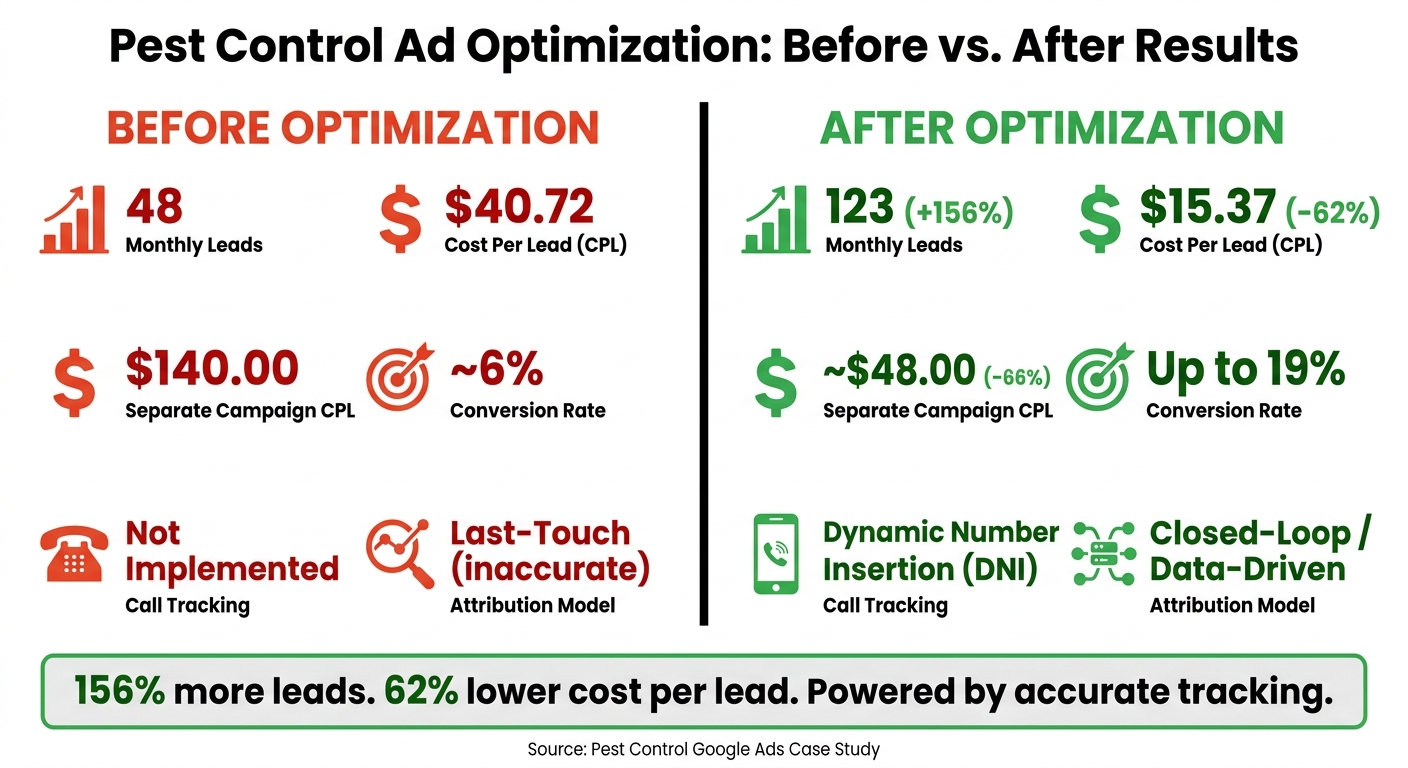
- Results: Monthly leads increased by 156% (from 48 to 123), while CPL dropped to $15.37.
Why It Matters:
Accurate tracking is the foundation for improving ad performance. By focusing on high-intent keywords, refining targeting, and integrating data systems, pest control businesses can maximize ROI and grow their lead pipeline.
Keep reading for a step-by-step breakdown of how this transformation happened.
Starting Point: Ad Campaigns and Tracking Gaps
Existing Ad Strategy
The pest control company relied on Google Ads, focusing on general pest control keywords. However, their approach leaned on broad keyword targeting without tailoring ads to specific service lines or creating customized landing pages. This is a common scenario for smaller pest control operators, where the primary goal often becomes driving clicks and traffic rather than securing booked appointments.
"Most operators just aren't capturing it because their Google campaigns are either nonexistent or built wrong. They were optimizing for clicks, not appointments." - Zorvo Digital
The result? Ad budgets were spent inefficiently, with no clear understanding of which keywords actually led to service calls. While the campaign generated traffic, it lacked the tools to evaluate conversion quality, making it difficult to refine or optimize.
Tracking Gaps and Challenges
One of the biggest hurdles was the lack of proper tracking. In the pest control industry, phone calls account for 70–80% of conversions. Yet, this company had no call tracking in place, leaving many booked jobs unrecorded.
Without integrated tracking systems, it was impossible to tie ad spend directly to booked jobs. Tools like Google Ads, website analytics, and call logs operated in isolation, which meant there was no way to connect an ad click to a completed service booking. On top of that, their attribution model relied on last-touch tracking. Research shows this method can overestimate search advertising’s impact by 30–40%, further skewing the campaign’s actual performance.
"If you can't track which ads drive calls, you're flying blind during peak season, costing thousands in wasted ad spend." - Cube Creative Design
Another issue was the lack of negative keyword filtering. This oversight caused ads to appear for DIY-related searches like "rat poison" or "pest spray", which attracted clicks from users who were unlikely to hire professional services.
Baseline Metrics
These tracking issues distorted the company’s performance metrics. For instance, their cost per lead (CPL) appeared artificially low because of the missing data. In many pest control campaigns, CPL can range between $39.25 and $120, depending on the level of tracking and optimization. The absence of accurate tracking meant their baseline metrics failed to provide a realistic picture of campaign effectiveness.
| Metric | Observed Baseline | Industry Benchmark |
|---|---|---|
| Cost Per Lead (CPL) | Reported figures at the lower range | $39.25 – $90.92 |
| Attribution Accuracy | Inaccurate (last-touch) | Data-driven attribution |
| Call Tracking | Not implemented | Essential (captures 70–80% of leads) |
sbb-itb-2aa0348
How I Get More Conversions for Pest Control Company | Google Ads
Setting Up a Tracking System
The next step tackled the issue of tracking gaps by connecting ad clicks directly to booked jobs.
Defining Conversion Events
To address previous tracking issues, conversion events were expanded to include phone calls, online bookings, inspection requests, and high-intent page visits. Each event was weighted based on its potential revenue impact. For example, emergency calls, which have shorter decision cycles, were tracked separately from termite plans. This ensured attribution data remained clean and actionable.
Call Tracking Setup
Since phone calls are the primary driver of conversions in pest control, getting this part right was crucial. The team implemented Dynamic Number Insertion (DNI) - a JavaScript tool placed in the website header. This script dynamically changes the displayed phone number based on the visitor's traffic source, allowing for source-specific tracking.
For Google Ads, a pool of unique phone numbers was used to track individual sessions down to the keyword level. Additionally, the Google Click ID (GCLID) - a unique identifier attached to each ad click - was captured during calls. This created a direct link between the phone conversation and the specific ad that generated it.
To filter out low-quality interactions, only calls lasting at least 60 seconds were considered valid.
"If you can not tell which marketing channel generated each call, you are optimizing blind." - Prospelle Team
CRM Integration
Call data was integrated into the CRM to enable closed-loop attribution, ensuring every advertising dollar could be tied to signed contracts. The call tracking platform, such as CallRail (starting at $45–$50/month), was directly connected to the CRM. The captured GCLID was stored in the CRM lead record, and when a job was marked as sold, revenue data was fed back into Google Ads. This allowed Google’s Smart Bidding algorithm to optimize campaigns based on actual revenue rather than just lead volume.
Christin Nein, Director of Product Management at Coalmarch, explained:
"By using CallTrackingMetrics' CRM integration, her team could track ROI for every marketing dollar our clients spend... the first time most of these companies have had visibility into that type of data."
The rollout followed a structured timeline:
- Month 1: Focused on selecting a provider and setting up DNI.
- Month 2: Handled CRM and Google Ads integration.
- Month 3: Conducted the first full data review and adjusted budgets accordingly.
The one-time cost for professionally setting up the closed-loop system ranged from $500 to $2,000. With this system in place, the campaign was ready to use data for precise optimizations in future adjustments.
Using Tracking Data to Improve Campaigns
With tracking systems in place, raw data transformed into actionable insights. Every click, call, and booked job left a clear trail, making it easier to spot where money was being wasted - and where it was making an impact. These insights paved the way for fine-tuning ad copy and targeting strategies.
Keyword and Budget Adjustments
The improved tracking system quickly highlighted inefficiencies in the budget. For instance, one ad group focused on dead animal removal was eating up a significant chunk of the budget. However, this service generated low-margin, one-off jobs with no potential for recurring revenue or upsells. The team redirected $5,000 of this wasted spend to core keywords like "termite" and "pest control." The result? Cost per lead dropped from $140 to $48.
Search term reports became a vital tool for refining campaigns. By regularly reviewing these reports, the team built a robust negative keyword list, cutting out irrelevant traffic. They also started with manual bidding to establish a clean baseline of conversion data. Once leads were coming in consistently, they shifted to Maximize Conversions, ensuring the algorithm had enough data to make informed decisions.
Ad Copy and Landing Page Updates
Tailoring ad copy to match search queries proved to be a game-changer. Using Dynamic Keyword Insertion (DKI), ad headlines automatically mirrored the user's exact search term. For example, someone searching for "bee exterminator" would see "Bee Exterminator" in the headline. Each ad group directed users to a dedicated landing page tailored to the specific pest or service they searched for.
The results were striking. A pest control company that incorporated DKI and pest-specific landing pages saw an 18.48% conversion rate, with a cost per conversion of $43.05 on a $1,000/month budget. To put that into perspective, the industry average conversion rate hovers around 1.4%. This stark difference highlights how much generic campaigns fail to capitalize on potential leads.
Geographic and Device Targeting
Beyond reallocating keywords, the team used detailed targeting to further refine campaign performance. Tracking data helped pinpoint high-performing and underperforming areas. By analyzing performance down to the zip code level, they identified which locations produced the best-quality calls. Bid adjustments were applied to prioritize these areas, while locations outside the service footprint were excluded entirely, reducing wasted clicks from users who couldn’t be served.
Device targeting also played a key role. For example, in one campaign, geotargeting adjustments within specific zip codes led to a dramatic improvement. Monthly conversions jumped from 30 to 68 - a 127% increase - while the cost per acquisition dropped by 33%, from $31.08 to $20.72, all within just 30 days.
"Managing Google Ads for emergency-driven local services - like wildlife removal - requires more than just setting up a few search campaigns. It demands precision, responsiveness, and an understanding of what drives people to call right now." - PPCAssist
Results and Key Takeaways
Pest Control Ad Optimization: Before vs. After Results
The introduction of the new tracking system brought about noticeable, measurable improvements in performance and business outcomes.
Performance Improvements
After optimization, the results were impressive: monthly leads jumped from 48 to 123 - a 156% increase - while the cost per lead (CPL) dropped significantly from $40.72 to $15.37. Here's a breakdown of the key metrics:
| Metric | Before Optimization | After Optimization |
|---|---|---|
| Monthly Leads | 48 | 123 |
| Cost Per Lead | $40.72 | $15.37 |
| Cost Per Lead (separate campaign) | $140.00 | ~$48.00 |
| Conversion Rate | ~6% | Up to 19% |
Some pest control campaigns achieved conversion rates as high as 19%, falling within the 17%–19% range reported for top-performing efforts.
Business Impact
These improved metrics directly translated into substantial business growth. For example, San Joaquin Pest Control in Visalia, CA, partnered with Rhino Pest Control Marketing over a decade and implemented a SMART CRM system to monitor every lead from the first click to closing. This strategy generated over $4 million in annual revenue growth and delivered a 200% ROI on digital marketing spend. The company not only doubled its service calls in key markets but also expanded into new regions - growth that would have been impossible without accurate tracking.
"Rhino Pest Control Marketing is seriously amazing! They have increased our online sales more than I would have ever expected! Online marketing is basically all we do and need to do now!" - Stephanie Morgan, General Manager, San Joaquin Pest Control
Reliable lead generation also boosts a business's market value. American Pest Control, operating in the Birmingham area, used targeted local campaigns to generate 509 phone calls and 385 form leads at an average CPL of $16. This steady lead flow played a key role in facilitating a successful business acquisition.
Lessons for Pest Control Businesses
The key takeaway? You can't improve what you don't measure. Businesses that prioritized fixing tracking gaps before tweaking bids or budgets saw the most dramatic results. By integrating call tracking with a CRM, they gained access to a comprehensive ROI dashboard - not just raw lead counts - which made budget decisions far easier.
This case study highlights that precise tracking is essential for better ad performance and business growth. Another critical insight is the importance of focusing on high-intent services that generate recurring revenue instead of one-off jobs. When combined with well-structured campaigns, pest-specific landing pages, and a carefully managed negative keyword list, the results compound over time. For pest control businesses looking to build such a system without starting from scratch, partnering with a specialist like Estatehub can streamline the process.
FAQs
What should I track besides form fills?
Did you know that 70–80% of home service leads come through phone calls? That makes tracking those calls absolutely essential. By using call tracking with Dynamic Number Insertion (DNI), you can link incoming calls directly to their marketing source - whether it’s a Google Ads campaign or even a yard sign. This gives you a clear picture of what’s driving your leads.
But don’t stop there. Keep tabs on completed jobs and their revenue to calculate your return on investment (ROI). For a more detailed view, monitor conversion goals for specific services. For example, tracking termite inspection leads separately can help you gauge the quality of those leads and adjust your strategy accordingly.
Tools like Estatehub’s CRM make managing all this data easier, giving you the insights you need to grow your business effectively.
How does DNI call tracking work on my site?
Dynamic Number Insertion (DNI) works by adding a small JavaScript snippet to your website's header. This script identifies how a visitor landed on your site - whether through Google Ads, Facebook, or organic search. Based on the source, it swaps out your static phone number with a unique, trackable one. This allows you to pinpoint which marketing channels, campaigns, or even keywords are driving phone calls, giving you the data you need to fine-tune your ad performance.
When should I switch to Smart Bidding in Google Ads?
When considering a switch to Smart Bidding, ensure your account checks these boxes: accurate conversion tracking, steady conversion volume, and achievable performance goals. Aim for at least 30 conversions per month per campaign (or 50+ for Target ROAS) to give the system enough data to work effectively. Additionally, your daily budget should be at least 10 times your target CPA, and your conversion data should exclude spam or low-quality leads to maintain accuracy.
Related Blog Posts

Sign up for the newsletter and be the first to read our articles.