
Planning seasonal campaigns for lawn care is about being prepared and timing your efforts to match customer needs. Here's the key takeaway: Start your campaigns 4–6 weeks before peak demand to stay ahead of competitors and reduce costs.
Why it Matters:
- Lawn care demand follows weather, not the calendar.
- Marketing year-round cuts lead costs by 23% compared to seasonal-only efforts.
- Customers plan projects 6–8 weeks in advance - early visibility is critical.
Seasonal Focus:
- Spring: Cleanup, aeration, fertilization.
- Summer: Pest control, irrigation checks.
- Fall: Leaf removal, overseeding, winter prep.
- Winter: Snow removal, equipment servicing.
Actionable Tips:
- Offer early-bird discounts (e.g., 10–15% off for spring services booked in winter).
- Use automation to manage reminders, follow-ups, and review requests.
- Target ads and messages based on customer needs and timing.
By planning ahead and staying consistent, you can maintain a full schedule and lower marketing costs year-round.
The Best Times to Market Your Lawn and Landscaping Services
As a lead generation agency specializing in Home Service, we understand the critical timing required for these campaigns.
sbb-itb-2aa0348
How to Build a Seasonal Lawn Care Campaign Calendar
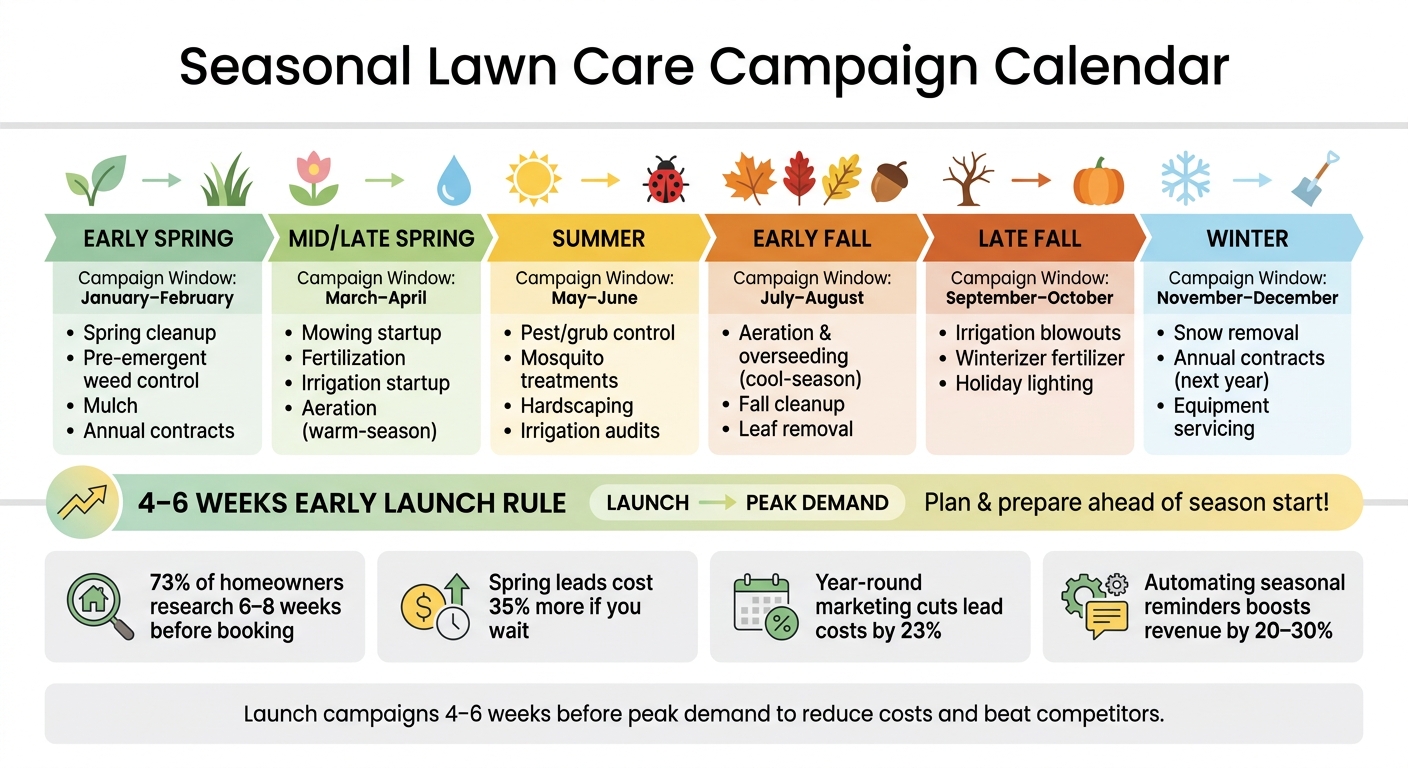
Seasonal Lawn Care Campaign Calendar: When to Market Every Service
Seasonal Lawn Care Services by Time of Year
Planning your lawn care campaigns around seasonal needs ensures you're reaching customers at the right time - before demand surges. Homeowners' needs change with the seasons, and starting your campaigns 4–6 weeks ahead of peak search activity puts your business front and center when they're ready to book.
Here’s a breakdown of services to promote and when to promote them:
| Season | Primary Services to Promote | Campaign Window |
|---|---|---|
| Early Spring | Spring cleanup, pre-emergent weed control, mulch, annual contracts | January – February |
| Mid/Late Spring | Mowing startup, fertilization, irrigation startup, aeration (warm-season) | March – April |
| Summer | Pest/grub control, mosquito treatments, hardscaping, irrigation audits | May – June |
| Early Fall | Aeration & overseeding (cool-season), fall cleanup, leaf removal | July – August |
| Late Fall | Irrigation blowouts, winterizer fertilizer, holiday lighting | September – October |
| Winter | Snow removal, 2027 annual contracts, equipment servicing | November – December |
Timing is everything. For instance, pre-emergent herbicide should be applied when the soil temperature reaches 50–55°F for three consecutive days. You can measure this with a soil thermometer, check a regional temperature map, or even rely on forsythia blooms as a natural indicator.
How to Map Out Your Seasonal Marketing Calendar
Think ahead to the decisions your customers will soon face. Instead of reacting to demand, anticipate it.
"The ones drowning every June and starving every January are running the same ads, posting the same content, and sending the same emails all twelve months." - Tinylawn
For example, offer an early-bird discount of 10–15% on spring cleanups in January and February. This strategy not only fills your schedule before the March rush but also helps you avoid higher ad costs later in the season. Similarly, use July and August - typically slower months - to pre-book fall cleanups and begin holiday lighting consultations. Automating these seasonal reminders can boost seasonal revenue by 20–30%.
Your calendar should align with your business model too. Maintenance-heavy operations should prioritize renewing routes in February and March. If your focus is on design and installation, use the winter months to schedule consultations so you're ready to start projects as soon as the ground thaws.
Adjusting Your Calendar for Regional Differences
A national calendar might not cut it - regional weather patterns and service needs can vary widely. For example, spring in Florida or Arizona might kick off in late January, while in Chicago or Minneapolis, it may not start until late February or early March.
"National lawn-care advice fails almost everyone. 'Fertilize in spring' is useless when spring starts in February in Phoenix, April in Chicago, and late May in Bismarck." - LawnBySeason
Grass type also plays a big role. Cool-season grasses like Kentucky Bluegrass and Fescue thrive in spring and fall, making September the prime time for aeration and overseeding. On the other hand, warm-season grasses like Bermuda and Zoysia grow best in summer, with aeration ideally scheduled between late April and June once the lawn is fully green. In transition zones like North Carolina and Tennessee, you might need to help homeowners identify their grass type before recommending specific services.
For northern states with shorter mowing seasons - sometimes as brief as 24 weeks - offering services like snow removal and holiday lighting can ensure steady revenue throughout the year.
How to Target the Right Customers with Seasonal Messaging
To get the most out of your seasonal campaigns, it's all about reaching the right people with messages that resonate. Once you've built your seasonal calendar, the next step is targeting your audience with tailored messaging.
How to Segment Your Customer Base
Start by breaking your customer list into clear groups. Consider categories like recurring mowing clients, treatment-only customers, seasonal cleanup bookers, and those lapsed leads who browsed but never converted. Beyond the type of service, think about timing. Some homeowners are early planners - the type who start researching lawn care in January or February - while others are last-minute buyers who wait until their lawn shows signs of trouble in April.
"A mowing-only customer needs a different message than one booking additional services." - EZ Lawn Biller
Don’t forget about commercial clients like property managers or HOAs. These groups often plan their budgets early in the year, so reaching out in Q1 can help secure their business.
Once you've defined these customer groups, focus on crafting messages that speak directly to their specific needs and timing.
Writing Seasonal Messages That Connect
Your messages should go beyond promoting services - they should address the challenges homeowners face during each season. For instance:
- Spring: Focus on recovery from winter damage and tackling overgrown weeds.
- Summer: Highlight solutions for heat stress and pest issues.
- Fall: Emphasize leaf removal and preparing the lawn for winter.
"Seasonal lawn care marketing works when the message matches the work. Spring should sell recovery and renewal, summer should support maintenance, fall should focus on preparation." - EZ Lawn Biller
Timing is everything. A whopping 73% of homeowners start researching landscaping projects 6–8 weeks before they want the work done. This means you need to engage them early, before they commit elsewhere. For example, sending out a spring fertilization offer in mid-April might be too late, as competitors could already be booked up by then.
Instead of pushing a hard sell, lead with helpful advice. For instance, rather than saying, "Book your fall aeration now", explain why fall is the best time for grass renovation and overseeding and the potential downsides of skipping leaf removal. This positions your business as a knowledgeable partner rather than just another service provider.
Using Personalization to Improve Campaign Results
Mass emails won’t cut it. Customers respond better to messages that feel personal and relevant to their needs. For example:
- A mowing client who hasn’t tried a treatment plan could be a great candidate for a fertilization upsell.
- A customer who booked a fall cleanup last year might just need a friendly reminder to re-book.
Using a tool like Estatehub’s CRM can make personalization easier. It tracks service history, property details, and past interactions, allowing you to tailor your outreach. Instead of sending a generic email about spring aeration, you can target mowing clients who haven’t added treatment services yet. Automated, seasonally timed follow-ups ensure your messages hit the right people at the right time.
How to Build and Run Seasonal Campaigns
Seasonal campaigns thrive on precise timing and targeted messaging. Once you've nailed down your seasonal focus, the next step is crafting offers that prompt immediate action.
How to Design Seasonal Offers
The best seasonal offers align with specific timeframes, creating urgency and relevance. For instance, services like pre-emergent weed control or preventative grub control have short windows of effectiveness. This naturally pushes customers to act quickly, knowing they'll otherwise have to wait an entire year.
Bundling related services simplifies decision-making for customers while increasing the value of each job. A great example is a Spring Clean-Up package that includes dethatching, aeration, fertilization, and weed control. Similarly, a fall package with leaf removal, overseeding, and winterization can be just as appealing. Tiered pricing further encourages customers to choose higher-value bundles without overwhelming them.
Early-bird discounts are another proven strategy. Offering 10–15% off for customers who book and prepay for spring services in February not only locks in revenue but also reduces last-minute cancellations. Prepayment builds commitment, ensuring your schedule stays intact when the busy season rolls around.
"Urgency does not mean yelling. It means giving homeowners a reason to act now instead of later." - fernflo
Once your offers are ready, the next step is getting them in front of the right audience at the right time.
Choosing the Right Channels for Seasonal Campaigns
The effectiveness of your campaign often comes down to using the right channels at the right moment. For example, Google Search Ads and Local Services Ads (LSAs) - especially those with the Google Guaranteed badge - are perfect for capturing demand when homeowners are actively searching. While leads from these channels typically cost $15 to $50 each, they deliver high-intent customers.
Meta platforms like Facebook and Instagram are ideal for building awareness before the peak season hits. Eye-catching content, such as before-and-after photos or short videos, tends to generate about 40% more engagement than text-heavy ads. These platforms are great for warming up potential customers in late winter, so your business is top of mind when they’re ready to book.
Hyperlocal strategies like door hangers and direct mail can also work wonders. Target neighborhoods where you've recently completed jobs to build route density and establish a strong local presence.
"If your marketing arrives when they're already searching, you're paying peak-season prices... If your marketing arrives four to six weeks earlier, you're the first name they remember." - Tinylawn
After selecting your channels, automation becomes essential for keeping your campaigns running smoothly during the busiest times.
How to Automate Your Seasonal Campaigns
During peak season, handling everything manually can be overwhelming. Automation helps by taking over repetitive tasks like follow-up emails, appointment reminders, and review requests, freeing up your team to focus on the actual work.
Responding to leads quickly is crucial. Studies show that 78% of customers hire the first contractor who gets back to them. Setting up an automated text message that fires within seconds of a form submission ensures your leads stay engaged, even when your team is swamped. Tools like Estatehub’s CRM can automate lead routing, so no inquiry slips through the cracks during hectic weeks.
Automated review requests are another powerful tool. Sending an SMS review link within two hours of completing a job can yield a 42% response rate, compared to just 6% if you wait two days. Consistently collecting reviews this way not only builds your reputation but also boosts your local search rankings as you prepare for the next season.
How to Measure and Improve Your Seasonal Campaigns
Launching seasonal campaigns is just the first step - tracking their performance is what really drives growth. Without measuring results, you’re essentially taking shots in the dark. Regularly evaluating your campaigns helps you avoid past mistakes and uncover what’s working.
Key Metrics to Track for Seasonal Campaigns
When it comes to seasonal campaigns, some metrics are absolutely essential. Focus on Cost Per Lead (CPL), close rate by channel, average ticket size, and customer retention rate. For example, you can calculate CPL by dividing your total marketing spend by the number of leads generated, breaking it down by channel to see which ones perform best. Close rates for recurring services often land between 30% and 45%.
Two often overlooked metrics are Customer Lifetime Value (LTV) and route density. Recurring clients, such as those signed up for maintenance services, can bring 8x more value over five years compared to one-time project clients. This means your customer acquisition cost goes much further with recurring customers. Route density - how geographically close your customers are to each other - also plays a big role in improving profitability. Less travel time means lower fuel costs, which is especially helpful during slower seasons.
How to Review Seasonal Campaign Performance
Reviewing your campaign’s performance isn’t just about knowing what worked - it’s about understanding why it worked. Compare results across different seasons and analyze factors like timing, offer structure, and target audience. For instance, if your spring aeration campaign performed better this year than last, take a closer look. Did you launch earlier? Change the offer? Target a different area? These details matter.
"Seasonal marketing should be reviewed like any other part of the business. If you do not measure what happened, you will keep repeating campaigns that only feel successful." - EZ Lawn Biller
Tools like call tracking can help tie specific keywords or mailers to actual jobs, not just leads. Pair this with UTM tags on digital ads to trace revenue back to its source. Also, keep an eye on your search terms report in Google Ads. By pausing low-intent keywords, you can shift your budget toward terms that are proven to convert. These insights provide a solid foundation for refining future campaigns.
Using Past Data to Plan Future Campaigns
Your historical data is a goldmine for planning upcoming campaigns. With 73% of homeowners starting their project research 6–8 weeks in advance, timing is everything. For example, if your spring cleanup campaign sold out by mid-March, consider launching early-bird offers in February. This is especially important since spring leads can cost 35% more than winter leads.
Past data also helps with budgeting. A smart move is to boost your Google Ads budget by 50–80% during the March–May surge to capture the seasonal spike in search volume. Then, as demand shifts, pivot to more specific keywords like "patio installation" in May and June. Businesses that market consistently throughout the year spend 23% less per lead, and those savings add up over time.
Conclusion: Building a Lawn Care Business with Seasonal Marketing
Seasonal marketing is all about timing and consistency. The companies that keep their schedules packed year-round aren’t necessarily spending more - they’re simply better at planning and executing their campaigns.
"The landscaping companies that stay booked year-round don't work harder on marketing than anyone else. They just time it right." - gettinylawn.com
As outlined earlier, smart seasonal planning can turn unpredictable demand into steady business growth. By planning ahead, segmenting your audience, crafting tailored messages, and tracking results, you can stay ahead of the competition. Starting campaigns 4–6 weeks in advance is especially important - spring leads, for example, can cost 35% more if you wait too long to act.
Running a seasonal marketing strategy consistently over several years pays off in big ways. It builds brand recognition, reduces customer acquisition costs, and helps smooth out revenue throughout the year. In fact, companies that market consistently, rather than only during peak seasons, spend 23% less per lead. That’s why top landscaping businesses don’t just think about seasons - they focus on maintaining a steady pipeline.
With a well-timed, consistent approach, your lawn care business can achieve lower costs and a fully booked schedule. Ready to take the next step? Partner with Estatehub to get started.
FAQs
How do I know the right time to start each seasonal campaign in my area?
Start your seasonal campaigns 4–6 weeks before customers typically begin their search. This approach helps you avoid the peak demand period when competition - and costs - skyrocket. For spring campaigns, February is often the sweet spot, as homeowners start planning and budgeting during this time.
Instead of sticking to fixed dates, align your campaigns with local weather patterns. Pay attention to temperature changes and forecasts. For example, timing your ads just before grass growth in spring or leaf fall in autumn can give you an edge. Estatehub specializes in crafting strategies that make the most of these weather-driven insights.
What’s the easiest way to segment my lawn care customers for seasonal messaging?
The easiest way to group your lawn care customers is by focusing on service type, recency, and acquisition source:
- Service type: Tailor your offers to fit recurring customers or those who only need one-time services.
- Recency: Reach out to recent customers with follow-ups or re-engage those who haven’t used your service in a while.
- Acquisition source: Customize your messaging and value propositions based on how customers discovered your business.
With Estatehub’s CRM tools, you can easily manage these segments and build campaigns that speak directly to each group.
Which numbers should I track to prove my seasonal marketing is working?
To gauge how well your seasonal campaigns are performing, focus on metrics like cost per lead, conversion rates, and cost per booked job. Dive into the revenue generated by different job types to pinpoint which services bring in the most profit. Keep an eye on the search terms triggering your ads and assess how performance varies by time of day to find the best windows for quality leads. Implement call tracking to connect specific keywords directly to booked clients. Estatehub leverages these data points to help home service providers refine their strategies and drive revenue growth.
Related Blog Posts

Sign up for the newsletter and be the first to read our articles.