

Overview of Common Stains
Full overview of the most common stains, including how to identify them and treat them
If your message sounds like every other contractor, homeowners will compare your quote on price. I’d fix that by building a clear value proposition: say who you help, what problem you solve, what result you deliver, and why your company is the better fit.
Here’s the short version:
A clear message can filter out price-only shoppers before they call. For example, saying “2-hour arrival windows” is much stronger than saying “prompt service.” And a line like “upfront fixed pricing” answers a common fear right away.
In short: if I want better leads, fewer price fights, and a smoother sales process, I need a message that is specific, easy to prove, and easy to repeat across every customer touchpoint.
What follows is a simple five-step way to do that.
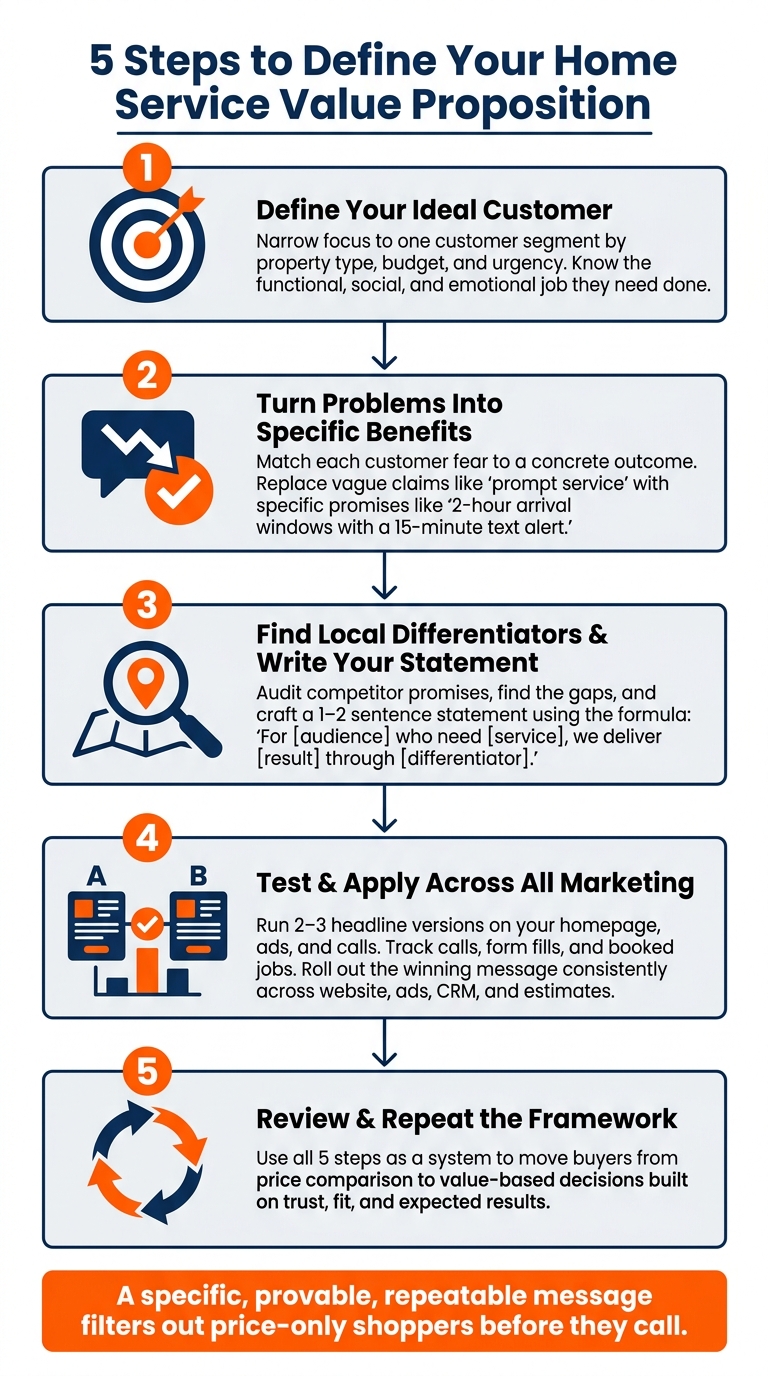
5 Steps to Define Your Home Service Value Proposition
Most home service businesses lose leads because they try to talk to everyone. That usually waters down the message. A better move is to start with one customer segment and one job you want to win. Then get clear on the exact result that person is hiring you for.
Three simple filters can narrow your focus fast: property type, budget range, and urgency level.
A plumber speaking to single-family homeowners who need emergency leak repair is talking to a very different person than a plumber targeting rental property owners who need routine upkeep across several units.
| Customer Segment | Core Need | Budget / Urgency |
|---|---|---|
| Single-family homeowner | Protect property value; peace of mind | High urgency (leaks, outages) or planned maintenance/improvements |
| Rental property owner | Minimize tenant complaints; protect asset | High urgency; price-sensitive |
| Commercial property manager | Minimize downtime; stay compliant | Higher budget; reliability-focused |
Budget matters too. A $5,000 kitchen refacing project calls for different messaging than a full custom remodel.
Once you narrow the audience, the next step is to name the outcome that audience wants most.
Customers don’t hire services. They hire outcomes.
A homeowner with a leaking roof isn’t looking for “roof repair” in the abstract. They want peace of mind before the next storm hits.
It helps to define the job in three parts:
When you understand all three, your value proposition stops reading like a service menu and starts sounding like a fix for a pressing problem. Once you know the customer and the job, Step 2 turns those needs into specific benefits.
Once you know who your customer is and the job they’re hiring you to do, the next step is simple: turn their frustrations into outcomes they can picture. Start with the fear behind the call. Then connect that fear to a clear result.
A service call is almost never just about the job itself. A homeowner calling an HVAC technician isn’t only dealing with a broken unit. They may be worried about sitting at home all day, getting blindsided by extra charges, or having someone track dirt through the house. Each fear points to a benefit you can state in plain terms.
| Common Pain Point | Desired Outcome | Specific Benefit Statement |
|---|---|---|
| Late arrivals / Waiting all day | Respect for the customer's time | "2-hour arrival windows with a text when we're 15 minutes away" |
| Surprise charges / Hidden fees | Financial certainty | "Upfront, flat-rate pricing - the price we quote is the quoted price" |
| Fear of poor workmanship | Peace of mind / Reliability | "Fixed right the first time, or labor is covered for one year." |
| Messy job sites | Property protection | "We use floor protectors and clean up so well you won't know we were there." |
| Slow emergency response | Immediate relief | "24/7 emergency response within 60 minutes" |
| Confusing technical jargon | Clarity and control | "Plain-English explanations with photo updates during the job" |
That’s the pattern to use in your own copy. Each benefit statement gives you a practical piece of your value proposition.
Vague claims don’t land. “Prompt service” is easy to ignore. “Same-day service when booked by 2:00 p.m.” gives people something solid to hold onto.
The same goes for the rest of your messaging:
Small changes like this make your promise feel concrete instead of fuzzy.
Here’s a simple gut check: show your benefit statement to someone outside your business for five seconds. Then ask what you do and why it matters. If they can’t answer right away, the wording needs to be simpler.
Next, compare these benefits with what local competitors are saying, then turn your strongest one into a one- to two-sentence statement.
At this stage, you’re turning a list of benefits into one claim local competitors can’t copy with a few lazy edits.
Start with local competitor websites, Google Business Profiles, and ads. Write down the promises they make. In most markets, you’ll see the same language over and over: “quality work,” “licensed and insured,” “great customer service,” and “fair prices.”
The problem? Those claims don’t help much. They’re baseline expectations. Customers assume them. Nobody picks a company just because it says it does “quality work.”
Your differentiator sits in the gap between what everybody says and what you do every day that nobody else is talking about.
A smart move here is to read competitor Google reviews and look for repeat complaints. That’s where things get interesting. If people keep mentioning late arrivals, surprise charges, poor communication, or messy cleanup, you’ve found an opening. Focus on claims nearby competitors can’t honestly make and that plainly save the customer time, money, or stress.
| Competitor Promise | What You Can Honestly Claim | Why It's a Differentiator |
|---|---|---|
| "Quality workmanship" | Before/after photos of every job + 2-year workmanship warranty | Tangible proof, not just a claim |
| "Fair prices" | Upfront, fixed pricing with good-better-best options provided before work starts | Removes financial uncertainty |
| "Fast response" | Emergency arrival within 60 minutes or the service call is free | Specific, measurable, and accountable |
| "Professional technicians" | Technicians specialized in pre-1940s homes with 200+ hours of annual training | Solves a real specialization need |
Once you see where local competitors stay vague, pick the one gap you can prove better than anyone nearby.
Once you’ve nailed down your differentiator, the statement gets much easier to write. Use this formula as a starting point:
"For [audience] who need [service], we deliver [result] through [differentiator]."
Here’s an example for a plumbing company serving dual-income households: "For busy homeowners who need plumbing repairs and cannot wait all day, we offer a guaranteed 2-hour arrival window and upfront fixed pricing."
That works because it’s specific, believable, and easy to use on a homepage or in a sales call. Skip lines like “best quality” or “lowest price.” They’re vague, hard to prove, and easy for people to tune out.
A simple gut check helps here: read the statement out loud to someone outside your business. If they can repeat the point back in plain English, you’re in good shape. Then put it to work on your website, in ads, and in sales calls.
Writing a strong value proposition is only half the job. The other half is proving it brings in better-fit leads and then using it across your marketing. Once you’ve written the statement, put it in front of real prospects before you roll it out everywhere.
Test 2–3 headline or benefit-angle versions on your homepage, ads, calls, and estimates. Then watch what happens with calls, form fills, and booked jobs.
A five-second test can help here too. Show the message to someone who doesn’t know your business and see if they can explain what you do, who you serve, and why you stand out. If they can’t, the message probably needs work.
Price comparison is another clue. If prospects still keep coming back to price, your value proposition may be too vague or too far removed from what they care about. The goal isn’t more traffic. It’s better-fit leads.
When one version starts to win, use it across every customer touchpoint. Don’t let your website say one thing while your ads, calls, and follow-up say another.
Keep the same core promise across your:
That kind of consistency makes your business easier to understand. And when people understand you fast, they’re more likely to trust what you’re offering.
Put together, these five steps turn fuzzy service claims into a value proposition people can grasp fast.
Steps 1–2 pin down who you serve and what result they want. Steps 3–4 take that insight and shape it into a message that stands apart, then put that message to work across your marketing.
That changes the sales conversation. Instead of getting pulled into a race on price, you move buyers toward value. They start comparing based on trust, fit, and the result they expect, not just the dollar amount.
Used as a system, the five steps help you build a clear promise you can repeat across your site, sales calls, emails, and other marketing.
Start by researching your market and your current customer base. The goal is to find specific, trackable niches with unmet needs. Focus on segments where your services can produce a strong return on investment.
Then pick a segment based on a few simple factors:
Be specific. When you narrow your focus, ideal clients feel understood. And the people who aren’t a fit can quickly see that too.
A value proposition works when people can believe it.
That means cutting the vague marketing talk and showing proof. Instead of broad promises, explain the problem you solve and back it up with clear results people can picture and measure.
Trust comes from specifics like:
Those details help turn a claim into something that feels solid and easy to trust.
Test your message until price objections start to lose steam. Skip the fixed timeline. Build 5 to 10 versions and put them in front of real customers, prospects, and your team.
Then use simple checks to see if the message lands. The 5-second test can tell you if people grasp it fast. A differentiation test can show whether your message feels clear, relevant, and different from the other options out there.
Sign up for the newsletter and be the first to read our articles.


Every single person on our agency team has spent a lot of time in the field either running their own business or working for larger marketing agencies. We have all put in the time responding to leads, helping customers, scheduling and doing services. This gives us a massive advantage when making decisions.
One thing that has always been very special to us, is the fact that (excluding spam / people that never used our services) we do not have any bad reviews. This absolutely does not mean we have never had unhappy clients, but if it happens, we make it right, and stand behind our promises.
We have seen, time and time again, other agencies using strategies and structuring campaigns the way that they are technically supposed to. Most of these "best practices" that are taught in our industry, simply do not transfer into local lead gen. This is partially because we do have a much different target audience, and are typically spending less, however optimizing for website traffic does not work here.
We have been there, jumping into starting a home service business, struggling, and doing everything wrong. It's humbling. Our team has all felt the highs and lows, which is why we get so excited for our clients to win, we know how good it feels.

Estatehub is not a normal agency, we know "clicks" don't get you sales. Let us show you how lead gen experts do it.

