


Overview of Common Stains
Full overview of the most common stains, including how to identify them and treat them
Managing your online reputation is critical for businesses, especially in competitive industries like home services. With 93% of consumers influenced by online reviews, reputation management software helps streamline feedback across platforms like Google, Yelp, and Facebook. These tools save time, automate review requests, and improve customer engagement. Below, we break down user feedback on seven platforms - Revuze, Sprinklr, Birdeye, Reputation.com, Yext, Podium, and Meltwater - highlighting their features, pricing, and best use cases.
| Platform | Strengths | Weaknesses | Best For | Pricing (Approx.) |
|---|---|---|---|---|
| Revuze | Sentiment analysis, insights | Expensive, limited industries | Product-focused companies | Custom (No free trial) |
| Sprinklr | Customization, global reach | High cost, complex interface | Large enterprises | $199+/seat/month |
| Birdeye | AI tools, review management | Costly, contract terms | Multi-location businesses | $299–$499/month |
| Reputation.com | Centralized dashboard, AI tools | Technical bugs, high pricing | Large enterprises | Custom |
| Yext | Business listings management | Cancellation issues | SEO-focused brands | $199–$999/year |
| Podium | SMS-first design, ease of use | Premium pricing | Local service businesses | $249–$599+/month |
| Meltwater | Media monitoring, PR tools | Irrelevant results, high cost | PR agencies, large enterprises | $6,000–$25,000/year |
Choosing the right platform depends on your business size, industry, and budget. Smaller teams might benefit from tools like Podium or Birdeye, while enterprises should consider Reputation.com or Sprinklr for more advanced needs.

Reputation Management Software Comparison: Features, Pricing & Best Use Cases
Revuze boasts an impressive 9.6 out of 10 rating on TrustRadius, with a "Likelihood to Recommend" score of 9.7 out of 10. These high marks reflect strong user satisfaction. Many users praise its ability to organize customer feedback effectively and provide meaningful insights. However, its primary focus lies in analyzing product experience data.
One of Revuze's standout tools is its AI-powered sentiment analysis, which pinpoints positive and negative feedback from unstructured reviews. The platform also categorizes customer comments by themes, making it easier to identify emerging patterns. Another feature users value is its ability to integrate data from multiple sources - like websites, surveys, and social media - into a single, unified dashboard.
Fernando Calderon, Senior Software Engineer, shares, "This platform is of great help for any type of company regardless of its size and number of products or services (similar to our other projects)... we recommend it for the effectiveness of its mission".
That said, some users have noted drawbacks, such as its limited applicability across industries and a user interface that could use improvement. Advanced customization options may also require additional onboarding support.
Revuze doesn’t disclose its pricing publicly, but users report that it can be expensive for smaller businesses. There’s no free trial or freemium version, which makes it harder for potential users to evaluate the platform before committing. This pricing model aligns more with companies that already have an established market presence.
Revuze is best suited for product-focused companies looking to monitor customer sentiment and track market trends. Teams in development, marketing, and product management can use it to assess profitability and stay ahead of industry shifts.
Sprinklr has earned solid user ratings across multiple platforms, reflecting its ability to handle the challenge of monitoring diverse review sites. It scores 4.0/5 on G2 (with over 975 reviews), 4.2/5 on Capterra, 8.7/10 on TrustRadius, and 4.0/5 on Gartner Peer Insights. Additionally, it boasts a 94% renewal rate, with 81% of PeerSpot users recommending it.
Users often highlight the platform's extensive customization options and dedicated support teams. However, some reviewers express concerns about its premium pricing, complex interface, and lengthy implementation process. As one Gartner Peer Insights reviewer noted:
"There is no other platform that has the level of customization that Sprinklr has, and we've vetted all of their major competitors".
Sprinklr offers a powerful suite of tools that combine social media management, customer service, marketing, and advertising. It supports interactions across 30+ social channels, 10 messaging apps, and monitors over 500 review sites. Its AI engine, featuring over 1,250 models in 100+ languages, provides sentiment analysis, intent categorization, and predictive analytics. Impressively, its Ratings & Reviews solution claims to reduce negative sentiment by 73%.
Virginia O., a Sales Marketing professional in Finance, shared her experience:
"Sprinklr is successfully able to collect and moderate data from over fifteen social platforms in real time... This makes Sprinklr effective for identifying social trends".
Other standout features include automated routing for case management, custom rule engines, and robust security measures like SOC 2 Type II, GDPR, and HIPAA readiness. Leonid Mironov, Senior Manager at Majid Al Futtaim, highlighted:
"The most valuable features are case management and reporting. The Unified-CXM Platform also helps in data aggregation and offers the capability to export data in different formats".
Sprinklr is tailored for enterprise-level organizations, with pricing starting at $199 per seat per month. Custom enterprise solutions require a minimum annual commitment of $35,000 to $50,000. Implementation typically takes 3–6 months, and there is no free trial or freemium version. For many mid-sized organizations, the high cost is a notable drawback.
Sprinklr is best suited for Fortune 500 companies, large enterprises, and industries with strict regulations. It excels in managing social media efforts, crisis management with Smart Alerts, and coordinating across multiple brands. Next, we’ll dive into Birdeye to see how it measures up in meeting user needs.
Birdeye has built a strong reputation across various review platforms. It boasts a 4.7/5 rating on G2 (from over 3,869 reviews), a 9.0/10 on TrustRadius (based on 179+ verified reviews), and a 4.3/5 on Gartner Peer Insights. Additionally, it holds a 97% user satisfaction score, with 95% of G2 users recommending the platform.
Users frequently highlight its easy-to-use interface, automated review requests, and effective onboarding process. However, some common criticisms include the requirement for a 90-day cancellation notice to avoid auto-renewals and its steep pricing, which can be challenging for smaller businesses.
"Birdeye is very user-friendly and simple to navigate, even for first-time users. The platform makes it easy to request and manage reviews in one place." – Alison, Verified User
Birdeye consolidates over 200 review sites - such as Google, Facebook, Yelp, Healthgrades, and TripAdvisor - into a single dashboard. Its BirdAI agents help automate review generation and craft responses using sentiment analysis. Businesses can send review requests through multiple channels, including SMS, email, and QR codes. On average, companies using Birdeye see a 128% increase in reviews within the first 90 days and a 71% response rate for reviews.
The platform integrates seamlessly with over 3,000 third-party applications, including Salesforce, HubSpot, ServiceTitan, Epic, and Cerner. This enables businesses to automatically trigger review requests right after customer interactions. Brandon Dowdy-Ernst, Chief Experience Officer at Smile Workshop, shared:
"With Birdeye, we've increased our number of reviews by nearly 200% YoY, which has greatly contributed to brand lift and recall."
One standout example is Complete Care, a healthcare provider that achieved a staggering 3,653% increase in reviews. They collected 29,650 reviews with an impressive 4.8-star average and maintained a 50% email open rate for review requests. Additionally, Birdeye supports local SEO by managing business listings across 50+ directories, ensuring consistency in Name, Address, and Phone (NAP) information.
Birdeye offers three main pricing tiers:
Optional add-ons are available, such as Referrals ($100/month), Mass Texting ($100/month), Google Seller Ratings ($150/month), Surveys ($100/month), Insights ($50/month), and Benchmarking ($50/month). The platform typically requires a 12-month contract, with a 90-day written notice for cancellation, and offers a 15-day free trial for new users. These pricing options make Birdeye particularly appealing for businesses with multiple locations.
Birdeye is best suited for multi-location businesses (5–50+ locations) in service-driven industries like healthcare, automotive, real estate, and retail. Its HIPAA-compliant features are especially beneficial for medical and dental practices. The hierarchical dashboard allows corporate offices to maintain a unified brand image while empowering local managers to engage directly with their communities. However, users recommend carefully reviewing contract terms and monitoring AI-generated responses to ensure they align with the brand's voice.
Up next, we’ll explore how Reputation.com approaches reputation management for enterprise-level businesses.
Reputation.com receives mixed feedback across different platforms. It boasts a 4.5/5 rating on G2 and 4.4/5 on Capterra but falls to 2.6/5 on Trustpilot (based on 94 reviews) and 7.0/10 on TrustRadius. On SaaSworthy, it averages 3.5/5 from 109 ratings, with 56.9% of users rating it "Excellent" and 36.7% labeling it "Terrible".
Users praise the platform's centralized dashboard for consolidating reviews, social media, and business listings, as well as its responsive account managers. However, frequent complaints highlight its high pricing, occasional data syncing issues, and the complexity of advanced features.
"Reputation does what I need it to do in the property management industry. Responding to reviews is so quick and easy. I like that all reviews come into one dashboard, and the prefilled responses make it so quick." – Alyssa, Property Management Professional
Reputation.com streamlines customer feedback monitoring from hundreds of third-party sites into a single dashboard. Its "Reputation X" score serves as a measure of overall brand health. Using Natural Language Processing (NLP), the platform categorizes feedback as positive, negative, or neutral.
The Review Booster tool has proven effective in increasing review volume. For instance, Kurt Kleindienst shared that after seven years with Reputation.com, his organization saw a tenfold increase in reviews and a 500% improvement in their Reputation X Score. Similarly, Jennifer Ksobiech noted a record number of reviews in a single month after adopting its review request and response features.
The platform also offers a Social Suite for scheduling posts and monitoring social media activity. However, its social listening capabilities lag behind specialized tools. For multi-location brands, the "Actions" tab is particularly useful for tracking how individual properties handle reviews, ensuring consistent brand management.
Reputation.com uses a quotation-based pricing model, tailoring packages to each business's needs. Pricing details are not publicly available, and there is no free trial. While some sources suggest no setup fees, the implementation process can be lengthy and complex.
This pricing model makes the platform relatively expensive, often out of reach for small businesses or startups with limited budgets. It primarily targets large enterprises and multi-location brands needing to centralize feedback across numerous sources.
Reputation.com is ideal for large, multi-location enterprises in industries such as hospitality, healthcare, automotive, retail, and property management. Its robust monitoring tools and dedicated support are particularly beneficial for regulated industries like home services. Randy Underhill, a Regional Marketing Director, shared:
"Reputation.com has proven to be an asset to my company... As a Regional Marketing Director in Property Management, it has saved me and my teams onsite so much time to improve social media scores."
The platform is designed for organizations with around 500–1,000 employees, emphasizing its focus on large-scale operations. Small businesses should carefully weigh whether the platform's cost aligns with their needs and resources.
Next, explore how Yext leverages business listings and local search optimization for reputation management.
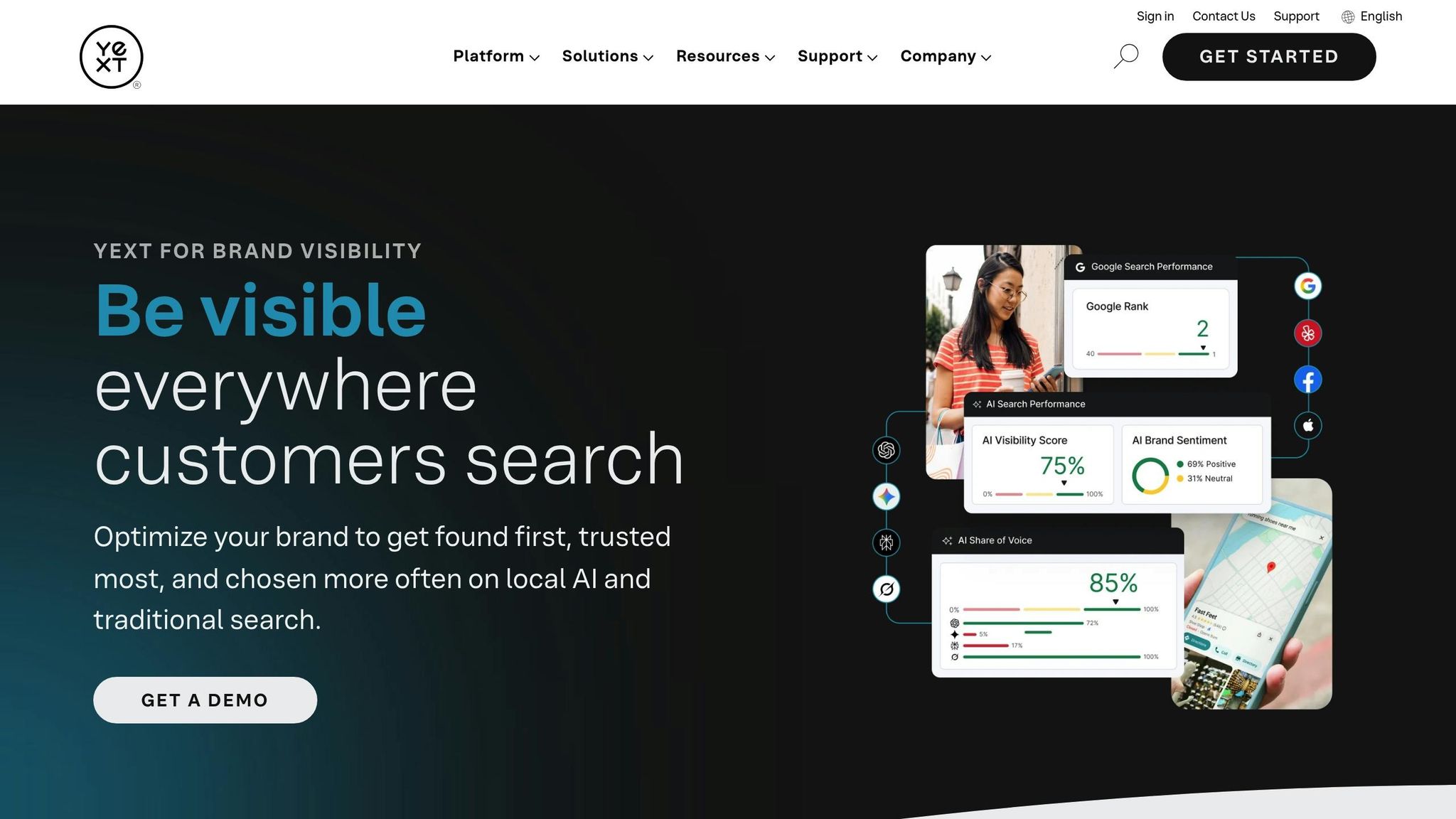
Yext has received mixed reviews across various platforms. It scores 8.9/10 on TrustRadius, 4.4/5 on G2 (444 reviews), 3.9/5 on Gartner Peer Insights (22 ratings), and 4.3/5 on Capterra (112 reviews). However, it fares poorly on Trustpilot, with a rating of 1.7/5 based on 341 reviews.
The most common criticism revolves around its listing practices. Users report that canceling a subscription can result in listings reverting to incorrect data or losing their "Owner Verified" status. Customer support also appears inconsistent - enterprise users often commend the dedicated account managers, while smaller businesses mention slow response times and frequent turnover among support representatives. These diverse experiences provide insight into how Yext's features are perceived by different user groups.
Yext’s standout tool is its Knowledge Graph, which serves as a centralized hub for managing business information. This tool allows users to update details like business hours, photos, and NAP (Name, Address, Phone) data across more than 200 platforms from one dashboard.
"Yext is an irreplaceable tool for accomplishing this. Specifically the photo upload and business hours edit functions: update it in one portal, hit publish, and those hours or those photos are hitting dozens of websites at once".
The platform also excels in review management, monitoring feedback from over 80 sites such as Google, Yelp, and Facebook. Its Natural Language Processing capabilities help identify sentiment trends, while the AI Response tool generates tailored replies, reportedly increasing 5-star reviews by 374% and cutting response times by 57%. Additional tools include Duplicate Suppression, which removes inconsistent listings, and automated review generation via email, SMS, or QR codes.
Yext uses a tiered annual subscription model tailored to enterprises. Here's a breakdown:
Custom pricing is available for enterprises, depending on the number of locations and required features. While Yext is praised for its value in managing large-scale operations, smaller businesses often find the cost hard to justify. As Frank Olivo, Founder of Sagapixel, explains:
"For a local business with just a few locations that aren't going to be moving any time soon, Yext makes very little sense. However, a large company like McDonald's... it makes sense".
There’s no free trial, and some users have expressed concerns about transparency regarding optional add-on costs.
Yext shines in scenarios where multi-location management is critical, particularly for industries like hospitality, healthcare, banking, retail chains, property management, and home service providers. Users report significant results, such as 30% higher conversion rates and 45% revenue growth after adopting Yext’s tools.
For small businesses with fewer than five locations, the subscription cost might outweigh the benefits of automating listing updates. As Colan Nielsen points out:
"The only time I have seen Yext provide value is for enterprise multi-location listing management. In other words, if you are managing 100's or 1000's of locations".
Podium has earned ratings of 4.4/5 on Gartner Peer Insights (20 ratings), 3.9/5 on Trustpilot (193 reviews), and 4.3/5 on Software Advice (522 reviews). The platform supports over 60,000 businesses, with 74% of its reviewers representing small businesses with 2 to 50 employees.
Users often praise Podium's SMS-based review collection system. However, some have raised concerns about long wait times for support, unresolved technical issues, and challenges in reaching human representatives. There are also reports of aggressive sales tactics and difficulties in canceling annual contracts.
Podium's SMS review invitation system allows businesses to send one-click Google review requests. One user shared that their rating improved from 3 to 4.5 stars across 250 franchise locations over six years. Another example is Radnet West, which saw a 34% increase in reviews requested via Webchat and reached 75,000 Google reviews within five months.
The platform includes a unified inbox that consolidates messages from SMS, Google, Facebook, Instagram, and Webchat. Alex A., in a verified G2 review, highlighted its convenience:
"Podium makes it very easy to communicate with customers and have other employees keep track of the conversation".
Podium also features an AI Reputation Specialist that suggests responses and automates replies, helping businesses maintain engagement.
Other tools include:
These features are available through various pricing tiers tailored to different business needs.
Podium uses a custom tiered pricing structure. Reports suggest that the Core/Essentials Plan starts at approximately $249–$399 per month, covering up to 3 users and 1,000 contacts with basic messaging and review collection features. The Standard/Pro Plan, priced around $409–$599 per month, adds advanced automations, AI tools, and text marketing capabilities. For larger teams with multi-location operations and advanced branding needs, the Professional/Signature Plan begins at $599+ per month.
Some users have expressed concerns about pricing transparency and unexpected add-on charges. Marina P., an Automotive Digital & Communications Director, shared:
"Podium is still our best contributor to getting public reviews online... [but] it feels like Amazon Prime (where you start paying for things you don't need nor want)".
A 14-day free trial is available for new users.
Podium is ideal for local service businesses that rely heavily on Google reviews and manage high volumes of mobile inquiries. This includes industries like automotive dealerships, HVAC services, medical practices, and retail shops through lead generation marketing. Jared Hardy, manager at Southwest Auto Recycling Inc., reported that within a year, the business significantly boosted positive Google and Facebook reviews while eliminating fraudulent credit card chargebacks.
For businesses seeking a comprehensive solution - including integrated payments, VoIP phones, and AI-powered lead conversion - Podium offers strong value. However, smaller teams requiring only basic review tools may find the premium pricing challenging, especially given the reported inconsistencies in customer support.
Meltwater has received a 4.0/5 rating on G2 (based on over 2,130 reviews), 4.0/5 on Capterra (90+ reviews), and 6.9/10 on TrustRadius (165+ reviews). On SoftwareReviews, it scores 7.1/10, with 86% of users expressing positive sentiment. However, only 63% of users feel it offers good value for its price.
While Meltwater provides strong monitoring tools, its global media reach and processing delays stand out. Users appreciate its extensive media coverage, which spans over 300,000 sources and 200 billion social conversations, paired with real-time alerts. However, a two-hour processing delay can be problematic for urgent situations. Another common complaint is the inclusion of irrelevant results, such as content from clickbait or AI-generated SEO sites. Abe, a Computer Software professional, shared:
"The reputation monitoring tool returned irrelevant results mostly from click-bait, AI-generated SEO sites".
One standout feature is Meltwater's spike detection, which helps teams identify sudden increases in brand mentions - useful for spotting potential crises or gauging campaign success. The Explore tool is highly regarded for its social listening capabilities on platforms like Reddit and X (formerly Twitter), allowing businesses to monitor niche community discussions.
The platform also includes the Mira Studio AI assistant, which automates tasks like trend detection and natural language queries while summarizing insights from over 1.3 billion posts, articles, and blogs daily. Another feature, the GenAI Lens, analyzes how large language models portray your company in AI-generated search results. Other tools, such as automated email reports and sentiment analysis, add to its functionality. However, configuring Boolean searches to filter irrelevant data can be challenging for some users.
Meltwater follows a custom tiered pricing model. On average, buyers spend about $25,000 annually. The Essentials Plan costs between $6,000 and $12,000 per year for basic monitoring, while the Suite Plan ranges from $15,000 to $25,000 for more advanced features. Larger organizations opting for the Enterprise Plan may pay over $100,000 annually. For example, a 2024 quote for managing 16 social profiles with 4 users was approximately $15,000 per year.
Some users express frustration with the platform’s lack of pricing transparency and aggressive sales tactics. Julie Collins, Owner of Julie Collins Consulting, remarked:
"Sales reps will push you into signing multi-year agreements to avoid steep year over year price increases".
Additionally, reviewers suggest that Meltwater is most cost-effective for organizations leveraging its full suite of tools rather than using individual features.
Meltwater is ideal for medium to large enterprises and PR agencies that need comprehensive global media monitoring and crisis management. It’s particularly effective for PR teams tracking competitors, managing brand reputation, and delivering insights to executives across multiple brands and markets. However, smaller teams focused solely on basic social media management may find the platform’s pricing too high, especially when compared to more affordable, specialized alternatives.
Next, the article explores the shared strengths and challenges of these platforms.
Here's a streamlined look at the key advantages and challenges of each platform, based on user feedback. These insights provide a snapshot of what each tool does well and where it falls short, complementing the detailed reviews shared earlier.
Birdeye excels with its comprehensive features, monitoring over 200 review sites and offering AI-driven response capabilities via BirdAI. Users frequently mention its intuitive dashboard, ease of use, and quick onboarding for teams. On the flip side, its enterprise-level features can feel overwhelming for smaller businesses, and customer support experiences are inconsistent.
"The Birdeye platform is super helpful to allow us to see all of our feedback in one place and respond accordingly so we can consistently monitor our online reputation".
Podium gains praise for its SMS-first design, which consolidates over 24 communication channels into a single inbox, fostering better customer interactions. Nicole, an Office Manager, shared:
"Using Podium for our business has streamlined our Customer Care so much! Our team is able to work together to quickly answer customers, day or night".
However, its premium pricing at $399/month for two locations, limited automation features, and onboarding challenges with its phone system deter some users.
Reputation.com is well-regarded for its large-scale management capabilities, offering tools like advanced sentiment analysis and competitive benchmarking across thousands of locations. Its unified inbox and AI-powered responses simplify managing feedback across platforms. That said, users have reported technical bugs in the social scheduling tools, inconsistent support knowledge, and challenges with sending review requests.
Yext is appreciated for its ability to distribute information across more than 200 platforms. Still, its interface has been criticized for being unintuitive, making navigation and workflow management more difficult.
To make comparison easier, here’s a quick-reference table summarizing each platform’s standout features and challenges:
| Platform | Main Strength | Primary Weakness | Best For |
|---|---|---|---|
| Birdeye | AI automation; monitors 200+ sites | Overwhelming for small businesses; inconsistent support | Multi-location franchises |
| Podium | SMS-first unified inbox | High cost; limited customization | Local service businesses |
| Reputation.com | Sentiment analysis; benchmarking | Technical glitches; difficult review requests | Large enterprises |
| Yext | Broad platform distribution | Counterintuitive interface | SEO-focused brands |
| Sprinklr | Global coverage on 30+ channels | Premium pricing; complex interface | International enterprises |
Selecting the right reputation management software means finding a tool that matches your business size and specific needs. For smaller businesses, cost-effective and easy-to-use platforms can simplify review generation without the need for advanced analytics.
For industries where immediate customer feedback is key - like dental practices, auto repair shops, or contractors - Podium's SMS-first approach stands out. Sending text messages to customers right after a service is completed helps capture timely, high-quality feedback when it’s most relevant.
Franchises with multiple locations often benefit from Birdeye’s monitoring tools and AI features, which strike a balance between corporate-level insights and local flexibility. Meanwhile, large enterprises managing 50 or more locations need scalable options like Reputation.com or Sprinklr, which provide features such as competitive benchmarking, sentiment analysis, and CRM integration. These enterprise-level solutions typically range from $300–$500 per month, with some contracts exceeding $5,000–$10,000 per month. While the cost is higher, the ROI can be substantial.
With the reputation management industry expected to grow to $12.57 billion by 2030, maintaining a strong online presence has never been more essential.
When deciding on the best platform for your business, it all comes down to your size and specific needs. Birdeye is a great fit for small to medium-sized businesses, offering tools like automated review requests and sentiment analysis to streamline customer feedback and engagement. On the other hand, Reputation.com is better suited for larger enterprises, providing advanced tools, personalized support, and detailed insights to manage a broader scope of operations. If you’re looking for simplicity and a focus on local engagement, Birdeye might be the way to go. For those seeking a more tailored, enterprise-level solution, Reputation.com stands out.
When reviewing agreements, pay close attention to the terms that define your responsibilities, the scope of services, account ownership, content rights, and any potential risks. Make sure the provisions cover essential aspects like account setup, content publishing, and data security. Taking the time to examine these details thoroughly can help you prevent misunderstandings or unforeseen issues down the line.
To evaluate the ROI of reputation management software, focus on outcomes like boosted customer trust, enhanced online visibility, improved conversion rates, and revenue growth. Key metrics to track include sentiment analysis, review volume, and social media engagement, which help link reputation efforts to measurable business results.
Beyond monetary gains, consider the less tangible benefits, such as greater brand awareness and stronger customer loyalty. These factors play a crucial role in fostering long-term growth and improving customer retention.
Sign up for the newsletter and be the first to read our articles.


Every single person on our agency team has spent a lot of time in the field either running their own business or working for larger marketing agencies. We have all put in the time responding to leads, helping customers, scheduling and doing services. This gives us a massive advantage when making decisions.
One thing that has always been very special to us, is the fact that (excluding spam / people that never used our services) we do not have any bad reviews. This absolutely does not mean we have never had unhappy clients, but if it happens, we make it right, and stand behind our promises.
We have seen, time and time again, other agencies using strategies and structuring campaigns the way that they are technically supposed to. Most of these "best practices" that are taught in our industry, simply do not transfer into local lead gen. This is partially because we do have a much different target audience, and are typically spending less, however optimizing for website traffic does not work here.
We have been there, jumping into starting a home service business, struggling, and doing everything wrong. It's humbling. Our team has all felt the highs and lows, which is why we get so excited for our clients to win, we know how good it feels.

Estatehub is not a normal agency, we know "clicks" don't get you sales. Let us show you how lead gen experts do it.

