

Overview of Common Stains
Full overview of the most common stains, including how to identify them and treat them
Retargeting ads help home service providers like HVAC, plumbing, and roofing businesses reconnect with website visitors who didn’t take action. These ads are shown to people who’ve already visited your site, making them 70% more likely to convert compared to first-time visitors. By focusing on warm leads, retargeting saves money and increases ROI by reducing wasted ad spend on cold traffic.
Key takeaways:
Effective retargeting campaigns involve:
Retargeting is essential for converting high-intent visitors into paying customers while maximizing ad spend efficiency.
Most people visiting your website aren't ready to hire on the spot. In fact, only 20% of website visitors will immediately reach out to a home service provider. Instead, they're often comparing companies, checking if you serve their area, or simply gathering information.
"Not every visitor is ready to buy immediately; many are researching."
– Nolen Walker, CEO, HVAC Webmasters
Think about it: decisions like hiring a plumber (with an average cost of $48.91 per lead) or a roofer ($101.49 per lead) aren't made impulsively. First-time visitors might not trust you yet - they haven’t read your reviews or seen proof of your expertise. This lack of familiarity is a big reason why so many visitors leave without taking action.
Here’s another challenge: a large chunk of your traffic leaves without doing anything. Around 80% of visitors don’t convert during their first visit. That doesn’t mean they don’t need your services - it’s just that they’re not ready to commit yet.
Homeowners often browse for services in their downtime, like evenings or weekends, while planning projects. But distractions happen. They might forget your business entirely, even if they were interested. Without a way to follow up with these visitors, you’re leaving money on the table. Every click you pay for through platforms like Google Ads or Facebook becomes a wasted expense if those visitors don’t return.
Lost leads and wasted ad dollars often go hand in hand, especially if your strategy focuses too much on cold traffic. Spending your budget on random clicks can drain your resources fast. Many home service providers fall into the trap of chasing "website traffic" instead of prioritizing high-quality leads, which leads to overspending on clicks from people who aren’t ready to buy. Depending on the service, click costs can range from $2.94 to over $9.00.
The problem gets worse when you’re competing with every other contractor for the same keywords. Standard search ads cast a wide net, often capturing DIY enthusiasts, job seekers, or other visitors who have no intention of hiring a professional. On the flip side, retargeting ads can help you save money. These ads focus on visitors who already know your business and are more likely to convert. In fact, retargeting ads typically cost 50% to 75% less per click, giving you a better return on your investment. Instead of chasing cold leads, you’re reconnecting with people who already recognize your name and just need a little push to take the next step.
Retargeting ads, often called remarketing, are designed to re-engage people who’ve already visited your website but didn’t take the next step, like booking a service. Unlike traditional ads that cast a wide net based on general demographics or search terms, retargeting zeroes in on individuals who’ve already expressed interest in what you offer.
Here’s how it works: when someone visits your site, a tracking pixel places a cookie in their browser. This cookie allows ad platforms to recognize them as they browse other websites, scroll through social media like Facebook or Instagram, or watch videos on YouTube. For instance, if someone checked out your "AC Repair" page but didn’t reach out, they’ll start seeing ads specifically about your AC repair services as they continue their online activities.
"Retargeting is not just about reminding your audience that you exist. It's also about staying present with relevant, personalized messages that push them to act when they're ready."
– Josh Nelson, Founder & CEO, Plumbing & HVAC SEO
This method works because retargeted visitors are 70% more likely to convert than first-time visitors. On average, homeowners need 3 to 7 interactions with a brand before making a decision. Retargeting ensures your business remains visible during this decision-making process, keeping you top of mind. By focusing on these already-interested audiences, you create a solid foundation for smarter campaigns powered by automation.
Automation enhances retargeting by making it more efficient and personalized. With dynamic retargeting, ads can display the exact service a visitor viewed on your site. For example, instead of showing a generic ad for your home services, the ad might highlight the specific furnace repair page they browsed.
Automation also helps segment your audience based on their behavior. It can differentiate between someone who abandoned a form and someone who just looked at a page, tailoring follow-ups accordingly. When integrated with CRM systems, automation can even identify opportunities for upselling. For instance, if a customer recently hired you for a furnace installation, they might see ads promoting annual maintenance plans.
Running cross-channel retargeting campaigns - spanning platforms like Google and Facebook - can amplify your efforts. These campaigns ensure your brand stays visible wherever potential customers spend their time online, increasing engagement rates by up to 300% compared to single-channel campaigns. This consistent presence makes it easier to guide potential customers toward taking action.
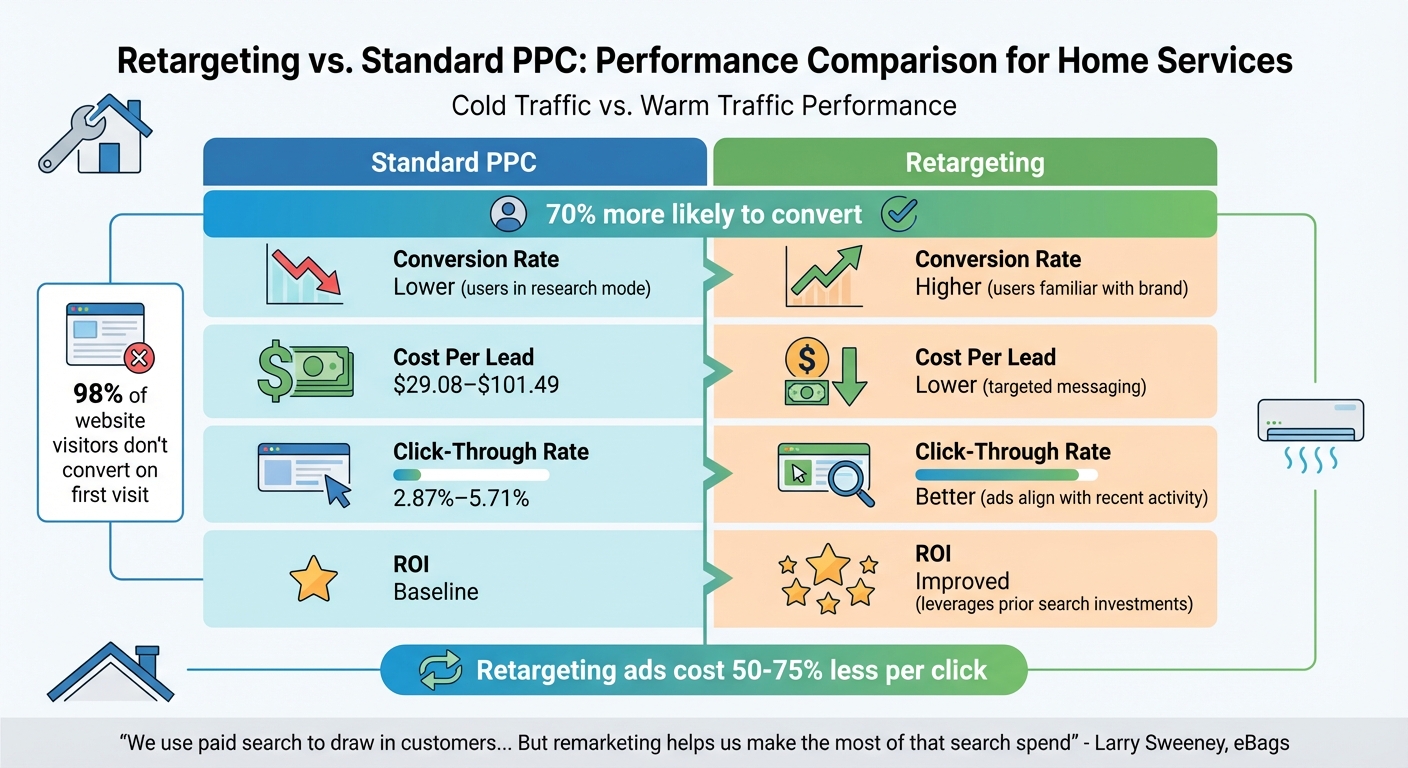
Retargeting vs Standard PPC Performance Metrics for Home Services
To start a solid retargeting campaign, you’ll need to install a tracking pixel on every page of your website, specifically in the <head> section. This pixel places a "cookie" on visitors, enabling platforms like Google Ads and Meta to identify and follow them as they browse other websites. Without this setup, retargeting simply won’t function.
Once installed, use tools like Google Tag Assistant to confirm that the pixel is firing correctly, especially on key pages like quote request forms or specific service landing pages. After verifying functionality, you can begin creating audience segments based on user behavior. For example, group visitors by the type of page they visited - emergency repairs versus maintenance plans - or by urgency. Someone searching for emergency repairs likely needs a different approach than a homeowner planning for seasonal maintenance.
For services with longer decision-making timelines, extend your retargeting list membership from the default 30 days to 60 or even 90 days. Homeowners often need multiple interactions before committing to higher-cost services. Additionally, create exclusion lists to remove users who’ve already converted by reaching your "Thank You" page. This step prevents wasting ad spend on existing customers and keeps them from being bombarded with irrelevant ads.
Consider diving deeper by building micro-segments for high-intent users. Examples include "High-Value Page Viewers" who visit a service page multiple times or "Cart Abandoners" who started but didn’t complete a quote form. These smaller, refined groups allow for highly tailored messaging that resonates with their specific decision stage.
Once your audience segments are ready, the next step is crafting ads that align perfectly with each group.
Launch retargeting ads on platforms like the Google Display Network and Meta. Use compelling visuals, such as before-and-after photos, to establish credibility and trust.
Tailor your messaging based on where the user is in their decision process. If someone has just discovered your business, focus on awareness-driven content. On the other hand, someone who abandoned a quote form might respond better to an offer like "15% off duct cleaning - expires in 48 hours". Incorporate trust elements such as certifications, customer testimonials, or ratings into your ads. Social proof is powerful - 92% of people trust recommendations over traditional ads.
Direct retargeting traffic to specific landing pages that match your ad’s offer. For instance, an ad promoting AC repair should link to your AC repair page, not your homepage. This consistency reduces friction and boosts conversions. On Meta platforms, use the standard image size of 1080 x 1080 pixels, and consider adding interactive features like polls or tappable text to increase engagement.
Maintain consistent branding across all platforms - use the same colors, logos, and tone. This kind of uniformity can increase revenue by up to 23%. Schedule your ads strategically, targeting evenings and weekends when homeowners are more likely to plan projects. To avoid overwhelming users, set frequency caps so they don’t see the same ad repeatedly.
With these steps, your ads will be primed to deliver the performance advantages that retargeting offers over traditional PPC campaigns.
Retargeting stands out because it focuses on visitors who’ve already shown interest. Here’s how it compares to standard PPC campaigns:
| Metric | Standard PPC (Cold Traffic) | Retargeting (Warm Traffic) |
|---|---|---|
| Conversion Rate | Lower - users are still in research mode | Higher - users are already familiar with your brand |
| Cost Per Lead | $29.08–$101.49 | Lower, thanks to targeted messaging |
| Click-Through Rate | 2.87%–5.71% | Better - ads align with recent user activity |
| ROI | Baseline | Improved, leveraging prior search investments |
The key difference lies in intent and familiarity. As Larry Sweeney, Search Engine Marketing Manager at eBags, explains:
"We use paid search to draw in as many customers as we can... But remarketing helps us make the most of that search spend and recapture more benefit from it" – Larry Sweeney, Search Engine Marketing Manager, eBags
While PPC works well for casting a wide net, retargeting excels at converting the 98% of website visitors who don’t take action right away. By focusing on these warm leads, you can significantly boost your campaign's effectiveness.
Retargeting campaigns are a game-changer when it comes to boosting conversion rates. Why? Because they target people who’ve already shown interest in your services - they just need that extra nudge to take action.
Here’s a striking stat: retargeted ads generate a 10x higher click-through rate compared to standard display ads. Take an HVAC repair ad, for instance. If someone previously visited your site, they’re far more likely to engage with that ad than someone seeing it for the first time.
Platforms like Facebook and Google amplify this effect. Retargeting campaigns on these platforms can increase engagement by up to 300%, while consistent branding across campaigns can lead to revenue gains of up to 23%. It’s all about staying visible and memorable.
The financial perks are undeniable. Combining retargeting with traditional search ads can slash your cost per lead by 3% to 29%. That’s a big deal, especially in competitive industries like home services. For example, plumbing leads average $48.91, and roofing leads can soar to $101.49. Even a small reduction in costs can make a huge difference. Plus, display retargeting ads inspire 27% of consumers to actively search for your business, driving conversion rates up by 59%.
These numbers aren’t just theoretical - they translate into real-world wins.
The power of retargeting becomes crystal clear when you look at real-world examples. Take a real estate agency partnered with Marketing 360. They used dynamic retargeting ads on Facebook, leveraging an IDXBroker feed to show updated property listings to past visitors. The results? Over three months, conversions skyrocketed by 455%, and the cost per conversion dropped by 66.36%. This strategy brought in 143 new leads from an audience that previously showed minimal engagement.
Another standout example is Postano. They ran a 60-day retargeting campaign using banner ads on the Google Display Network to re-engage prospects who were comparison shopping. The results were staggering: a 278% increase in conversion rates (measured by product demo requests) and a 364% boost in click-through conversions. Scott Huber, Marketing Director at Postano, summed it up perfectly:
"A customer that has already visited your website is really a unique opportunity for marketing because having a second conversation with them is easier to do." – Scott Huber, Marketing Director, Postano
And these aren’t isolated successes. Estatehub, for instance, helps home service providers achieve similar results by combining smart audience segmentation with tailored ad creative for each platform. By focusing on warm leads - those who’ve already interacted with your business - retargeting campaigns consistently outperform efforts aimed at cold traffic. It’s proof that retargeting can turn missed chances into profitable leads, especially for home service providers.
Once your retargeting campaigns are up and running, the next step is to fine-tune them. Ads can lose their effectiveness over time, so testing is key. A/B testing is a simple yet powerful way to compare two versions of an ad and see which one connects better with your audience. For home service providers, this might mean testing emotional messaging (like "peace of mind") against practical messaging (such as certifications or transparent pricing) to figure out what drives more conversions.
Small details can make a big difference. For example, 8 out of 10 people read the headline, but only 2 out of 10 read beyond that. Experimenting with different headlines and offers - like limited-time discounts versus free add-ons - can help pinpoint what grabs attention and drives engagement. Even tweaking an ad’s design can improve click-through rates by 17%.
If you're using Facebook ads, take advantage of Dynamic Creative Ads. This feature automatically tests multiple combinations of images, headlines, and call-to-action buttons, saving you time and making it easier to figure out what works. Regularly testing and refining your ads ensures they stay effective and aligned with your broader strategy.
Nobody likes seeing the same ad over and over again - it can annoy your audience and hurt your brand's image. Frequency caps are a simple fix. They limit how often a single user sees your ad within a set timeframe, whether daily, weekly, or monthly.
A good rule of thumb is to cap exposure at 17–20 ads per user per month. For more aggressive campaigns, you might want to limit it to 3 times per user. If someone sees your ad more than twice without clicking, it’s probably time to either pause it or switch to a fresh design. This approach reduces wasted ad spend while keeping your audience interested.
Another smart move? Exclude users who’ve already converted. If someone has booked a service, remove them from your retargeting list to avoid serving irrelevant ads. For high-value services like HVAC or roofing, where the decision-making process takes longer, consider extending your retargeting list duration to 60 or 90 days. This ensures your brand stays visible during their research phase. Keep in mind that click-through rates can drop by almost 50% after five months with the same ad design, so regular updates are essential.
To get the most out of your retargeting efforts, don’t rely on ads alone - integrate them with other channels like email. When retargeting is part of a larger strategy, it becomes far more effective. For instance, if you send out an email promoting seasonal HVAC tune-ups, you can run retargeting ads featuring the same offer to people who opened the email but didn’t book. This multi-channel approach reinforces your message and increases the chances of conversion.
List-based retargeting is another powerful tool. By uploading your unconverted leads to platforms like Facebook or Google, you can target these users with highly personalized ads. Campaigns that combine multiple channels can boost engagement rates by as much as 300% compared to single-channel efforts.
Consistency is key. Keeping your branding and messaging uniform across platforms - whether it’s social media, search engines, or email - builds recognition and can boost revenue by up to 23%. Use UTM tracking codes on your links to see which channel combinations are driving the most leads. If your focus is on a specific local area, consider pairing web retargeting with platforms like Nextdoor, which lets you target by ZIP code. This kind of localized strategy ensures your ads are relevant and effective, helping to turn leads into loyal customers.
Retargeting ads are a powerful way to re-engage potential customers, ensuring your business stays top-of-mind during their decision-making process. With retargeted visitors being 70% more likely to convert, this method delivers results that traditional advertising often can't match.
One of the key advantages of retargeting lies in its cost efficiency. By focusing your ad spend on warm leads who are already familiar with your brand, you’re investing in an audience that’s more likely to take action. Plus, cross-channel campaigns - using platforms like Facebook and Google together - can increase engagement rates by up to 300% compared to sticking with a single platform. This approach not only stretches your budget but also maximizes your return on investment.
Success with retargeting requires a thoughtful strategy. This includes installing tracking pixels, segmenting your audience, testing different ad formats, and setting frequency caps to avoid overwhelming users. When executed well, retargeting delivers personalized and timely messages that effectively turn casual browsers into paying customers.
If managing retargeting campaigns feels daunting, Estatehub offers specialized digital marketing services tailored for home service providers like roofing, HVAC, and plumbing companies. Their expertise spans paid ads, SEO, and lead generation, ensuring strategies that drive measurable results. As they emphasize:
"Estatehub is not a normal agency, we know 'clicks' don't get you sales. Let us show you how lead gen experts do it".
With a focused approach, Estatehub helps you turn every ad dollar into a meaningful connection, converting visitors into loyal customers. Whether you’re launching your first campaign or refining an existing one, professional guidance can mean the difference between wasted spend and steady lead generation.
Retargeting ads are a game-changer for home service businesses. They reconnect with potential customers who’ve already visited your website or interacted with your content but didn’t book or commit right away. Think of them as gentle nudges, reminding homeowners about your services as they browse other sites or scroll through social media. This keeps your business top of mind and increases the chances of turning curiosity into actual bookings.
This approach works particularly well for services like HVAC maintenance or gutter cleaning - areas where customers often need a little extra prompting before making a decision. By focusing on people who’ve already shown interest, retargeting ads make your ad budget work harder, build trust with potential clients, and help convert warm leads into paying customers more quickly. For home service businesses, this strategy can be a powerful way to generate more leads and grow your client base.
To build a retargeting ad campaign that works, start by setting clear goals. Are you aiming to boost leads or drive more bookings for your home services? Knowing your objective will guide the entire process.
Next, segment your audience. Use tools like cookies or tracking pixels to identify website or app visitors. This step lets you serve them ads that are highly relevant to their interests or behaviors.
Create personalized ad content that speaks directly to your audience. Whether it's a special offer or a message that reflects their previous interactions, make sure your ads feel tailored and engaging. When your ads are ready, launch them on platforms like Google or Facebook, ensuring your targeting settings match your audience segments.
Finally, keep a close eye on performance metrics such as click-through rates (CTR) and return on ad spend (ROAS). Use this data to tweak your campaign - whether that means refining your audience targeting, updating ad creatives, or reallocating your budget. Following these steps can help you reconnect with potential customers and generate more leads for your home services.
Retargeting ads work even better when combined with other marketing strategies, especially for home service providers looking to boost lead generation. For instance, pairing retargeting with local SEO ensures that people who’ve already visited your website keep seeing your business prominently online. This keeps your services fresh in their minds and encourages them to take the next step.
Another powerful combination is retargeting and email marketing. By sending personalized follow-ups to visitors who didn’t convert the first time, you can nurture those leads and build trust over time. This increases the likelihood of them eventually booking your services.
You can also align retargeting with paid ad campaigns on platforms like Google or social media. This creates a consistent message across different channels, improving both visibility and engagement. By leveraging data from website visits and ad interactions, you can design highly targeted campaigns that address customer needs at every stage of their decision-making journey.
Sign up for the newsletter and be the first to read our articles.


Every single person on our agency team has spent a lot of time in the field either running their own business or working for larger marketing agencies. We have all put in the time responding to leads, helping customers, scheduling and doing services. This gives us a massive advantage when making decisions.
One thing that has always been very special to us, is the fact that (excluding spam / people that never used our services) we do not have any bad reviews. This absolutely does not mean we have never had unhappy clients, but if it happens, we make it right, and stand behind our promises.
We have seen, time and time again, other agencies using strategies and structuring campaigns the way that they are technically supposed to. Most of these "best practices" that are taught in our industry, simply do not transfer into local lead gen. This is partially because we do have a much different target audience, and are typically spending less, however optimizing for website traffic does not work here.
We have been there, jumping into starting a home service business, struggling, and doing everything wrong. It's humbling. Our team has all felt the highs and lows, which is why we get so excited for our clients to win, we know how good it feels.

Estatehub is not a normal agency, we know "clicks" don't get you sales. Let us show you how lead gen experts do it.

