

Overview of Common Stains
Full overview of the most common stains, including how to identify them and treat them
If your business does not reply to new leads within 5 minutes, you are likely losing jobs to the company that answers first.
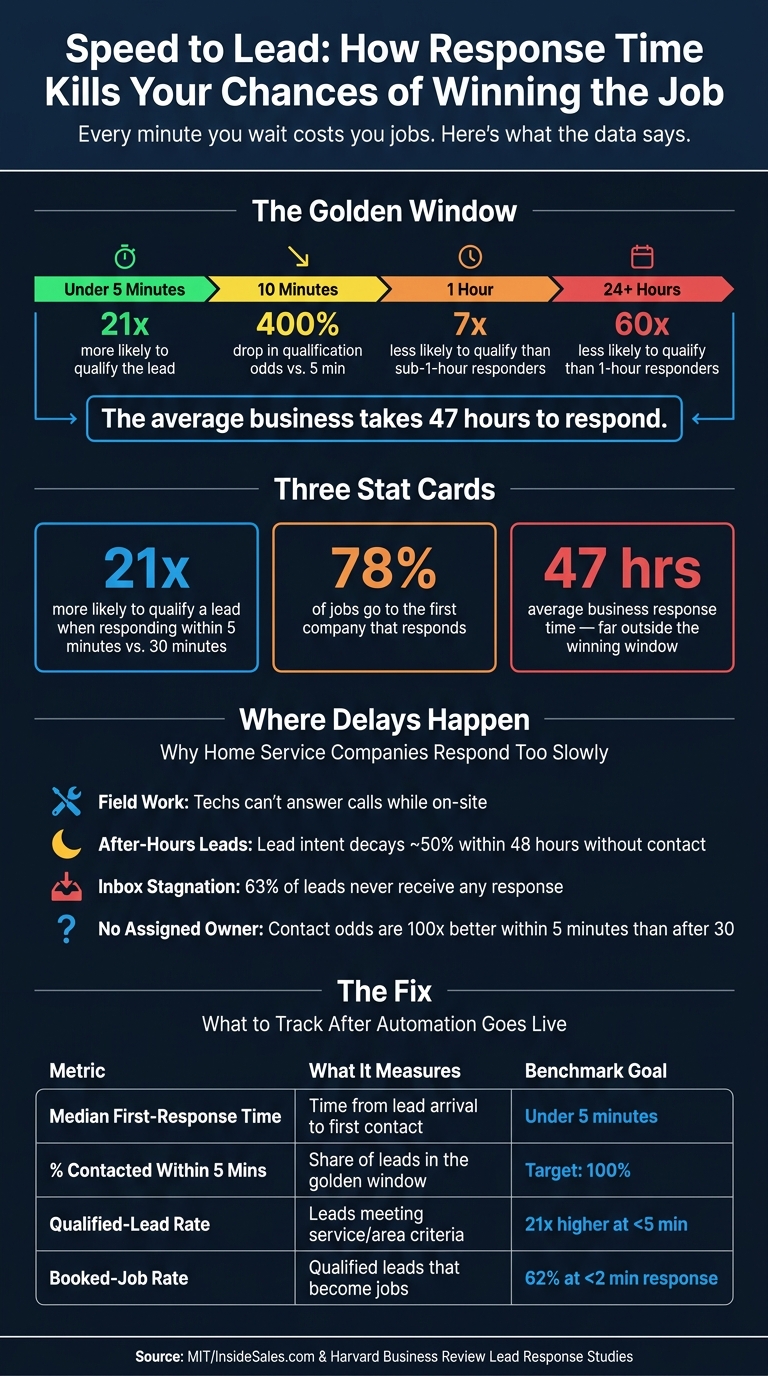
Speed to lead is the time between a customer reaching out and your first real response. In home services, that window matters a lot: businesses that reply within 5 minutes are 21x more likely to qualify a lead than those that wait 30 minutes, and the first company to respond gets the job in 78% of cases. By contrast, many businesses still take about 47 hours to reply.
Here’s the short version:
You should track:
This article explains what speed to lead means, why slow follow-up drains revenue, where delays happen, and how automation helps you reply fast even when your team is busy.
Speed to lead is the gap between a prospect’s first contact and your first meaningful response. In plain English, it’s the first reply that starts the sales chat or gets the job booked. A generic auto-reply doesn’t count. If you count that as the response, you hide the delay that loses the job.
That distinction matters because every minute after first contact cuts your odds of booking the work.
"Speed to lead is the single biggest controllable factor in whether that lead turns into a job." - Ryan Goering, CEO & Founder, BaaDigi
The formula is simple: lead creation time to first meaningful response. If a homeowner sends a quote request at 2:15 PM and your first real follow-up goes out at 2:43 PM, your speed to lead is 28 minutes.
In your CRM, track three numbers:
Track these in minutes, not days. Why? Because the gap between 5 minutes and 30 minutes is huge. Responding within 5 minutes makes a business 21x more likely to qualify the lead than waiting 30 minutes.
This should cover every channel where leads come in:
Each lead should get the same fast follow-up, no matter where it came from.
Once you measure this the right way, the slow spots stop hiding.
Not every home service call is a crisis. But when the request is urgent, speed matters even more. Think emergency plumbing or exterior repairs. In those cases, people usually don’t sit around waiting for a callback. They go with the first company that responds and can help.
Home service phone leads convert at about 46%, and your response time is the first sales impression a customer gets. That’s why your CRM needs to trigger an immediate, trackable first response. For the automation workflow, see /gohighlevel-crm.
The next step is figuring out where those delays happen before a lead gets a real response.
Speed to Lead: How Response Time Affects Your Chances of Winning the Job
Lead-response research is blunt: wait longer, and your odds of reaching that homeowner drop hard. Two studies from Harvard Business Review and MIT/InsideSales.com show just how fast that drop happens. And that gap? That's where jobs slip away.
The MIT and InsideSales.com research found that waiting just 10 minutes instead of 5 leads to a 400% drop in the chance of qualifying the lead. That's not a slow decline. It's a cliff.
The 1-hour mark matters a lot too.
"Firms that contacted potential customers within one hour were nearly 7 times more likely to qualify the lead than those that waited even 60 minutes longer, and 60 times more likely than those that waited 24 hours or more." - Harvard Business Review
By 24 hours, the odds fall off hard. A firm that replies after 24 hours is 60 times less likely to qualify that lead than one that replied within the hour. In plain English: by then, the homeowner has often already moved on and called someone else.
And here's the part that stings: the average business takes 47 hours to respond.
So the pattern is pretty clear:
For contractors, speed isn't just a support metric. It's a sales metric.
These studies track contact and qualification, not guaranteed booked jobs. So don't read the numbers as a promise that a fast reply will close every deal.
Still, the takeaway is simple: faster response gives you more chances to win.
That's why CRM automation matters. It helps keep response time short enough to start the sales conversation before the lead goes cold. The answer isn't more chasing. It's faster lead handling through CRM automation. See the CRM automation setup.
Those losses usually come from handoff gaps, not weak demand.
Most contractors are slow for a simple reason: one person is often expected to sell, answer calls, reply to texts, and do the work. In $1 million to $3 million shops, that creates a bottleneck fast. If that person is on a roof, under a house, or inside a panel, new leads can sit there with no reply.
The delay usually shows up in the handoff. That's where speed tends to fall apart:
| Delay Source | Where it breaks | Impact |
|---|---|---|
| Field Work | Techs can't answer calls or texts while on-site. | Leads go unanswered during the hours most jobs are being quoted. |
| After-Hours Leads | Leads arrive evenings or weekends with no one available, including during staff sick leave or vacation. | The lead sits until the next business day, and intent can decay by about 50% within 48 hours without contact. |
| Inbox Stagnation | Form fills land in unmonitored email. | 63% of leads never receive any response at all. |
| No Assigned Owner | Follow-up is tracked by memory or sticky notes. | Contact odds are about 100x better within 5 minutes than after 30 minutes. |
This is why so many shops feel busy and still miss jobs. The issue usually isn't lead flow. It's what happens in the gap between lead comes in and someone takes action.
A lot of contractors assume strong service will make up for slow follow-up. It won't.
Speed starts the conversation. Quality wins the job. But if you never get into the conversation, your workmanship never gets a shot. The first responder wins 78% of the time, no matter who does better work.
CRM automation closes those gaps before leads go cold. See the CRM automation setup.
CRM automation cuts the time between a new lead coming in and your first reply. It also fixes the handoff problems that slow teams down: crews in the field, leads that arrive after hours, crowded inboxes, and no clear owner. The first touch happens on its own, so a lead doesn't just sit there while your team is busy or off the clock.
The setup is pretty simple. When a lead comes in, the CRM pulls it into one dashboard, time-stamps it, creates or updates the contact record, and sends an automated text or email within 60 seconds. A short message like Got your request - are you free for a quick call? does the job.
After that, the system alerts the right team member with the lead's name, address, and job details. It also creates a follow-up task, so no one has to rely on memory. If nobody logs contact within a set time, the CRM sends it up to a manager on its own. Business-hour rules matter here too. A lead that comes in at 7:42 PM on a Friday should get an after-hours message, while a lead that comes in at 10:00 AM on a Tuesday should get a business-hours response. An automated call handler can take it a step further by answering after-hours calls, qualifying the job, and booking an estimate right on your calendar. Once the lead replies or books, the sequence should stop.
In plain English, automation swaps manual entry, slow handoffs, voicemail, and spotty follow-up for instant capture, routing, and response.
After launch, you need to check if the workflow is actually cutting response time. These numbers tell you if it's working or if leads are still slipping through the cracks.
| Metric | What It Measures | Benchmark Goal |
|---|---|---|
| Median First-Response Time | Time from lead arrival to first outbound contact attempt | Under 5 minutes |
| % Contacted Within 5 Mins | Share of leads reached in the golden window | Within 5 minutes |
| Qualified-Lead Rate | Share of leads that meet your service and area criteria | 21x higher when you respond within 5 minutes |
| Booked-Job Rate | Share of qualified leads that turn into scheduled jobs | 62% when responses happen under 2 minutes |
When you track those numbers, you can see if your CRM is helping you keep revenue on the table or still letting jobs slip away. Estatehub's GoHighLevel CRM setup includes pre-built pipelines, templates, and automations for home service businesses.
Speed to lead is measurable, and the cost of delay is plain: fast follow-up wins more deals than slow follow-up. This isn’t a guessing game. It’s a process problem, not a hope problem.
Most delays come from broken handoffs. No one owns the lead. There’s no after-hours coverage. Or the team is out in the field when the lead comes in. That’s where revenue starts to slip.
"Fix the first five minutes, and your marketing starts working harder."
The move is simple: set a sub-five-minute response target, send an automatic first text within 60 seconds, assign each lead to one owner, and check response-time metrics every week. If you want the system that supports that process, see /gohighlevel-crm.
Use the CRM automation setup in /gohighlevel-crm to build the workflow and track response times 24/7.
A strong response doesn't have to be a full quote on the spot. What matters most is a prompt, professional reply that shows you're paying attention and makes the next step clear, including when the quote will be sent.
Speed matters here. An instant SMS or email sent through CRM automation can keep the prospect interested while your team puts together a more detailed follow-up.
Have your CRM add a timestamp when each inquiry comes in and another when the first reply goes out, whether that reply comes from a team member or an automated message.
Then use reporting dashboards to measure the gap between lead creation and first engagement, find bottlenecks, and track performance against the five-minute response goal.
Start with your first-touch response so new leads hear from you inside that critical five-minute window. Set your CRM to send an instant SMS or email the moment someone fills out a form or calls.
Then layer in missed-call text-backs, automated lead routing, and internal alerts so your team can step in with a personal follow-up within 15 minutes.
Sign up for the newsletter and be the first to read our articles.


Every single person on our agency team has spent a lot of time in the field either running their own business or working for larger marketing agencies. We have all put in the time responding to leads, helping customers, scheduling and doing services. This gives us a massive advantage when making decisions.
One thing that has always been very special to us, is the fact that (excluding spam / people that never used our services) we do not have any bad reviews. This absolutely does not mean we have never had unhappy clients, but if it happens, we make it right, and stand behind our promises.
We have seen, time and time again, other agencies using strategies and structuring campaigns the way that they are technically supposed to. Most of these "best practices" that are taught in our industry, simply do not transfer into local lead gen. This is partially because we do have a much different target audience, and are typically spending less, however optimizing for website traffic does not work here.
We have been there, jumping into starting a home service business, struggling, and doing everything wrong. It's humbling. Our team has all felt the highs and lows, which is why we get so excited for our clients to win, we know how good it feels.

Estatehub is not a normal agency, we know "clicks" don't get you sales. Let us show you how lead gen experts do it.

