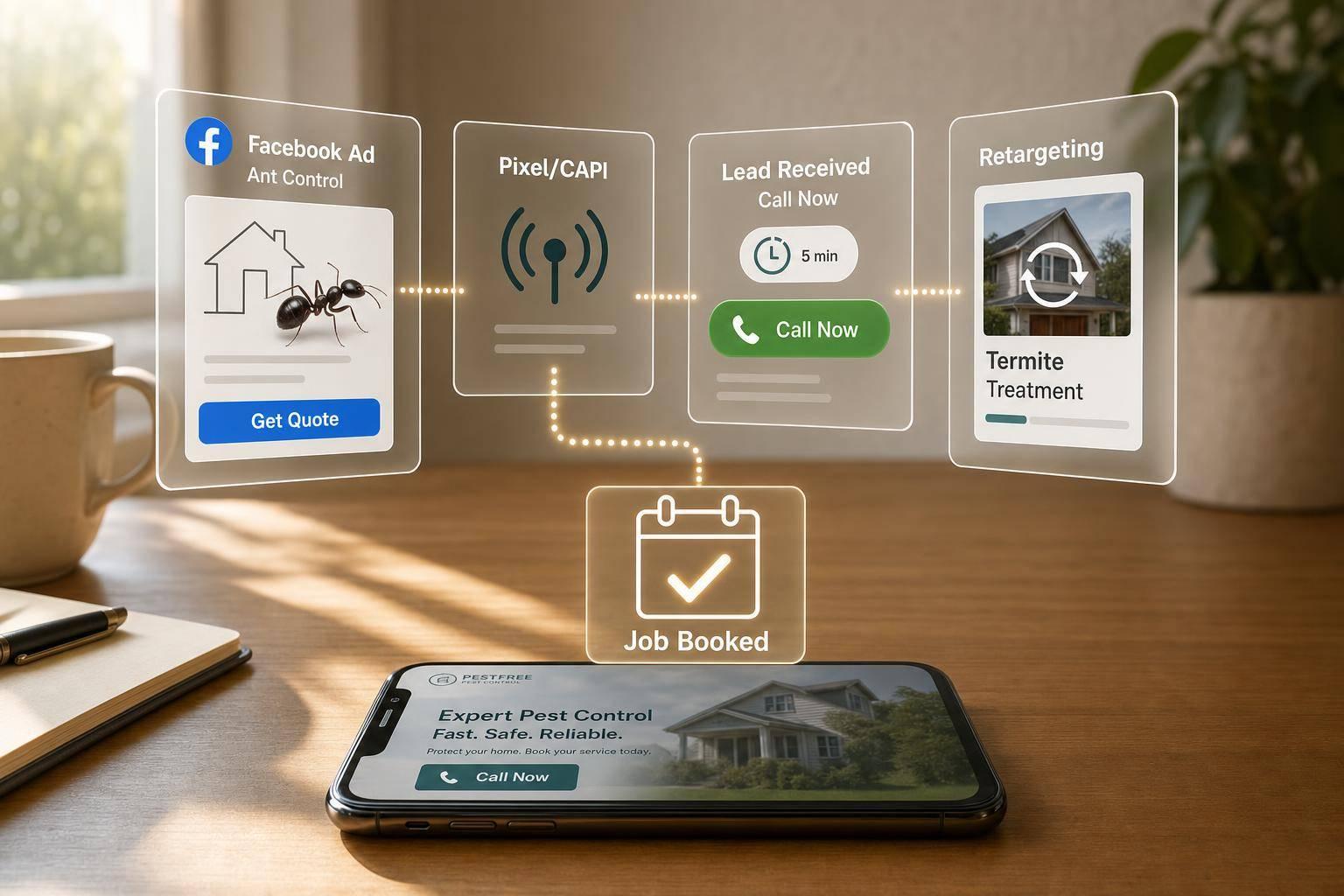
Facebook Ads can help pest control companies turn local homeowners into calls, form fills, and booked jobs with digital marketing for home service providers - if tracking, targeting, and follow-up are set up right.
If I had to boil this down, it’s this:
- Track every lead source with Meta Pixel, Conversions API, and CRM reporting
- Build separate campaigns by service like termites, rodents, mosquitoes, and general pest control
- Match the ad type to the job: Instant Forms for routine service, landing pages for high-ticket work, and call ads for urgent infestations
- Keep forms short and ask one filtering question to cut low-intent leads
- Follow up within 5 minutes or lead quality drops fast
- Judge performance by booked jobs and revenue, not just cheap leads
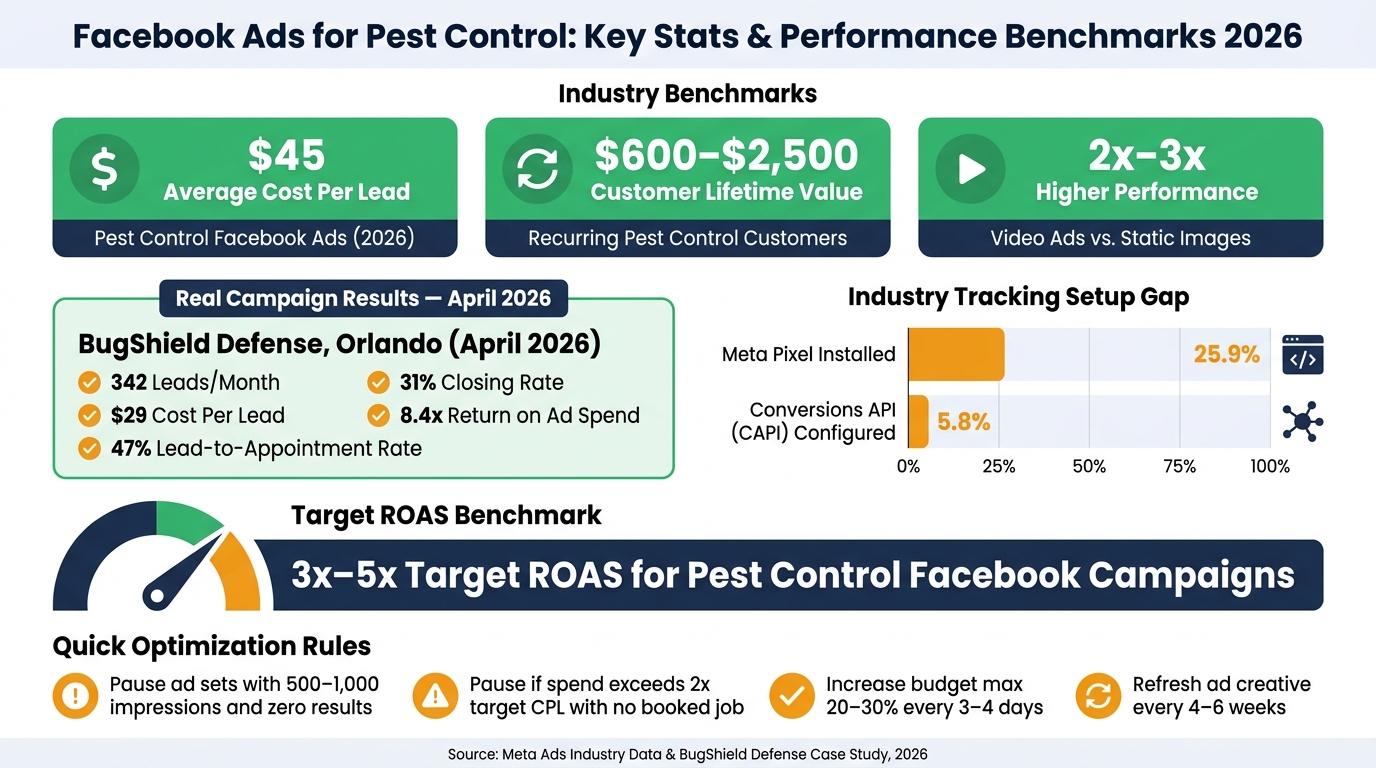
A few numbers stand out. Pest control Facebook leads average about $45 per lead in 2026. Recurring customers can be worth $600 to $2,500 over time. And in one April 2026 example, a pest control company generated leads at $29 each, with a 47% lead-to-appointment rate and an 8.4x return on ad spend.
The big point: a low CPL means very little if your team can’t turn that lead into an appointment.
Here’s the short version of what matters most:
- Target homeowners in your service area
- Use seasonal offers based on the pest problem
- Write simple ads around pain, safety, and speed
- Retarget visitors who checked service pages but didn’t book
- Scale slowly by moving budget to the ZIP codes and services that bring in revenue
If you want Facebook Ads to work for pest control, I’d focus less on reach and more on one thing: which ads produce booked work at a cost you can afford.
Facebook Ads for Pest Control: Key Stats & Performance Benchmarks 2026
The ULTIMATE Guide To Facebook Ads (For Pest Control Business) - Jake Sheldon
sbb-itb-2aa0348
Step 1: Set Up Your Account, Service Area, and Tracking
If you want local reach to turn into booked jobs, get the setup right before launch. That means account access, service-area targeting, and tracking all need to be in place first.
Set Up Business Manager, Ad Account, and Business Details
Use Meta Business Manager, one ad account, and a connected Page with admin access. On your Page, add a U.S. phone number, business hours, service categories, and your service area.
It also helps to keep campaigns separate for termite, rodent, mosquito, and general pest control. That way, you can tell which services are bringing in the best leads instead of lumping everything together.
Install the Meta Pixel and Track Lead Actions

Install the Meta Pixel and Conversions API to track quote forms, click-to-call events, and booking requests. Since iOS 14.5+ changed how tracking works, CAPI sends event data server-to-server and helps cover gaps when browser data is missing.
The gap in setup across the industry is bigger than most people expect. Only 25.9% of pest control advertisers have the Meta Pixel firing on their landing pages, and only 5.8% have CAPI configured.
Set up both through your tag manager or CRM connector before you spend a dollar on ads. If you skip this step, you'll have a hard time seeing which ads are driving booked jobs instead of just form fills.
Connect Leads to Fast Follow-Up Workflows
Send leads into a CRM with instant SMS or email alerts so your staff can respond within 5 minutes. Also, connect your Facebook lead forms straight to your CRM so no submission ends up sitting in a queue.
Once tracking is live, you can start building service-specific campaigns around each major pest problem.
Step 2: Build Facebook Campaigns Around Your Pest Control Services
With tracking set up, the next step is to build campaigns around how homeowners think when they have a pest issue. A termite problem is not the same as a wasp nest in the backyard. And someone dealing with roaches tonight won’t act like someone comparing quotes for seasonal service. So each service should have its own goal, audience, and form.
Choose the Right Campaign Objective and Service Structure
Build one campaign per service and intent so each ad set has a single, clear job.
Then match the campaign objective to the service:
- Leads with Instant Forms for general pest control and seasonal services. This keeps people on Facebook, pre-fills their contact info, and often lowers CPL.
- Conversion ads sent to a dedicated landing page for higher-ticket services like whole-home termite treatments, where lead quality matters more.
- "Call Now" for urgent cases like wasp nests or active cockroach sightings, where speed matters more than form volume.
Target the Right ZIP Codes, Radius, and Audiences
Once the offer is set, tighten delivery to the ZIP codes and homeowners most likely to book. Start with a 10–15 mile radius around your main service hub, then add the ZIP codes where you already have jobs or want more market share.
Focus on homeowners ages 30–65 with interests like home improvement, DIY, and gardening. Cut out non-homeowners, since they rarely book residential service. When you have at least 100 past customers in your CRM, upload that list to Meta and build a Lookalike Audience to reach similar homeowners nearby. For termite or whole-home treatment campaigns, filtering for homes 15+ years old can help improve lead quality even more.
Build Lead Forms That Filter for Real Jobs
After targeting, the form does the sorting. Its job is to separate real service requests from casual clicks. Keep it short. Use pre-filled contact fields for name, phone, and email, then add one qualifying question, such as pest type, property type, or urgency timing.
In April 2026, BugShield Defense in Orlando ran Instant Forms with three pre-filled fields and one pest-type question, generating 342 leads per month at $29 per lead, a 47% lead-to-appointment rate, and a 31% closing rate - an 8.4x return on ad spend.
A multiple-choice pest type question - options like Termites, Rodents, Cockroaches, or Mosquitoes - helps keep completion rates high while giving your sales team a simple way to call the best leads first.
Step 3: Write Ads and Offers That Get Homeowners to Act
Use Offers That Match Seasonal Pest Problems
Once your targeting and forms are in place, the ad itself needs to turn interest into action. That starts with an offer strong enough to stop the scroll.
The best offers match the problem in front of the homeowner. Think free inspections for termites and rodents, discounts for general pest control, bundled plans for mosquitoes and ticks, and same-day service for urgent infestations.
Timing matters too. Tie each offer to what people are dealing with in your area: spring for ants and termites, summer for mosquitoes and wasps, fall for rodents, and winter for indoor pests and annual-plan promos.
Write Simple Ad Copy Around Pain, Safety, and Speed
Once the offer gets attention, the copy has to move the homeowner to act. Good pest control ads usually follow a simple pattern: lead with the pest, explain the risk, name the fix, and finish with one clear CTA.
Keep the wording short and direct. Lines like "Same-day service available" and "Pet-safe treatments" can lower hesitation, especially for parents and pet owners who want the problem handled fast.
Three or four sentences is usually enough. Any longer, and the message can get muddy.
Choose Visuals That Build Trust Quickly
Visuals need to feel real, local, and immediate. Use real team photos, branded trucks, before-and-after shots of treated areas, and short smartphone video.
Video tends to do especially well here. In pest control, video ads typically outperform static images by 2x to 3x. That edge matters when you're trying to win attention in a crowded feed.
It's also smart to rotate creative often. Refresh ads every 4 to 6 weeks to avoid fatigue.
With the offer, copy, and visuals lined up, the next move is to track which combinations bring in booked jobs at the lowest cost.
Step 4: Lower Lead Costs, Improve Booking Rates, and Grow Revenue
Track the Numbers That Show Real Lead Quality
Once your campaigns are live, stop judging success by lead volume alone. At this stage, booked revenue matters more than a pile of form fills.
It’s easy to look at cost per lead and call it a day. But CPL only shows what you paid to get someone to submit a form. It does not tell you if you reached that person, if they were a fit, or if they ever booked service.
What matters more is whether a lead turns into an appointment and, later, into revenue. That’s why the key numbers are your callback connection rate, qualified-lead rate, booking rate, cost per booked appointment, and revenue per lead. A cheap lead isn’t much of a win if it never becomes a scheduled job.
For pest control, ROAS - revenue per $1 spent - should usually fall between 3x and 5x. It also helps to track response time inside your CRM and connect that data to booked jobs. If your team takes too long to call people back, even a good campaign can fall flat.
Make Small Changes Based on Campaign Data
Check CPL every day, but review callback connection rate, qualified-lead rate, and booking rate each week so your changes come from patterns, not guesswork.
A few rules keep things simple:
- If an ad set gets 500–1,000 impressions and still produces no results, pause it.
- If an ad set spends 2x your target CPL without a booked job, pause it.
- If an ad set is working, increase the budget slowly - only 20% to 30% every 3 to 4 days.
That slow ramp matters. Big budget jumps can throw off delivery and make a good campaign lose steam. It’s usually smarter to move spend toward the ZIP codes and service types that bring in the best booked revenue.
Use Pixel and CRM Data to Scale What Works
Once you know which ads are turning into booked jobs, start putting more weight behind them. Retargeting is one of the easiest ways to bring back people who already showed interest.
Say someone visited your termite or rodent service page but didn’t fill out the form. They were close, but not quite there. A retargeting ad with a direct offer can pull them back in, often at a much lower cost than cold prospecting.
You can also upload your top customers from your CRM into Meta and build Lookalike Audiences based on the homeowners already paying you. That gives Meta a better model for finding more people like them.
When Meta Pixel, Conversions API, and CRM data sit in one reporting view, it becomes much easier to connect ad spend to the final invoice amount in your CRM. That’s the kind of tracking that shows what’s making money and what’s just making noise.
Cold prospecting often brings in the lowest-cost leads. Retargeting and campaigns for higher-ticket services often bring in better booked revenue. Use that split to decide what stays on, what gets cut, and where more budget should go.
Conclusion: A Simple Facebook Ads System for Steady Pest Control Leads
If you follow the setup, targeting, and follow-up in this guide, Facebook Ads can bring in pest control advertising strategies that generate steady leads. The main mistake is treating every form fill like a win. In home services, the biggest lever is how fast you make contact.
The system is simple: service-specific campaigns, accurate tracking, seasonal offers, and five-minute follow-up. That’s the whole play. Turn interest into booked jobs, then put more budget behind what converts.
For optimization, refresh ad creative every two to four weeks, move spend toward the ZIP codes and services driving the best booked revenue, and use CRM data to decide what to scale. Measure booked jobs, not form fills, and scale only what pays back.
FAQs
How much should I budget to start?
Start with a daily budget of $15 to $50. That usually gives the algorithm enough data to make smarter optimization decisions.
As a rule of thumb, average cost per lead tends to fall between $25 and $50.
For monthly planning, many pest control companies spend:
- $1,500 to $3,000 in the off-season
- $3,000 to $8,000 during peak season
Most teams adjust those numbers based on demand, seasonality, and how many leads they need coming in.
Should I use lead forms or landing pages?
It depends on how fast your team follows up and how much filtering you need.
Lead forms keep people on Facebook. That cuts friction because the fields are often pre-filled, which can help you get more leads at a lower cost.
Landing pages add one more step. That extra step can weed out casual browsers and often brings in leads with stronger intent.
If your team can reach out within five minutes, lead forms can work especially well.
What if my leads aren’t booking?
If your leads aren’t booking, the problem is often slow follow-up.
Speed matters. A lot.
You’re much more likely to qualify a lead if you reach out within five minutes. That’s especially true for Facebook leads, where people often need instant human contact before their interest fades.
To improve booking rates, focus on a few simple fixes:
- Follow up fast by phone, text, or live chat
- Add screening questions to weed out low-intent leads
- Use landing pages, DNI, and clear calls to action
Related Blog Posts

Sign up for the newsletter and be the first to read our articles.