


Overview of Common Stains
Full overview of the most common stains, including how to identify them and treat them
If you want local links that help your home service business get calls, start with chambers, trade groups, supplier directories, partner pages, and local community sites.
The main point is simple: not all local links matter equally. Some links help show Google where you work. Others send people who are ready to book. The strongest places to focus first are:
A citation lists your business details. A backlink is a clickable link to your site. You need both, but backlinks can support rankings, Maps visibility, and referral traffic. Sourcing these kinds of relationship-based links is a regular part of Estatehub's SEO service, since chambers and trade groups tend to produce steadier, more relevant links than cold outreach. The article also points out that partner-based leads can convert at 4.5x the rate of paid social leads, which shows why relationship-based links matter, and why the pages those links point to need to be built to convert once traffic arrives, which comes down to a solid websites setup.
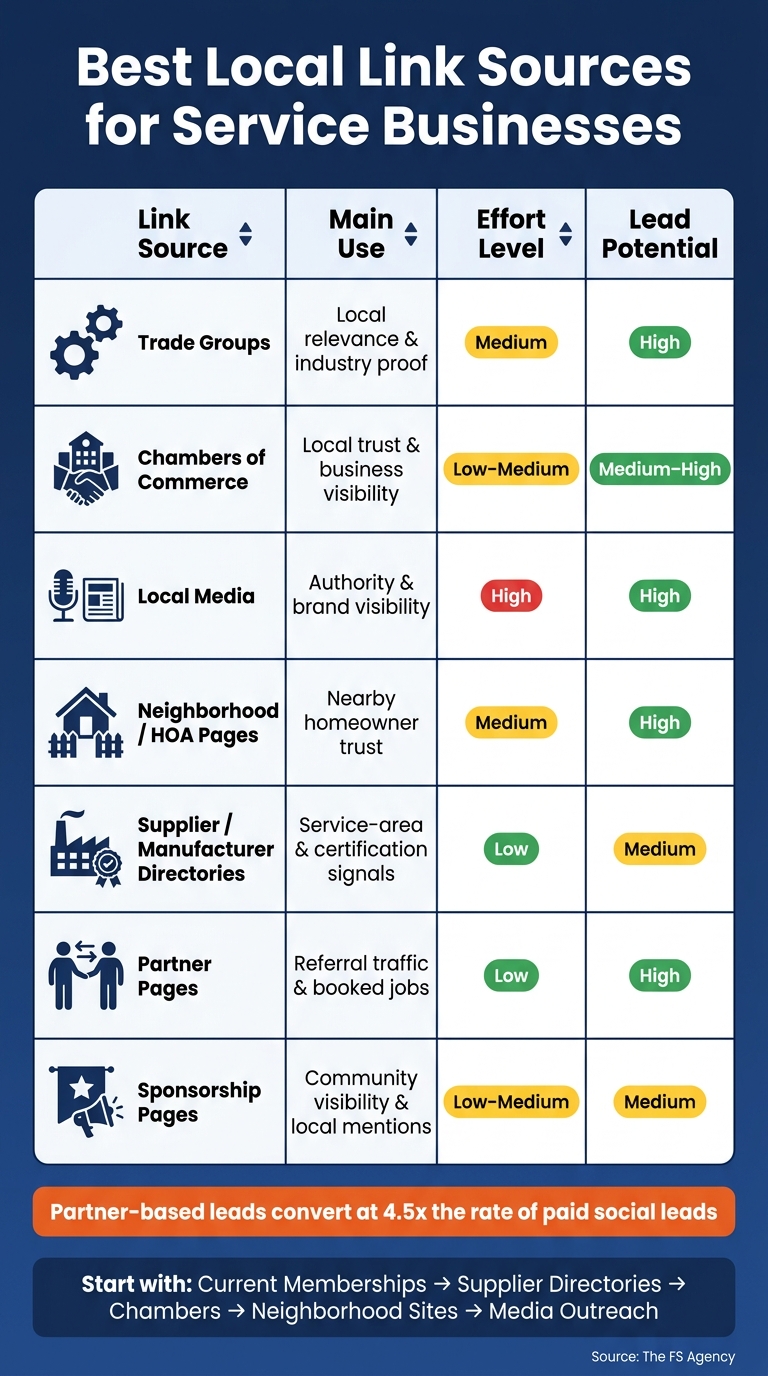
Best Local Link Sources for Service Businesses: Quick Comparison Guide
| Link source | Main use | Effort | Lead potential |
|---|---|---|---|
| Trade groups | Local relevance and industry proof | Medium | High |
| Chambers | Local trust and business visibility | Low to medium | Medium to high |
| Local media | Authority and brand visibility | High | High |
| Neighborhood/HOA pages | Nearby homeowner trust | Medium | High |
| Supplier/manufacturer directories | Service-area and certification signals | Low | Medium |
| Partner pages | Referral traffic and booked jobs | Low | High |
| Sponsorship pages | Community visibility and local mentions | Low to medium | Medium |
The short version: start with the links you can get from current memberships and business relationships, then move to media and community pages, and track which sources lead to calls and jobs.
Chambers and trade groups are high-trust local link sources because they check members and publish trusted directory listings. That’s a big reason they’re often some of the easiest strong links to get. These membership pages are made for verified businesses, so the fit is natural.
Industry-specific groups make a lot of sense for contractors because they give you a place to show certifications and licenses right next to your directory listing. That matters even more in trades where customers compare several bids before choosing, like HVAC, roofing, and remodeling. In those cases, third-party verification can help you look more credible during quote comparisons.
Local chambers of commerce and city business groups often include a member profile or sponsor listing that links to your website. And there’s another upside here: these groups are built on local relationships. So the link itself is useful, but so are the warmer referrals and referral traffic that can come with it.
Use the table below to compare which membership sources fit your trade and how much vetting they usually require.
| Membership Source | Typical Link Placement | Verification | Best-Fit Categories |
|---|---|---|---|
| Trade Associations | Member Directory, Chapter Pages | High | HVAC, Plumbing, Electrical |
| Chambers of Commerce | Member Profile, Event Sponsor | Medium | All Home Services |
| Business Alliances | Partner Pages, Referral Lists | Low to Medium | Landscaping, Cleaning, Painting |
These sources do two jobs at once: they help build local authority, and they put your business in front of nearby homeowners. They’re tougher to earn than simple memberships, but they often bring more visibility and stronger referral value. Here, the two main formats worth going after are editorial coverage and community listings.
Think of local news and lifestyle coverage as editorial mentions, not ads. It tends to work best when the story is honestly useful to people in the area.
For service businesses, strong media placements can support brand trust, local visibility, and search authority. In this group, media links are usually the highest-authority option.
Neighborhood portals, HOA pages, and local resource hubs often work like hand-picked vendor lists. And that can shape how homeowners decide which contractor to call.
These pages act like trust filters. So if you want to show up well there, reviews and reputation matter a lot.
| Metric | Editorial Coverage | Neighborhood Listings |
|---|---|---|
| SEO Value | High (compounding authority) | Moderate (trust signal) |
| Effort | High (consistent content and outreach) | Moderate (review and reputation management) |
| Lead Quality | Very high (search-driven) | High (trust-based) |
| Referral Traffic | High intent (search-driven) | High intent (platform-driven) |
| Longevity | Permanent (builds equity) | Variable (requires active updates) |
From there, move to vendor, partner, and sponsorship pages, which often bring faster wins.
Relationship-based links can turn suppliers, trade partners, and local connections into local authority. After memberships and media mentions, some of the fastest wins come from people and groups you already work with.
Many manufacturers and suppliers publish certified installer directories. These are worth going after when they list certified installers, show service areas, and display trust badges.
Complementary local businesses - like a plumber working with an HVAC company - often keep preferred vendor or trusted partner pages on their sites. A link from one of those pages can carry real weight because it comes from an actual business relationship, not a basic directory listing.
These links tend to work best when the connection is already in place and the partner already sends customers your way. That part matters. A partner page is much stronger when it reflects how business happens in real life.
Organic leads driven by referral and partner-based trust convert at 4.5x the rate of paid social leads, according to The FS Agency. So even if a partner page doesn't send huge traffic numbers, the link can still be worth a lot more than it looks on paper.
School programs, youth sports leagues, charities, and community events often publish sponsor pages that link to local businesses. Those links strengthen local trust signals and put your name in front of nearby homeowners through sources they already know.
Some companies also send referral rewards to local charities. It's a simple move, but it can deepen community ties and create chances for donor-page or partner-page mentions. Here's what each sponsorship type usually looks like:
| Source Type | Typical Cost (USD) | Link Visibility | Long-Term Relationship Value |
|---|---|---|---|
| Charity/Nonprofit | $50+ per donation/event | High (donor or partner pages) | High (community trust) |
| Local Events | $250–$1,000+ | High (event pages or local news) | Medium (seasonal awareness) |
| Referral Partners | $25–$150 per lead | Medium (partner pages) | Very High (recurring leads) |
"Organic online visibility through SEO, AEO, and GBP Optimization is like a snowball that keeps building and building. The efforts compound over time." - Amber S. Hoffman, Founder, The FS Agency
These sources may be smaller than media links, but they're often easier to get and easier to repeat.
After you map out your local link options, sort them by three things: ease, trust, and lead value.
Start with the links you can get fastest from memberships and business relationships you already have. That usually includes current memberships, supplier directories, installer programs, and sponsorships. These opportunities are often sitting right in front of you. And they tend to carry stronger trust signals because they come from verified listings or from a real business connection.
After that, work outward. Go next to local associations and chambers of commerce, then move on to neighborhood sites and community resource pages.
Once your links are live, track which ones lead to calls and booked jobs. Some links will send better leads than others. What matters most isn't domain authority by itself. What matters is whether that source sends people who are actually looking to hire.
Use call tracking by source so you can connect each link placement to calls and form fills. That gives you a much clearer picture of which links are leading to booked jobs instead of just piling up raw lead numbers. Over time, you'll spot which sources are worth renewing and which ones aren't sending calls or form fills.
Estatehub is built around that idea - connecting SEO and link-building work to actual booked jobs and revenue, not just clicks.
Put your energy into trade groups, chambers, vendors, partners, and community pages — the link sources that bring in real leads, not just links. This is the same lead-focused approach Estatehub takes with its SEO service, and it only pays off if the pages those links point to are built to convert once someone clicks through, which is where a solid websites foundation comes in.
Start with your Google Business Profile. Make sure your business name, address, and phone number stay the same across major local directories and citation sites.
Next, focus on platforms like Yelp, Angi, and HomeAdvisor. These sites matter because they help people find you and help search engines confirm that your business details match.
After that, work on community-based links. Good options include local business associations, neighborhood websites, and sponsorships. Think Little League teams, school events, or chamber of commerce pages. These links can send trust signals and put your business in front of local customers at the same time.
A local backlink is worth going after when it comes from community organizations, nearby businesses, or local directories with a good reputation. Those links help show search engines that your business is tied to a specific area and belongs there.
Focus on sources that put you in front of your target audience and help build your local authority. Local partnerships can help with search visibility too, especially in places where Google puts a lot of weight on proximity and local relevance.
Use UTM tracking codes to see which links, channels, and campaigns bring in your best leads. Then connect that data to a CRM so you can follow each lead from the first click all the way to a booked job, not just a site visit.
That matters because clicks don’t pay the bills. Booked jobs do.
You should also use call tracking for phone leads. If someone finds you through Google Ads, organic search, or social media and then calls, call tracking helps you see where that lead came from.
From there, compare cost per lead across each source. That makes it much easier to spot which channels give you the best return on investment and which ones are draining budget without bringing in enough business.
Sign up for the newsletter and be the first to read our articles.


Every single person on our agency team has spent a lot of time in the field either running their own business or working for larger marketing agencies. We have all put in the time responding to leads, helping customers, scheduling and doing services. This gives us a massive advantage when making decisions.
One thing that has always been very special to us, is the fact that (excluding spam / people that never used our services) we do not have any bad reviews. This absolutely does not mean we have never had unhappy clients, but if it happens, we make it right, and stand behind our promises.
We have seen, time and time again, other agencies using strategies and structuring campaigns the way that they are technically supposed to. Most of these "best practices" that are taught in our industry, simply do not transfer into local lead gen. This is partially because we do have a much different target audience, and are typically spending less, however optimizing for website traffic does not work here.
We have been there, jumping into starting a home service business, struggling, and doing everything wrong. It's humbling. Our team has all felt the highs and lows, which is why we get so excited for our clients to win, we know how good it feels.

Estatehub is not a normal agency, we know "clicks" don't get you sales. Let us show you how lead gen experts do it.

