
Most landscaping companies blend together, and that makes price the default tie-breaker. To stand out, your business needs a clear answer to three things: who you serve, what service you want to be known for, and how that message shows up in your pricing, website, and ads.
Here’s the short answer: you should pick a narrow customer type, match services to your crew and margin goals, package those services in a way people can grasp fast, and keep the same message from the ad click to the quote request. That matters even more when landscaping has a low average click-through rate of 4.69%, branded campaigns average about $34 per lead, and blended Google Ads spend can hit $117.92 per lead.
At a glance, the article covers:
- Target customer selection based on property type, ZIP code, and customer value
- Service focus based on crew skill, equipment, insurance, and profit
- Market position such as budget mowing, premium lawn care, estate service, or organic lawn care
- Package and pricing setup built from your cost per billable hour
- Seasonal offers timed to demand, like spring promos launched in February
- Website and ad messaging that says the same thing across every step
- Lead tracking by ZIP code, service tier, and close rate so ad spend goes where booked jobs come from
This guide breaks down how to turn that position into a simple offer homeowners can understand and a marketing setup that brings in better-fit leads.
How to "BRAND" Your Landscaping Business and STAND OUT Amongst the Competition
sbb-itb-2aa0348
Choose your target customer and service focus
Trying to serve every kind of property can stretch your crew thin. When your service mix gets too broad, routes get less efficient, margins get harder to protect, and your message starts to blur.
Define your ideal landscaping customer
Start with your CRM data. Check property type, ZIP code, and lifetime value to spot the customers and neighborhoods that fit your business best. You can also use tiered packages to segment customers without locking your brand into just one property type.
Maintenance contracts help bring in steady cash flow. Seasonal specials can help fill slower periods.
Match your services to your crew, equipment, and margin goals
Your position in the market should match what your crew can deliver right now. Basic maintenance packages usually depend on standard mowing equipment. Premium care calls for more specialized know-how. Hardscaping brings construction work into the mix, which means more jobsite complexity and, in some cases, added permits or insurance. It only makes sense if your crew has the experience, equipment, and insurance to back it up.
Here’s the simple tradeoff:
- Basic maintenance and seasonal work are the easiest to sell and deliver
- Premium lawn care tends to offer stronger margins with moderate complexity
- Hardscaping has the highest profit potential, but it also brings the most sales and operating difficulty
The best position is the one your crew can handle consistently and profitably.
If you're starting with a lean crew, basic maintenance and premium lawn care are usually the best places to begin. If you want to take on larger project work, leasing specialized machinery like skid-steer loaders or mini-excavators for one-off jobs can cut upfront cost while you build that part of the business.
Pick a clear market position customers can understand fast
A strong position should be easy for a homeowner to repeat in one sentence: "They do premium lawn care" or "They specialize in organic lawn care." Common positions include basic maintenance, premium lawn care, estate packages, seasonal specials, and organic or eco-friendly lawn care.
Pick one lane, then build your message around it. That includes your truck wraps, yard signs, website, and ad copy. Yard signs and truck wraps in your target neighborhoods can help build local brand recognition and make nearby routes more efficient.
Service still matters just as much as the offer. Showing up on time, staying in touch, and following through can make a big difference. Testimonials and before-and-after photos can also help support premium pricing for higher-ticket services like hardscaping or organic lawn care.
That position should shape your pricing, packages, website copy, and ad angles.
Build offers and pricing that match your position
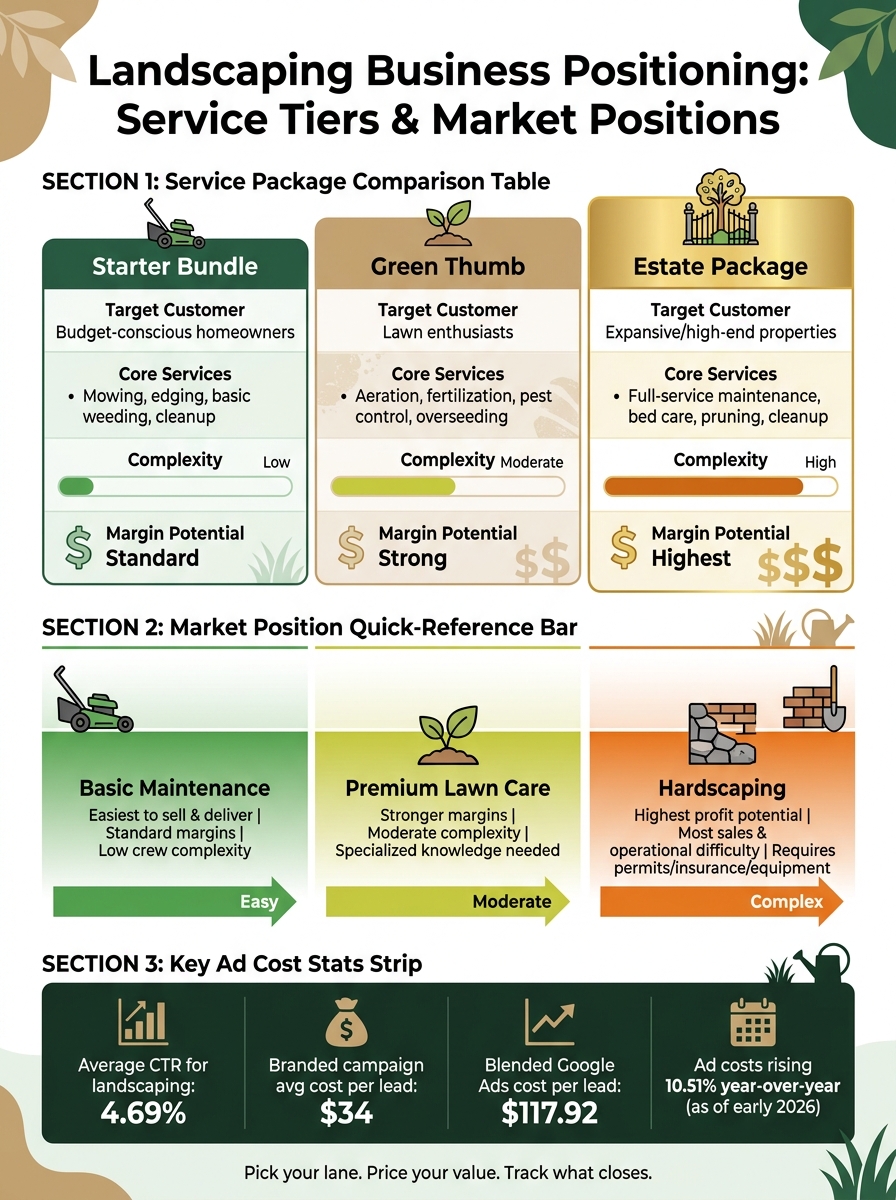
Landscaping Service Tiers: Positioning, Complexity & Profit at a Glance
Create service packages for premium, mid-market, or budget positioning
Once you’ve chosen your market position, your packages should reflect it. If your services sit as a loose list, the offer gets muddy. Packages make the choice easier. A customer should be able to look at your options and get the difference in a few seconds.
Your position needs to show up in both how you bundle services and how you price them.
A simple three-tier setup works well for most landscaping businesses:
| Package | Target Customer | Core Services |
|---|---|---|
| Starter Bundle | Budget-conscious homeowners | Mowing, edging, basic weeding, cleanup |
| Green Thumb | Lawn enthusiasts | Aeration, fertilization, pest control, overseeding |
| Estate Package | Expansive or high-end properties | Full-service maintenance, bed care, pruning, and cleanup |
Price each tier from your true cost per billable hour. That means labor, overhead, equipment depreciation, fuel, and fertilizer. Start by setting your minimum profitable hourly rate. Then price each package above that number based on the level of service and attention involved.
Plan seasonal offers around real customer demand
Seasonal promotions work best when they match what customers need at that point in the year. A random discount might fill a gap for a week, but it can also cheapen your offer.
Seasonal packages should support your market position, not pull you away from it.
| Season | Offer Name | Included Services |
|---|---|---|
| Spring | Spring Revival | Aeration, dethatching, early weed control, mulching |
| Summer | Summer Survival Kit | Irrigation management, grub control, heat stress treatments |
| Fall | Fall Wrap-Up | Leaf removal, final mowing, winter dormancy prep |
| Winter | Winter Watch | Snow removal, winter pruning for trees and shrubs |
Timing matters just as much as the offer. Launch spring campaigns in February - about 6 to 8 weeks before demand peaks - so your calendar starts filling before competitors crowd the market in March. That early window gives you room to use early-bird messaging and limited-capacity framing instead of defaulting to broad discounts. For a premium or mid-market business, that’s usually a much better fit than teaching customers to hold out for a deal.
The same timing applies to past customers. Reach out to customers who have been inactive for 14+ months with a short email or SMS before peak season.
Turn your positioning into website messaging and ad copy
Once you've picked your customer, service focus, and offer, turn that position into the words people see first.
Write website pages that reflect your niche and service area
Your homepage hero should answer three questions fast: what you do, who you serve, and where you work. A headline like "Full-Service Lawn Care for Luxury Homes in Scottsdale, AZ" does all three in one line. Use the same words your ideal customer uses when they describe the job they want done.
On each service page, stick to a simple flow: problem, outcome, promise, proof. It works because it mirrors how people make decisions. They want to know what's wrong, what life looks like after it's fixed, what you're saying you'll deliver, and why they should believe you.
For a premium position, proof usually means high-quality before-and-after photos and testimonials from clients with similar properties. For value-focused offers, proof looks different. In that case, clear package names and visible inclusions do more of the heavy lifting.
If you've added hardscaping or organic lawn care, give each service its own page. Don't bury them on a general services page. A page built around "Lawn Care in [City Name]" with copy that mentions local climate and regional landscaping trends tells people you know the area you serve.
That same position should show up in your ads too. If your site says one thing and your ad says another, people notice.
Use ad copy angles that match how you want to be known
Your headline needs to be specific. It should reflect your position directly, not every service you happen to offer.
| Position | Headline Example | Offer | Call to Action |
|---|---|---|---|
| Budget / Value | "Affordable Weekly Mowing in [City Name]" | Starter Bundle | "Get Your Instant Quote" |
| Premium / Health | "The Greenest Lawn on the Block" | Aeration & Fertilization Bundle | "Request a Lawn Analysis" |
| Elite / Full-Service | "Meticulous Care for Luxury Estates" | Estate Package | "Book a Property Walkthrough" |
Keep the same message from click to quote request
Message mismatch costs leads. Someone clicks an ad that says "Reliable Weekly Service - Guaranteed," then lands on a homepage talking about stuff that has nothing to do with that promise. The thread snaps. So does trust.
Keeping the message the same from ad to landing page makes the next step feel easy. It cuts friction and can improve conversion from click to form.
Repeat the same promise across your map listing, ad, landing page, and quote form. Keep the CTA in line with the job you're selling. A simple mowing package fits "Get Your Instant Quote." A full estate maintenance contract fits "Book a Property Walkthrough." That small shift helps screen out poor-fit leads before they ever hit your inbox.
Use marketing systems to grow a clear landscaping brand
Positioning only matters if your systems track the right leads. Once you know who you want to serve, your marketing setup should show that in the numbers.
How Estatehub can support a positioned landscaping brand
Estatehub ties paid ads, SEO, website development, and CRM tools into one setup that tracks leads from the first click to the booked job. For landscapers, that can look like a Google Ads campaign for an estate package feeding straight into a CRM that shows whether the lead turned into a booked job, not just a form fill.
That’s the core idea: track revenue, not just clicks. With landscaping ad costs up an average of 10.51% year-over-year as of early 2026, you need to know which campaigns are bringing in closed jobs if you want to protect your budget.
This setup also helps your brand stay consistent across ads, your website, and follow-up. So if you’re aiming at a premium, mid-market, or budget customer, the same offer keeps showing up for the same type of buyer.
Track lead quality and adjust campaigns by customer segment
Next, break results down by ZIP code, service tier, and close rate. Not every ZIP code is worth the same spend. The same goes for every job type. Lead costs can swing hard by channel, so budget should follow close rate, not click volume.
Use CRM data to move spend toward the ZIP codes and services that close best. That gives you a much cleaner view of whether your premium, mid-market, or budget offer is pulling in the right customers.
A few simple moves can help:
- Filter your CRM for clients who haven’t booked in 14+ months and send a targeted reactivation offer.
- Follow up on unsold estimates within 48 hours and wrap outreach before day 10.
Clear positioning paired with tight tracking leads to fewer wasted estimates and more jobs that fit your business.
FAQs
How do I choose the best landscaping niche?
Start by looking at your local market. Check the climate, the lawn types people have in your area, and the landscaping styles that show up again and again. Then review 3 to 5 local competitors to see where the gaps are. You might spot services they don't offer or topics they barely cover, which can give you room to stand out.
Next, take an honest look at what your business can support. Think about your skills, your equipment, and how much labor capacity you have. That matters a lot if you're thinking about niche services like organic lawn care or water feature installation, which can often command premium pricing.
What if I offer several landscaping services?
Offering several services can help position your business as a one-stop solution for outdoor needs. It makes things simpler for customers, and that kind of convenience can help build loyalty over time.
To keep everything easy to manage, group your services into clear packages and create a dedicated landing page for each one. That gives customers a simple way to compare options, and it can also help improve your local search visibility.
How can I tell if my brand positioning is working?
Track whether your business is bringing in and converting the right clients for your goals. Pay attention to cost per lead, conversion rates, and whether those leads turn into booked jobs, not just clicks or traffic.
You can also survey clients to see how they view your value next to competitors. If branded campaigns bring in lower acquisition costs than non-branded ones, that’s a strong sign your positioning is building local visibility and trust.
Related Blog Posts

Sign up for the newsletter and be the first to read our articles.