

Overview of Common Stains
Full overview of the most common stains, including how to identify them and treat them
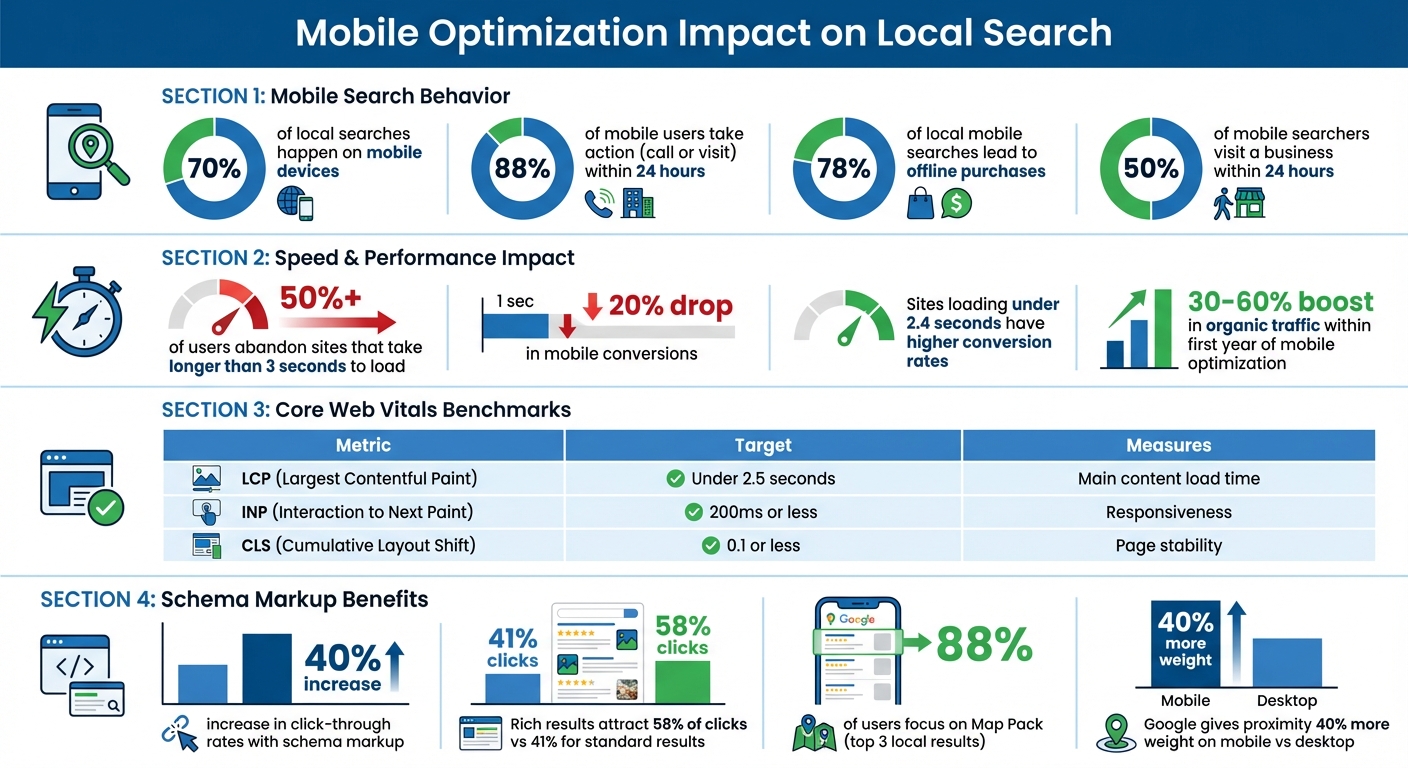
If your business isn’t mobile-ready, you’re losing customers. Over 70% of local searches now happen on mobile devices, and 88% of users who search for local businesses on their phones take action - like calling or visiting - within 24 hours. Google’s mobile-first indexing means your mobile site determines your search rankings, making mobile optimization critical for visibility and conversions.
Here’s why this matters:
To stay competitive, focus on:
Mobile optimization isn’t optional - it’s a must for attracting local customers and driving revenue.
Mobile Optimization Impact on Local Search: Key Statistics and Performance Benchmarks
Mobile optimization plays a key role in local search success for three main reasons: Google's indexing approach, user interaction, and its effect on SEO.
As of March 2021, Google fully adopted mobile-first indexing, completing the transition by October 2023. This means Google's crawlers now prioritize the mobile version of your site when determining rankings and deciding what to include in its index.
If your mobile site lacks content found on the desktop version - whether it's text, images, videos, or structured data - Google might not index that content, which could hurt your rankings. This shift is particularly crucial for local businesses. Mobile searches often indicate immediate intent, and Google gives proximity about 40% more weight on mobile compared to desktop. If your mobile site is slow or hard to navigate, you risk losing visibility in the Map Pack - the top three local search results - which is where 88% of mobile users focus their attention.
In short, a strong mobile presence is no longer optional - it's the foundation for staying competitive.
Google doesn't just check if your site is mobile-friendly; it evaluates the entire mobile experience. As Kurt Fischman, Principal at Growth Marshal, explains:
"Google doesn't rank mobile sites - it ranks mobile experiences. Prioritize speed, scroll behavior, and semantic clarity".
Speed is critical here. Over half of mobile users will leave a site if it takes longer than 3 seconds to load. Even a one-second delay can slash mobile conversions by up to 20%. Every second matters - if your site doesn't load quickly, users will move on.
Google also monitors user behavior, such as click-through rates, dwell time, and pogo-sticking (when users return to search results immediately after clicking a link), to measure the quality of the mobile experience. For home service businesses, a strong mobile experience encourages actions like calls, requests for directions, and in-person visits - all of which are key signals for local rankings. Improving mobile usability can lead to higher conversions and better local search performance.
A smooth, fast mobile experience not only keeps users engaged but also boosts your local SEO metrics.
Mobile optimization directly affects local SEO by improving engagement and conversion rates. A fast, user-friendly mobile site increases click-through rates in the Map Pack and reduces bounce rates, both of which are critical for local search rankings.
Mobile-specific ranking factors, such as speed and click-to-call functionality, take center stage. While desktop users may prefer in-depth content, mobile users lean towards concise, easily scannable information.
Google's Core Web Vitals, including metrics like Largest Contentful Paint (LCP) and Interaction to Next Paint (INP), are now key ranking signals that reflect actual mobile user experience. To meet Google's standards, aim for an LCP under 2.5 seconds and an INP below 200 milliseconds.
As Gombos Atila Robert, CEO of Jasmine Business Directory, puts it:
"If your website isn't mobile-friendly in 2025, you're essentially invisible to most local searchers".
Considering that 78% of local mobile searches lead to offline purchases, mobile optimization isn't just a nice-to-have - it's a must for staying competitive in today's market.
Here are four key steps to help your home service business improve local rankings and turn mobile visitors into customers.
Responsive web design ensures your site adapts seamlessly to any device, from smartphones to tablets. It uses CSS3 media queries to serve the same HTML on a single URL, automatically adjusting the layout based on screen size, orientation, or resolution. This approach eliminates the need for separate mobile sites.
Start by adding this viewport meta tag to your site's header:
<meta name="viewport" content="width=device-width, initial-scale=1">
This tells browsers to scale your page based on the device's width. It's crucial to maintain content consistency across desktop and mobile versions, including high-quality content, metadata, and structured data, to align with Google's mobile-first indexing. Also, make sure Googlebot can access your JavaScript, CSS, and image files - this helps verify your site's responsiveness.
For a better user experience, use fonts that are at least 16px with good contrast and ensure buttons and links are at least 44px wide to avoid tap errors.
Lastly, focus on fast loading speeds to keep visitors engaged.
Quick load times are critical. Websites that load in under 2.4 seconds tend to have higher conversion rates. For home service providers, speed is especially important when customers need immediate help.
Here are some ways to reduce load times:
Key performance metrics to monitor include:
| Metric | Target Benchmark | What It Measures |
|---|---|---|
| LCP (Largest Contentful Paint) | Under 2.5 seconds | How quickly the main content loads |
| INP (Interaction to Next Paint) | 200 milliseconds or less | Responsiveness to user input |
| CLS (Cumulative Layout Shift) | 0.1 or less | Stability of the page layout |
After improving speed, focus on creating touch-friendly navigation.
Mobile users interact with websites differently than desktop users. Simplify navigation by using hamburger menus to keep the interface clean while ensuring all pages are accessible. Place essential actions - like tap-to-call buttons or directions - front and center so visitors can act quickly.
Proper spacing between clickable elements is also important. This prevents "fat finger" errors that can frustrate users and drive them away. Use straightforward layouts that guide visitors toward key actions, such as calling your business or requesting a quote.
With navigation optimized, take it a step further by implementing schema markup.
Schema markup is structured data that helps search engines better understand your website and display key business information in search results. For home service businesses, schema types like LocalBusiness, Service, Review, and PostalAddress can highlight your name, location, phone number, and services.
Google recommends using JSON-LD schema for its simplicity and accuracy. Make sure your Name, Address, and Phone number (NAP) in the schema match exactly with your Google Business Profile to build credibility with search engines. You can also add Service schema to individual service pages and Review schema to showcase star ratings directly in search results.
Websites using schema markup have seen up to a 40% increase in click-through rates, and rich results can attract 58% of user clicks compared to 41% for standard results. Use Google's Rich Results Test to validate your schema implementation and ensure it's error-free.
Mobile optimization is crucial for capturing high-intent customers. Did you know that 88% of consumers who search for local businesses on mobile either call or visit within 24 hours? Mobile users are often in need of immediate service, making it essential for your site to perform well on mobile devices.
By focusing on mobile optimization, you improve your visibility, especially for localized searches. Fast-loading, mobile-friendly sites rank higher and attract more attention. For home service providers, this translates directly into revenue - every second of load time and every tap-friendly button matters. Businesses that prioritize mobile SEO often see a 30–60% boost in organic traffic within the first year. This increase in traffic leads to more inquiries and, ultimately, more customers.
A mobile-friendly site does more than just look good - it builds trust. When your website loads quickly and functions smoothly on a phone or tablet, it sends a clear message: your business is professional and reliable. This is especially important during emergency service calls when customers need quick solutions.
Mobile optimization also makes the customer journey seamless. Features like click-to-call buttons, integrated maps, and simplified forms allow users to contact you or find your location with just one tap. Convenience is key here: 50% of mobile searchers visit a business within 24 hours of their search. A responsive, fast site not only improves user experience but also ensures customers can reach you without any hassle.
Estatehub takes these benefits to the next level with tailored strategies designed to deliver lasting results. By focusing on lead generation and customer engagement, they help home service providers thrive in local markets.
Their approach is content-driven. Estatehub's Professional and Enterprise SEO plans include 3–10 keyword-optimized content pieces per month, which help businesses build authority and climb search rankings faster. What sets them apart is their deep understanding of the home service industry. Instead of generic marketing tactics, their strategies are shaped by real lead response patterns.
Estatehub’s Presence Builder Plan is another standout feature. It focuses on managing local listings and optimizing on-page elements specifically for the areas you serve. With over 350,000 leads generated and more than $7 million in advertising spend optimized, Estatehub combines mobile optimization with conversion rate optimization to turn traffic into paying customers. Their approach addresses both the technical aspects of mobile-first indexing and the content strategy needed to dominate local search results.
Optimizing for mobile isn't just a nice-to-have - it's a must for thriving in local search. With Google's mobile-first indexing, your mobile site plays a crucial role in determining your online visibility. To stay competitive, focus on responsive design, fast load speeds, and local schema markup. These elements come together to deliver smooth, user-friendly experiences that turn mobile visitors into loyal customers.
"Mobile SEO is a speed date with Google - you've got to load fast, look clean, and speak structured data. Remember, Google doesn't rank mobile sites - it ranks mobile experiences." - Kurt Fischman, Principal, Growth Marshal
By nailing these fundamentals, you're setting yourself up to attract and convert local leads effectively.
Start by evaluating your mobile site's performance. Tools like Google PageSpeed Insights and the Search Console Mobile Usability report can help pinpoint areas that need attention. Dive into your Core Web Vitals - Largest Contentful Paint (LCP), Interaction to Next Paint (INP), and Cumulative Layout Shift (CLS) - to measure how well your site meets critical performance benchmarks.
If you're in the home services industry, working with professionals who understand both the technical side of mobile optimization and the specific needs of your market can make all the difference. Estatehub specializes in creating mobile-friendly, conversion-driven strategies, including local schema integration and AI-powered content designed to drive results.
With 88% of mobile searchers taking action within 24 hours, the time to optimize your mobile presence is now. Make sure your business is easy to find and ready to deliver.
Mobile-first indexing means Google primarily evaluates the mobile version of your website when determining its search rankings. That makes having a mobile-friendly website more important than ever for boosting your local business's visibility.
A mobile-optimized site not only improves the user experience but also ensures faster load times and smoother navigation. These factors play a big role in improving your rankings in local search results. On the flip side, a site that's not mobile-friendly can hurt your chances of connecting with potential customers looking for services in your area. To stay ahead, focus on responsive design, clear calls-to-action, and fast loading speeds. These features can make all the difference in staying competitive in local search.
Improving your website's speed for mobile users is essential for better local search rankings and creating a smooth user experience. Start by focusing on image optimization - compress images to shrink file sizes while keeping the quality intact. Also, trim down unnecessary code to make your site run more efficiently.
Other helpful strategies include enabling browser caching to load pages faster for returning visitors and working on reducing server response times. Make sure your site uses a responsive design that adjusts effortlessly to different screen sizes. To stay on top of your game, regularly test your mobile site’s speed with tools like Google Lighthouse. These tests can pinpoint areas where you can improve.
A faster, mobile-friendly site does more than just please your visitors - it also improves your visibility in local search results.
Schema markup plays a key role in improving local search optimization. It helps search engines grasp important details about your business - like your location, the services you offer, and your operating hours. By using this structured data, you can boost your chances of showing up in local packs, map results, and rich snippets.
This added visibility can translate into better click-through rates and improved local search rankings, giving your business an edge in reaching nearby customers.
Sign up for the newsletter and be the first to read our articles.


Every single person on our agency team has spent a lot of time in the field either running their own business or working for larger marketing agencies. We have all put in the time responding to leads, helping customers, scheduling and doing services. This gives us a massive advantage when making decisions.
One thing that has always been very special to us, is the fact that (excluding spam / people that never used our services) we do not have any bad reviews. This absolutely does not mean we have never had unhappy clients, but if it happens, we make it right, and stand behind our promises.
We have seen, time and time again, other agencies using strategies and structuring campaigns the way that they are technically supposed to. Most of these "best practices" that are taught in our industry, simply do not transfer into local lead gen. This is partially because we do have a much different target audience, and are typically spending less, however optimizing for website traffic does not work here.
We have been there, jumping into starting a home service business, struggling, and doing everything wrong. It's humbling. Our team has all felt the highs and lows, which is why we get so excited for our clients to win, we know how good it feels.

Estatehub is not a normal agency, we know "clicks" don't get you sales. Let us show you how lead gen experts do it.

