


Overview of Common Stains
Full overview of the most common stains, including how to identify them and treat them
Most retargeting waste comes from treating every visitor the same. Your best move is to sort people by intent, then match the ad, page, and follow-up speed to how close they are to booking.
Here’s the short answer:
A few numbers stand out:
| Segment | Intent | What they need | Follow-up |
|---|---|---|---|
| Blog visitors | Low | Education and soft next steps | Light nurture |
| General browsers | Low to mid | Trust and local proof | Stay visible for days or weeks |
| Service-page visitors | Mid | Service-specific proof | Within 24 hours |
| Pricing/financing visitors | Mid to high | Payment clarity and lower risk | Within 24 hours |
| Form starters | High | Less friction and direct contact | About 5 minutes |
| Quote viewers | Very high | Booking push and estimate proof | Same day |
| Past customers | Rebook intent | Seasonal reminders and easy rebooking | Based on service cycle |
The core idea is simple: the closer someone is to booking, the tighter your message and timing need to be. The rest of the article breaks down how each segment works and where most campaigns go wrong.
Lead intent changes three things at the same time: your ad message, your landing page, and your follow-up timing. If one of those is off, you end up paying for clicks that go nowhere.
Low-intent visitors, like blog readers and DIY researchers, usually aren't ready to book. They need education and trust signals first. If you hit them with a hard-sell ad too early, they'll scroll right past it. As intent goes up, the message needs to change too. Mid-intent visitors are in comparison mode. They're checking providers, looking at options, and trying to figure out who feels like the right fit. This is where proof matters most: gallery pages, reviews, and a clear path to a free estimate. High-intent leads are different. They want help NOW. A response within 5 minutes sharply raises contact and qualification rates, and the first company to respond often wins the job. For emergency leads, use call-only mobile ads.
Landing pages should match that same pattern. An emergency plumber landing page needs a visible tap-to-call button above the fold. Someone researching a full HVAC replacement needs more detail, like a project gallery, financing options, and a clear quote path.
Here’s how the mix shifts by intent:
| Intent Level | Ad Message | Landing Page Focus | Follow-Up Timing |
|---|---|---|---|
| Low (blog readers, DIY researchers) | Educational, trust-building | Blog content, email sign-up | Automated nurture sequence |
| Mid (service page, pricing browsers) | Proof, financing, "Free Estimate" | Gallery, credentials, reviews | Same day |
| High (form starters, estimate visitors) | Immediate help, call-only ads | Tap-to-call button, trust signals, minimal form | Under 5 minutes |
Use this framework to match each segment below to the right message, page, and response window.
These visitors are in research mode. They're looking up a symptom or trying to prevent a problem, not asking for service yet. So this group needs topic-matched retargeting, not a quote ad pushed at them too soon.
That makes them a fit for light-touch retargeting, not an immediate push to convert.
Skip the hard sell. This is where educational ads tend to work best: a technician demo, a short explainer, or a customer story tied to the exact problem they just read about.
"A service manager explaining why an AC is blowing warm air... Those ads often beat polished brand spots because they answer real questions and feel tied to an actual service business, not a production company."
Instead of opening with a heavy offer, make the first step feel easier. Position it as an inspection or tune-up. That lines up better with where this visitor is in the process.
Send them back to the same topic, then present the next step naturally: a checklist, an inspection, or a service guide. The page should answer the same question the article brought up, not switch gears halfway through.
This group usually has a long buying window. Keep them in social retargeting until the issue feels urgent. Then, once the homeowner starts comparing providers, move them to the next intent level.
When they begin comparing providers, shift them into service-page retargeting.
These visitors looked at more than one page, often including a service page, then left without taking the next step. That matters.
Once someone moves past blog content and starts clicking through several pages, their intent changes. They’re no longer just reading. They’re comparing options. They may go back to service pages, scan reviews, and leave before reaching out. At this stage, they’re trying to figure out whether your business feels trustworthy and local.
For this group, trust beats polish.
A short video works well here. Think of a technician walking through what happens during a leak inspection, or a service manager explaining a common repair in plain English. That kind of ad feels grounded and helps the visitor picture what working with you looks like. Don’t go for the hard close yet.
Keep the ad tied to the service they viewed. If they spent time on your HVAC page, show HVAC-related advertising content. Skip the generic “we do it all” message.
The landing page should answer two quiet questions the visitor is already asking: “Am I in the right place?” and “Can I trust these people?”
Lead with things that lower doubt:
Use a low-friction call to action, such as “Request an inspection” or “See our process.”
"The job is simple. Stay visible across the buying window so your offer is familiar before the homeowner is ready to call, and easy to find when they are." - Wojo Media
This segment can take weeks to convert, so keep showing up while they’re still weighing their options. If they begin comparing specific services, move them into service-page retargeting.
This is the middle of the funnel. These people are past casual research, but they haven’t reached the estimate-request stage yet.
Unlike broad site visitors, they zeroed in on one service and got pretty close to taking action. They viewed a service page, stayed on it for 45–180 seconds, scrolled through project photos, or clicked into sections like "Our process" or FAQs. Then they left before requesting an estimate, booking, or calling.
That means this is still comparison-stage traffic, not ready-to-book traffic. Your job here is simple: move them from interest to confidence.
Match the ad to the exact service they viewed, then show why you’re the safer pick.
They already understand the problem. What they need now is proof that your company is the better fit. Use trust-first copy that leans on things like local experience, licensed techs, warranty coverage, and recent project proof.
Lead with offers like a free inspection, free consultation, or written quote. Skip discount-heavy messaging here. At this stage, trust usually does more work than a price cut.
Send ad clicks to a service-specific page that lines up with the ad.
Start with a local headline. Then back it up with reviews, project photos, and a simple 3-step next-step section:
Keep the form short. Ask only for:
These visitors are close enough to act fast, but they still need a little more proof before they commit.
Retarget them within 24 hours. Push hardest on days 1–3, then ease off through day 7. Use a 30-day audience window, and extend it to 60 days for bigger projects. Exclude converters right away.
These visitors are in comparison mode. They’re weighing options and looking for a lower-risk way to move ahead. Once they shift from checking prices to starting a form, they should move into a higher-intent segment.
Lead with financing and a clear risk-reversal offer, not price by itself. For high-ticket services like HVAC replacements or repipes, put financing first. Then back it up with service guarantees, fast dispatch, or waived fees.
Match the financing offer with the right proof point:
Cut navigation clutter. Answer financing concerns right away. Stick to one primary CTA.
Use one CTA per page:
The next step should feel simple, not like work.
Retarget within 24 hours. After that, stay visible for 30 to 60 days on larger jobs. If they move from price-checking to form starts, shift them into the next segment.
At this point, the lead is close to booking. People who start a form or begin an estimate request but don’t finish show strong buying intent. They’re interested. They just hit a bit of friction before submitting.
That’s why the follow-up needs to be fast and easy.
A strong offer helps sort serious buyers from casual browsers much faster. But don’t open with the full service price. Sell the first step instead: a low-cost inspection or diagnostic visit.
The ad should match the exact service the person was looking at. If they were checking out AC repair, the ad should talk about AC repair. If they were on a plumbing page, keep the message about plumbing. That one-to-one match makes the ad feel more relevant.
Risk-reversal language also helps lower hesitation. Phrases like "diagnostic fee waived with repair," "same-day dispatch," or "straightforward options, no hidden costs" make the next step feel simpler and safer.
The landing page should match the ad exactly: same service, same offer, same tone. No bait-and-switch. No extra clutter.
Keep the page centered on a single CTA. A few things matter most:
If the visitor has already shown this much intent, don’t make them work harder than they need to.
Call within 5 minutes. That speed matters here.
Then keep retargeting through the first 7 days. If the request still isn’t finished, keep the retargeting running until it is.
| Service Line | Recommended Retargeting Angle |
|---|---|
| HVAC | No-cool diagnostic |
| Plumbing | Leak detection |
| Roofing | Storm inspection |
When someone views a quote or estimate, they’ve moved past the research stage. Now they’re deciding who to hire.
That makes this a high-intent group. These people already asked for a quote or looked over an estimate. At this point, they’re weighing options. They want proof, clear pricing, and an easy next step that doesn’t feel like work.
The ad should match the estimate the homeowner just saw. Keep the message close to the job in front of them.
Lead with estimate proof: project photos, reviews, and financing tied to the size of the job. That works because reviews help answer, “Can I trust this company?” and financing helps answer, “Can I make this fit my budget?”
Use crew photos, project photos, review counts, star ratings, and financing options. The page should do two things well: build trust and push one clear action.
If the visitor has to hunt for what to do next, you’ve already lost momentum.
Follow up the same day with a call-first sequence. Then send a reminder within 24 hours.
Intent doesn't stop after the first visit. In many cases, past service history is one of the clearest signs that someone may book again.
This group shows intent through service history, not website activity. These customers already know your brand, so retargeting should focus on getting them to rebook, not introducing your business for the first time.
The main CRM signals to watch are:
A good target group is customers whose last job was 6–24 months ago and who still haven't booked again.
The best ad angle is usually a seasonal or lifecycle reminder tied to the last service they received. For repeat services like HVAC tune-ups, lead with timing and preferred customer pricing. For one-time jobs like roofing, shift the message toward long-term upkeep, like a free roof inspection to help protect the warranty.
The longer someone has been inactive, the more proof and incentive you'll usually need.
Send this audience to a rebook page, not your main services page. The page should speak to them like existing customers. It should also pre-select the most relevant past service, let them confirm it with one click, and make the booking process feel easy.
Social proof should lean on repeat-customer testimonials.
For seasonal repeat services, start retargeting 10–11 months after the last service date. Then step up frequency 4–6 weeks before the season that matters.
For one-time project work, a 12–24 month follow-up cycle tends to work better. In those cases, lighter touchpoints make more sense, like a referral request or a maintenance checkup offer once or twice a year.
Use 1–2 impressions per week and 1–2 emails per month during key seasonal windows. Remove contacts as soon as they rebook.
Next, compare each segment's ad, landing page, and timing side by side.
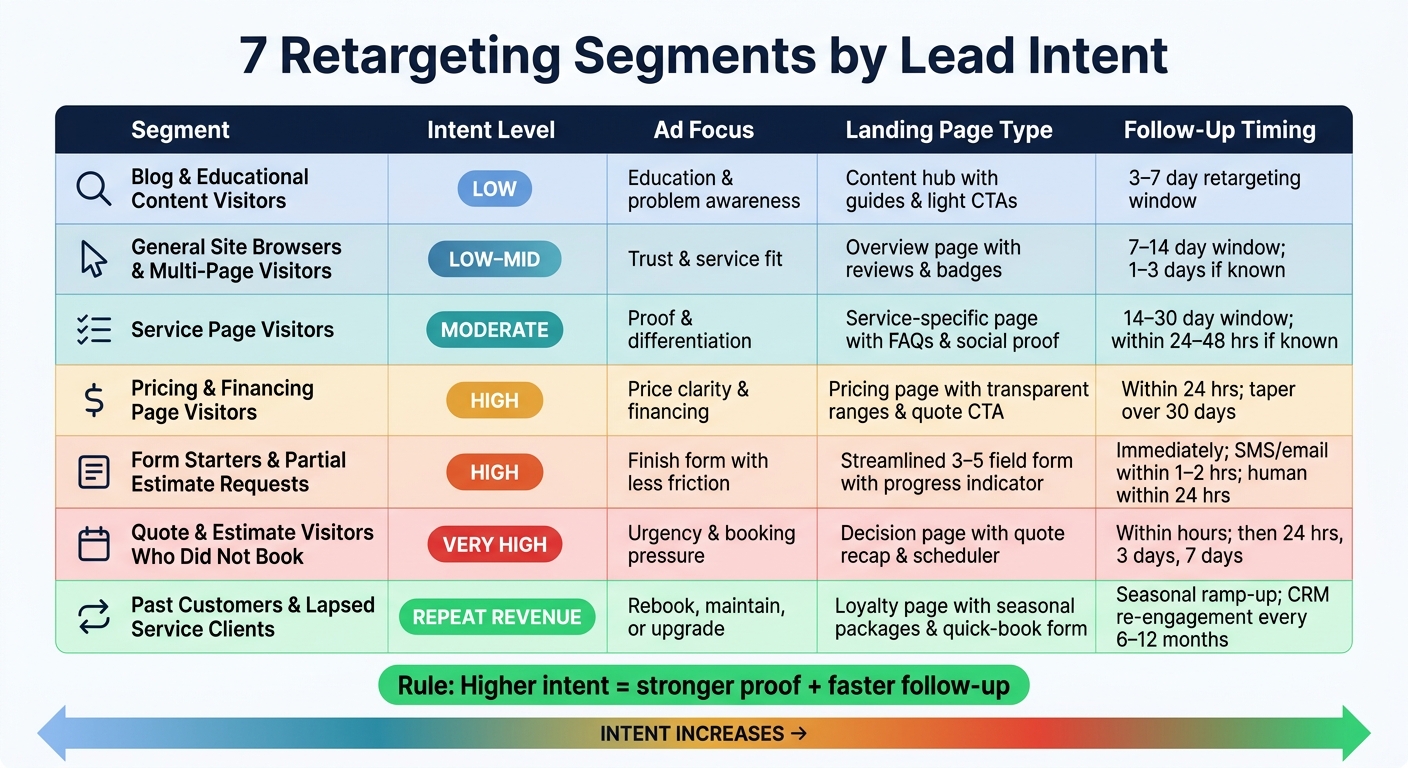
7 Retargeting Segments by Lead Intent: Ad, Page & Follow-Up Guide
Not every lead is at the same stage. Some people are just learning. Others are checking prices, starting forms, or looking at a quote with one foot at the finish line.
That’s why message, landing page, and timing need to line up with intent. Higher-intent leads need tighter timing and stronger offers.
Here’s the same framework in one scan-friendly view.
| Segment | Intent Level | Common Behaviors | Ad Focus | Landing Page Type | Follow-Up Timing |
|---|---|---|---|---|---|
| Blog and Educational Content Visitors | Low | Blog views, short sessions, no service or pricing activity. | Education and problem awareness | Content hub with related articles, downloadable guides, and light CTAs | 3–7 day retargeting window; weekly or biweekly nurture if they opt in |
| General Site Browsers and Multi-Page Visitors | Low–moderate | Multiple pages, mixed browsing, no form or quote action. | Trust and service fit | Overview page with company story, service categories, badges, and review snippets | 7–14 day retargeting window; follow up within 1–3 days if known |
| Service Page Visitors With Moderate Intent | Moderate | Service-page visits, deep reads, no estimate start. | Proof and differentiation | Service-specific page with FAQs, local project photos, social proof, and estimate CTA | 14–30 day retargeting window; follow up within 24–48 hours if known |
| Pricing and Financing Page Visitors | High | Pricing or financing visits, payment checking, no submission. | Price clarity and financing | Pricing page with transparent price ranges, financing breakdowns, cost-vs.-value explanations, and direct quote CTA | Start within 24 hours; taper over 30 days; respond within 1 business day if contact info is captured |
| Form Starters and Partial Estimate Requests | High | Form started, then abandoned. | Finish the form with less friction | Streamlined form page with 3–5 fields, progress indicator, and optional phone contact | Retarget immediately; automated email or SMS within 1–2 hours; human follow-up within 24 hours if contact info is captured |
| Quote and Estimate Visitors Who Did Not Book | Very high | Estimate viewed, no booking. | Urgency and booking pressure | Decision page with quote recap, scheduler integration, and a clear booking CTA | Begin within hours; follow up at 24 hours, 3 days, and 7 days |
| Past Customers and Lapsed Service Clients | Repeat revenue | Completed past job, no recent rebooking. | Rebook, maintain, or upgrade | Customer loyalty page with seasonal packages, service club details, quick-book form, and upsell suggestions | Seasonal ramp-up; CRM reengagement every 6–12 months depending on service type |
Use this matrix to match the right offer to the right lead. If the message misses the moment, even a good lead can go cold fast. The next step is avoiding the mistakes that waste that match.
A solid segment plan can still fall apart if the execution gets messy. You can map audiences the right way, then lose momentum when the ad, landing page, or follow-up no longer lines up with what the visitor just did.
The most common mistake is using one ad for every segment. A blog reader and a form abandoner are not in the same place. One is still learning. The other was close to taking action. If both see the same generic "Book your service today!" ad, the message falls flat for each group.
Another big miss is sending every click to the homepage. This hurts mid- to high-intent visitors the most. If someone just looked at your financing page and then lands on the homepage after clicking your ad, they have to retrace their steps. That adds friction fast. Dedicated landing pages tend to beat homepages because they keep people moving along the same path.
Timing matters just as much as where the click lands.
Delaying follow-up on form starters can drain conversions. For urgent jobs, follow up within 1 to 2 hours. For non-emergency work, reach out within 24 hours.
The other major budget drain is sending offers to people who already booked.
Most home service companies retarget every visitor the same way. That burns budget for no good reason. Someone who read a blog post is in a very different spot from someone who started a form, and your ads should reflect that. This is the segmentation logic Estatehub builds into every retargeting campaign it runs for home service clients.
Use one rule across every segment: higher intent calls for stronger proof and faster follow-up. Match the offer to the visitor, the landing page to the offer, and the response time to how close they are to booking. As intent goes up, the message gets tighter and the follow-up gets faster.
"Ad platforms show clicks; CRM shows booked jobs."
That gap is where intent-based segmentation earns its keep, and it's exactly what CRM-based lead scoring is built to close. You get cleaner reporting, less wasted spend, and more booked work. At that point, retargeting does the job you built it for: it brings in revenue.
Integrate your website and ad platforms with your CRM so behavior data lives in one place. Set up tracking pixels and cookies to log actions like pricing page visits, quote form abandonment, and service link clicks. Then assign tags or scores based on those actions.
From there, tighten your segments with filters like service type, location, and past interactions. CRM features such as smart lists, dynamic segments, and lead scoring can group contacts by engagement level and trigger timely, personalized follow-up.
Start with tracking and audience triggers. Install and verify your tracking pixel on key pages, especially quote request forms and service landing pages.
Then split audiences by intent-based actions, like pricing page viewers versus form abandoners, so your follow-up timing and ad copy match what people actually did. That helps you log the right events, cut wasted spend, and send people to the right ads and landing pages.
Refresh ad content every 2 to 3 weeks to help prevent ad fatigue. At the same time, check performance data daily so you can adjust bids and targeting as new data comes in.
Leave the same ad design running for too long, and performance can slide. In some cases, click-through rates drop by nearly 50% after 5 months. That’s why regular updates matter.
Sign up for the newsletter and be the first to read our articles.


Every single person on our agency team has spent a lot of time in the field either running their own business or working for larger marketing agencies. We have all put in the time responding to leads, helping customers, scheduling and doing services. This gives us a massive advantage when making decisions.
One thing that has always been very special to us, is the fact that (excluding spam / people that never used our services) we do not have any bad reviews. This absolutely does not mean we have never had unhappy clients, but if it happens, we make it right, and stand behind our promises.
We have seen, time and time again, other agencies using strategies and structuring campaigns the way that they are technically supposed to. Most of these "best practices" that are taught in our industry, simply do not transfer into local lead gen. This is partially because we do have a much different target audience, and are typically spending less, however optimizing for website traffic does not work here.
We have been there, jumping into starting a home service business, struggling, and doing everything wrong. It's humbling. Our team has all felt the highs and lows, which is why we get so excited for our clients to win, we know how good it feels.

Estatehub is not a normal agency, we know "clicks" don't get you sales. Let us show you how lead gen experts do it.

