

Overview of Common Stains
Full overview of the most common stains, including how to identify them and treat them
If I had to sum this up in one line: keeping past customers is often the lowest-cost way to grow a home service business.
I’m not talking about vague brand loyalty. I’m talking about simple math:
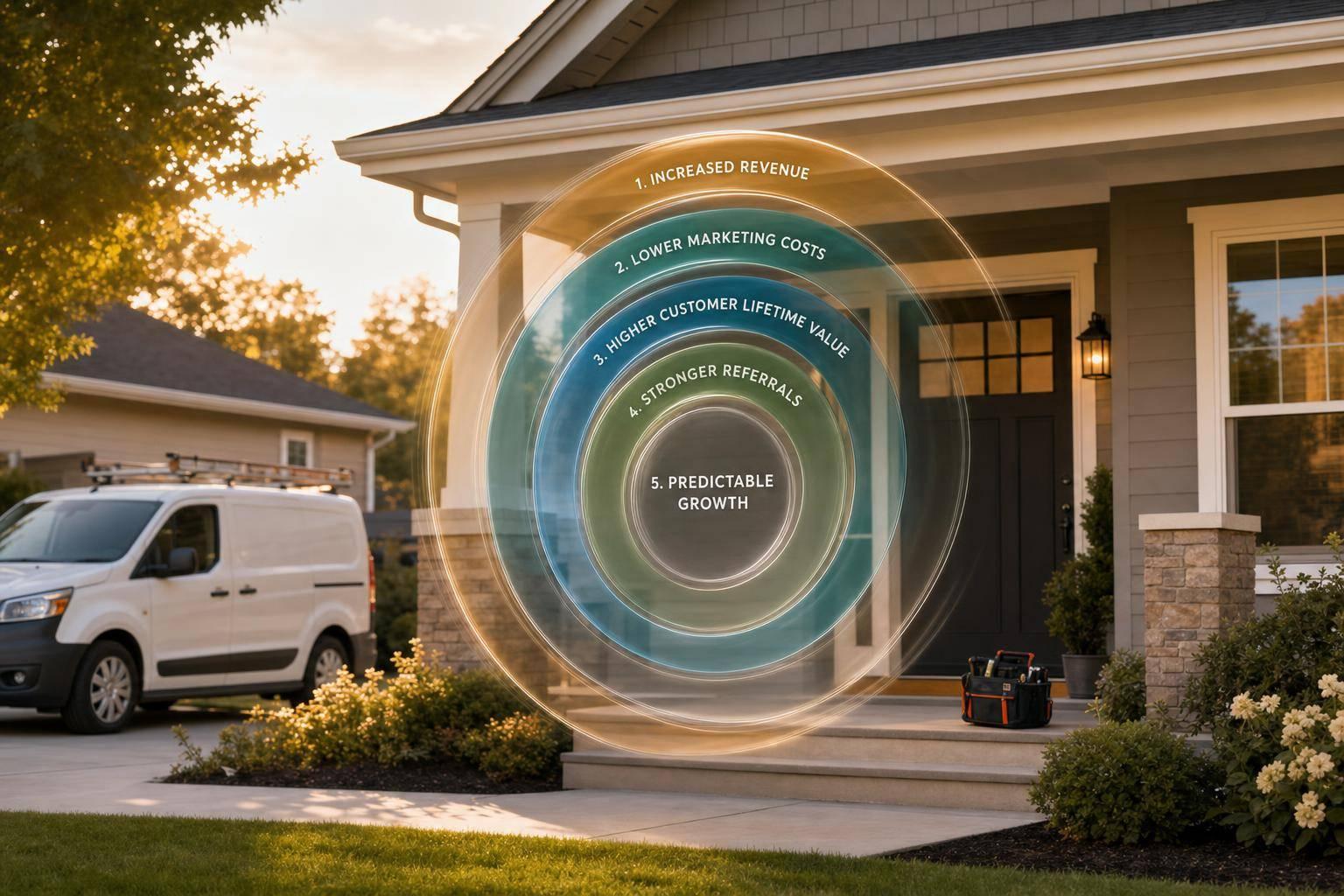
So the core idea is simple: when customers come back, ROI gets better. That happens in five main ways:
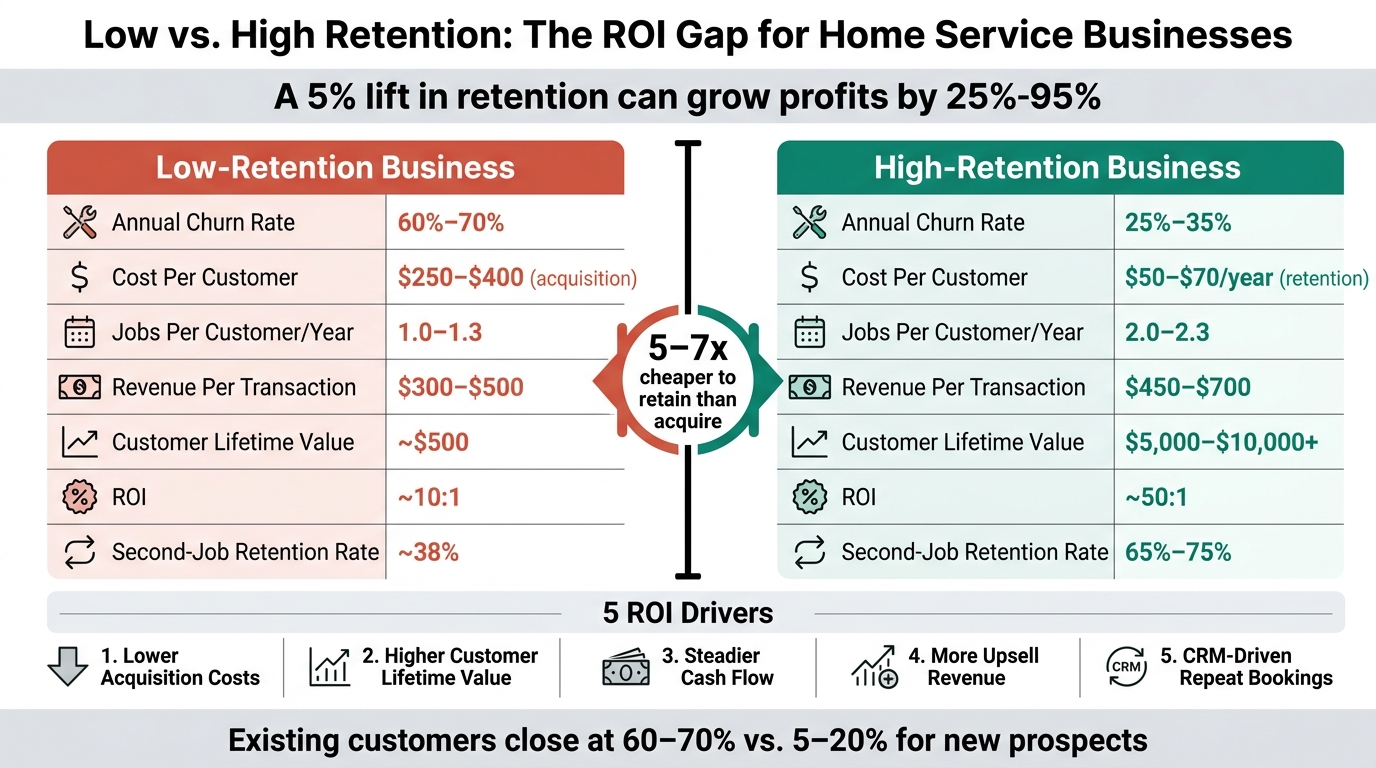
The big gap is hard to ignore. Many home service companies keep only about 38% of customers for a second job, while top performers reach 65%–75%. That difference can mean more booked work, less ad pressure, and better profit from the same customer list.
Low vs. High Retention ROI for Home Service Businesses
| Area | Low retention | High retention |
|---|---|---|
| Cost per customer | $250–$400 to replace lost customers | $50–$70/year to keep them engaged |
| Jobs per customer | About 1.0–1.3 jobs per year | About 2.0–2.3 jobs per year |
| Customer value | Often near a one-time ticket | Can reach $4,000–$10,000+ over time |
| Revenue pattern | More seasonal swings | More repeat and recurring income |
| Sales chances | More cold leads to convert | More past customers ready to book again |
If you run an HVAC, plumbing, electrical, or handyman business, this article comes down to one point: retention helps you spend less, sell more, and get more value from every job you already paid to win.
U.S. home service businesses lean hard on retention for a simple reason: demand is seasonal and often reactive. One week the phones won’t stop ringing. A month later, the calendar can look thin. Retention helps level that out by bringing in more repeat work and more scheduled appointments.
The math makes the case pretty fast. A new lead from Google Ads usually costs $250–$400 per customer. Platforms like Angi or Thumbtack can run $150–$300 per booked job. By contrast, keeping an existing customer engaged with automated emails, SMS reminders, and seasonal check-ins costs about $50–$70 per year.
That’s a 5–7x cost difference. And it doesn’t stop there. It stacks up over time.
The bigger leak is what happens after the first job. 74% of home service contractors have no systematic follow-up after completing a job. So even happy customers can drift away. In fact, more than half of customers who don’t come back were satisfied - they just forgot the contractor or found someone else more easily online.
This is where repeat work starts to snowball, especially with maintenance plans. One visit can turn into steady recurring revenue. HVAC customers on annual maintenance plans have an 89% retention rate, compared with 42% for customers without one.
In mature home service companies, existing customers account for 65% of total business. That turns the customer list into a revenue asset, not just a contact database. And that cost gap is the first clear ROI edge: retention cuts acquisition pressure before it does anything else. That’s why the first ROI win is lower customer acquisition cost.
Winning a new customer through Google Ads usually costs $250–$400 per lead. Keeping a past customer active through email, SMS, and seasonal reminders costs only $50–$70 per year. That’s a 5x to 7x gap.
And the savings don’t stop there.
Repeat customers are much easier to close. The odds of selling to an existing customer sit at 60–70%, while the odds of closing a new prospect are just 5–20%. That makes sense. Past customers already know your prices, your crew, and the kind of work you do. You’re not starting from zero. Most of the time, they just need a nudge instead of a long sales pitch.
One Sacramento handyman owner saw this play out in plain numbers. By adding 48-hour follow-up calls and seasonal reminders, the business lifted retention from 28% to 63% and grew revenue from $47,500 to $89,400. That’s the heart of retention: spend less to land the next job.
Referrals push costs down even more. Customers who’ve used a service three or more times refer other people at a 22% rate, compared with only 4% for first-time customers. And those referrals convert at 4x the rate of cold leads.
So when retention improves, acquisition pressure drops. You spend less, close more often, and get more booked jobs from people who already trust you.
Retention lifts ROI because each customer keeps producing revenue long after the first job.
That matters a lot in home services. Repeat customers spend 67% more on average than first-time clients. So the first visit isn't the whole story. It's more like the opening chapter.
In HVAC, the gap gets even bigger. An average single job is about $340, but contractors with strong retention can hit a 5-year customer lifetime value of $4,200. Another way to look at it: a one-time service ticket is worth about $350, while a maintenance customer can reach $5,200 over eight years.
That's why retention changes the math. You're not just selling one repair or one tune-up. You're building a customer relationship that can lead to repeat service, maintenance plans, and later replacement work. And when revenue comes from customers you already know, forecasting gets a lot easier.
Membership revenue is where this effect shows up fastest. billyGO grew from zero to $7.5 million in annual revenue with over 2,000 subscribers. Its $99 annual membership produced $200,000 in recurring fees and $1.6 million in replacement revenue.
Higher LTV also makes cash flow more predictable.
Higher customer value matters even more when repeat work shows up on a set schedule. In a seasonal business, recurring revenue helps smooth out the ups and downs. Service agreements and memberships create a revenue floor, so the business can keep moving even when inbound calls slow down.
According to TruLine, businesses with 30%+ recurring revenue cut revenue volatility from 180% to 70%.
| Month | Transactional Only | With 40% Recurring Revenue |
|---|---|---|
| January (Slow) | $80,000 | $140,000 |
| July (Peak) | $200,000 | $220,000 |
| Revenue Volatility | 180% | 70% |
That kind of steadier income changes how you run the business day to day. You can book work during slower months, keep crews busy, and make hiring or equipment purchase plans with a lot less guesswork.
Mattioni Plumbing's VIP membership, priced at $15.58 per month, shows how this can play out in practice. Members spend 2.5x more per transaction and generate 256% more revenue overall.
Steadier cash flow can also make upsells and add-ons easier to sell.
When customers come back, each visit creates another chance to grow the sale. And it usually happens more easily than with a first-time buyer. The reason is simple: trust is already there.
That trust shows up in the numbers. First-time customers spend about $300–$500 per visit, while retained customers spend $450–$700. So upgrades, add-ons, and premium options often feel like a natural next step instead of a hard sell.
The same pattern applies to recurring plans. If you offer a maintenance plan during installation, close rates land around 40–50%. If you offer it right after a repair, close rates still reach 20–30%. Timing matters, but so does the pitch. Position the plan as protection from emergency repairs, not just another monthly bill.
This is where maintenance plans can have the biggest effect. Retention increases ROI because each customer brings in more revenue, and you don't have to spend more to acquire them.
Retention gets a lot easier when follow-up runs on its own.
A lot of customers don't come back for a simple reason: the follow-up ends. And that's a missed chance, because 52% of non-returning customers were satisfied with the work. A CRM helps turn that silence into repeat bookings.
With the right setup, you can stay in touch at the right moments without piling more work onto your team. That might include:
These automated touchpoints keep your company in front of the customer without manual effort. And they can move second-job retention from 38% to 65%–75%.
There’s also a direct payoff in time and revenue. CRM automation can give back 7–13 hours per week for CSRs and dispatchers by taking over manual estimate follow-ups, renewal outreach, and job-status calls. For a contractor doing $1M+ in annual revenue, the monthly ROI from automation can land between $5,930 and $13,710, based on lead conversion lift, membership upsells, renewal gains, and staff time saved.
The lift can be even stronger with membership offers. Sending a membership pitch within 24 hours of job close can drive close rates of 15–25%, compared with 5–10% for in-person pitches made during the visit. That gap matters. The customer is home, the job is done, and the value of maintenance is still fresh in their mind.
Estatehub's CRM tools can support these automated sequences for home service providers.
Once retention is automated, the next step is measuring the ROI it creates.
Once your retention work is up and running, the next step is simple: check if it brings in more revenue and cuts acquisition cost. If you can't measure that, retention ROI is just a guess.
The starting point is tracking the right metrics. Each one shows a different piece of the picture.
| Metric | What to Measure | Benchmark to Target |
|---|---|---|
| Retention Rate | (Customers at end of period − New customers) / Customers at start of period | 40–60% |
| Repeat Booking Rate | Customers who book a second service within a specific timeframe / Total customers | 30–50% |
| Average Ticket Size | Average spend per visit for new vs. returning customers | $300–$500 vs. $450–$700 |
| CLV (HVAC with agreement) | Average Transaction Value × Purchase Frequency × Customer Lifespan | $4,000–$8,000 |
| CLV (Plumbing, regular service) | Average Transaction Value × Purchase Frequency × Customer Lifespan | $1,500–$3,500 |
| Maintenance Renewal Rate | % of service agreements renewed annually | 75%+ |
| Acquisition vs. Retention Cost | Cost to acquire a new customer vs. cost to retain an existing one | $250–$400 vs. $50–$70 |
A few numbers matter more than most: retention rate, repeat booking rate, customer lifetime value (CLV), average ticket size for returning customers, maintenance agreement renewal rate, and marketing cost per acquired versus retained customer. Put together, they show whether your current customers are spending more, staying longer, and costing less to keep.
Your CRM should track customer history, follow-up sequences, and agreement renewals. Your job management software should show repeat revenue and maintenance-plan conversion rates. Then, when you connect that data to accounting software like QuickBooks, you can compare profit margins from repeat jobs against first-time acquisitions.
That’s where the math starts to get useful. You’re not only seeing top-line revenue. You’re seeing whether repeat customers book more often, renew at a higher rate, spend more per visit, and produce better profit per customer.
The tricky part is attribution. A lot of systems can show that a repeat booking happened, but they can't show which follow-up message, ad, or visit pushed that customer to come back. Estatehub links ads, SEO, website traffic, and CRM data so you can see which channels drive the highest long-term value.
These numbers make the gap pretty clear. When retention is weak, a business burns more money replacing customers. When retention is strong, that same business gets more jobs, more revenue, and better ROI from each customer.
| Metric | Low-Retention Business | High-Retention Business |
|---|---|---|
| Annual Churn Rate | 60%–70% | 25%–35% |
| Average jobs per customer per year | 1.0–1.3 | 2.0–2.3 |
| Customer Lifetime Value (CLV) | ~$500 (single transaction) | $5,000–$10,000+ |
| Annual Marketing Spend per Customer | $250–$400 (acquisition-focused) | $50–$70 (retention-focused) |
| ROI | ~10:1 | ~50:1 |
| Revenue per Transaction | $300–$500 | $450–$700 |
The sharpest contrast shows up in marketing spend per customer. A low-retention business may spend $250–$400 just to replace one lost customer. A high-retention business, by comparison, spends about $50–$70 per year to keep that customer relationship going.
That difference adds up fast. Lower churn means less replacement cost, more repeat jobs, and a much bigger return from the same customer base. Put plainly: when customers stick around, spend drops and ROI climbs.
Retention has a direct impact on profit. It cuts customer acquisition costs, increases lifetime value, smooths out cash flow, and opens the door to upsells.
You can see that in the data. Increasing retention by just 5% can boost profits by 25% to 95%. For a home service business with 500 customers, a 10% lift in retention can add $75,000–$175,000 in annual revenue. And it doesn’t stop there. When past customers book more jobs, approve more repairs, and send new people your way, revenue starts to stack up.
The fastest wins often come from follow-up and memberships. Structured follow-up within 24–48 hours after a job is done can catch problems before they turn into lost customers. Monthly membership plans also help by bringing in predictable recurring revenue. On top of that, a CRM that automates seasonal reminders and win-back campaigns can help keep customers from slipping away after a strong first visit.
For U.S. home service providers, Estatehub's CRM tools can automate follow-up, reminders, and re-engagement to turn existing customers into repeat revenue.
Start with your current customer list. If you’ve been in business for two years or more, there’s a good chance you have past clients who haven’t heard from you in a while.
A simple way to make that list more useful is to group people by trade type or by the date of their last service. Then send a helpful message that fits their situation before your next busy season. That way, you’re not blasting the same note to everyone. You’re reaching out with something that feels timely and useful.
It also helps to stay consistent with post-job follow-up. A quick text or a two-minute call can go a long way. It keeps your company top of mind and gives customers an easy chance to mention any quality issues that didn’t come up right after the job.
Improving retention takes work over time, but the payoff can show up fast. Even a simple move like a post-job follow-up call within 24 to 48 hours can help protect customer satisfaction, support your reputation, and improve profitability almost at once.
Over the longer term, staying in touch with past clients helps turn one-time jobs into lasting, high-value relationships. That steady contact can increase overall ROI little by little, job after job.
Track the core metrics that show whether customers come back and spend more over time:
For home services, a healthy LTV-to-CAC ratio is 3:1.
Sign up for the newsletter and be the first to read our articles.


Every single person on our agency team has spent a lot of time in the field either running their own business or working for larger marketing agencies. We have all put in the time responding to leads, helping customers, scheduling and doing services. This gives us a massive advantage when making decisions.
One thing that has always been very special to us, is the fact that (excluding spam / people that never used our services) we do not have any bad reviews. This absolutely does not mean we have never had unhappy clients, but if it happens, we make it right, and stand behind our promises.
We have seen, time and time again, other agencies using strategies and structuring campaigns the way that they are technically supposed to. Most of these "best practices" that are taught in our industry, simply do not transfer into local lead gen. This is partially because we do have a much different target audience, and are typically spending less, however optimizing for website traffic does not work here.
We have been there, jumping into starting a home service business, struggling, and doing everything wrong. It's humbling. Our team has all felt the highs and lows, which is why we get so excited for our clients to win, we know how good it feels.

Estatehub is not a normal agency, we know "clicks" don't get you sales. Let us show you how lead gen experts do it.

