
Market your remodeling business year-round, but plan next year’s budget and spring campaigns in Q4 - before December 31. That gives you time to prepare your website, ads, and lead tracking before project work fills your schedule.
Your plan should cover three things:
- Budget and channels: Set monthly spending limits, choose SEO and paid search channels, and track leads through to booked jobs.
- Spring timing: Pick projects that fit your margins and crew openings, then launch campaigns 6 to 8 weeks before local demand peaks.
- Seasonal reviews: Use May and June to check lead quality, follow up on unsold estimates, and adjust spending for summer and fall.
<u>Keep consultation dates separate from project start dates.</u> Your marketing should fill available job slots - not promise work your crews can’t deliver.
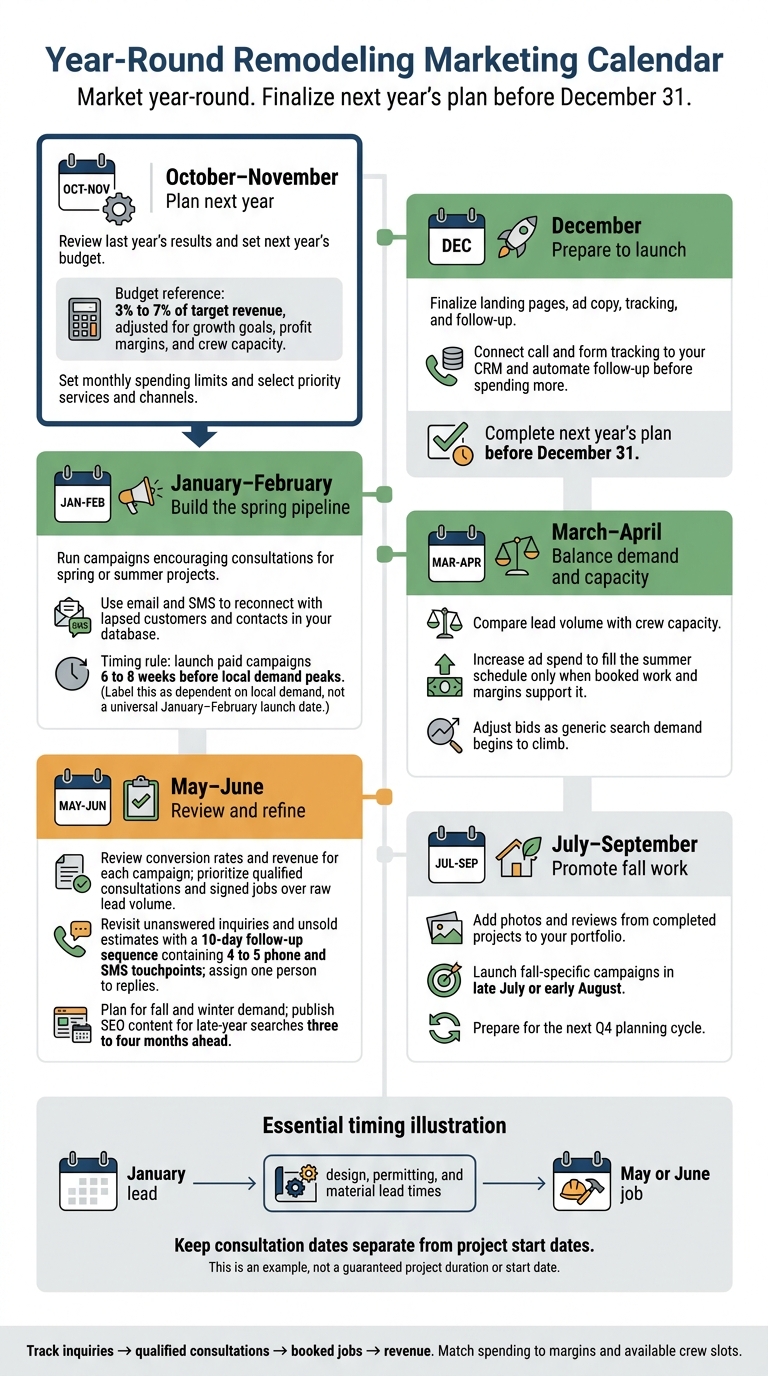
Year-Round Remodeling Marketing Calendar
What to Decide in Q4
Set Your Annual Budget and Monthly Limits
Use the Q4 search surge to set next year’s spending before January. Many remodelers budget 3% to 7% of target revenue, with adjustments for growth goals, profit margins, and crew capacity. Measure that budget against qualified consultations, booked jobs, and revenue - not lead volume alone. Separate fixed visibility costs, such as website hosting and SEO, from variable lead-generation costs, such as PPC and LSAs. Leave room for setup and testing, too.
Match monthly limits to open project slots. Work backward from revenue, delivery costs, overhead, and profit to determine what you can afford to acquire a customer. Before launching a campaign, give it a spending cap and a review date. Increase spending only when booked work and margins support it. Then choose the channels that can fill those slots.
Choose Marketing Channels and Track Leads
In Q4, focus on high-intent channels: Google Search Ads, Local Services Ads, and SEO. Use email and SMS to reconnect with lapsed customers and follow up on past estimates.
Before spending more, connect call and form tracking to your CRM and automate follow-up. Get these tools in place during Q4 so leads don’t slip through the cracks later. Speed matters: lead contact rates drop by more than 80% after five minutes. For a paid-search example, see the remodeling PPC case study. Once tracking is ready, decide which services to promote for spring.
Choose Which Spring Projects to Promote
Choose kitchens, bathrooms, and additions based on margin, demand, crew fit, and available start dates. Focus on projects your crews can complete profitably within the spring schedule. Give each priority service its own page and ad messaging rather than promoting every service equally.
Schedule initial outreach for January or February, and launch paid campaigns 6 to 8 weeks before peak demand.
sbb-itb-2aa0348
How to Build a Remodeling Marketing Plan From Scratch
Your Year-Round Remodeling Marketing Calendar
Plan marketing around when homeowners research and when construction can start, working backward from those dates.
| Period | Marketing work to schedule |
|---|---|
| October–November | Review last year’s results and set next year’s budget. |
| December | Finalize landing pages, ad copy, tracking, and follow-up. |
| January–February | Run campaigns that encourage consultations for spring or summer projects. Use email and SMS to reconnect with lapsed customers and contacts in your database. |
| March–April | Compare lead volume with crew capacity. Increase ad spend to fill your summer schedule, and adjust bids as generic search demand begins to climb. |
| May–June | Review conversion rates and revenue for each campaign. Plan for fall and winter demand, and publish SEO content for late-year searches three to four months ahead. |
| July–September | Add photos and reviews from completed projects to your portfolio. Launch fall-specific campaigns in late July or early August, then prepare for Q4 planning. |
Keep consultation dates separate from project start dates. A January lead may turn into a May or June job after design, permitting, and material lead times. Account for that gap and your backlog before promising a spring start your crews can’t deliver.
Use the Smaller May–June Search Bump to Review Campaigns
With spring campaigns already live, use the May–June search bump to check what’s working. Search volume climbs from 140 in February and March to 260 in April and 320 in May and June - still below the October–November peak.
Start with lead quality. Which inquiries turned into qualified consultations and signed jobs? The remodeling PPC case study offers an example. Add questions about budget, timeline, and project type to your intake process so you can spot poor-fit inquiries before scheduling a visit.
Next, review unanswered inquiries and unsold estimates. Set up a 10-day follow-up sequence with 4 to 5 phone and SMS touchpoints, and put one person in charge of replies. Automation should start the sequence, not end the conversation.
Use what you learn to adjust spending and offers for the rest of the season. Match those changes to crew openings: do you need summer jobs or fall consultations? Tighten targeting during this bump so your budget supports the work your crews have room to take on.
Conclusion: Finalize Your Plan Before Year-End
Search interest in “remodeling marketing” peaks in October and November, with 590 and 390 searches, respectively. That may reflect owners planning next year’s budget in Q4, but the data don’t prove it.
Before year-end, bring your budget, channels, spring offers, and launch dates into one plan. Assign responsibility for tracking and follow-up, and track inquiries through to booked jobs - not just clicks.
Use marketing for remodeling as a framework. Keep marketing active year-round, adjusting spending and project focus by season instead of waiting until spring to plan.
FAQs
How do I identify my local remodeling peak season?
Compare Google search volume in your service area with your past leads, booked jobs, and estimate requests. Look for repeated spikes in search interest and customer demand. These patterns can help you pinpoint your local remodeling peak season.
Then, check those patterns against broader market trends to forecast busy periods and adjust your marketing. SEO and seasonal campaigns take time, so plan your content and offers 3 to 4 months ahead.
Should I keep marketing when my crews are fully booked?
Yes. Consistent marketing keeps your brand top-of-mind, helps you retain clients, and protects your future project pipeline. Keeping current clients also costs far less than winning new ones.
Rather than turning off ads when you're busy, focus on high-value projects and stay in touch with leads for future openings. Keep inquiries coming in to support long-term growth.
How should I split my budget between SEO and ads?
During peak months, put 60–80% of your budget toward paid search and Local Services Ads to reach customers looking for help now. Reserve the other 20–40% for SEO content, published 3–4 months before demand picks up.
Track cost per booked job - not clicks. Use the first 30 days to collect data, then shift spending based on results. Review performance every 2 weeks. Running SEO alongside paid ads can lower your overall customer acquisition costs.
Related Blog Posts

Sign up for the newsletter and be the first to read our articles.