If you want more plumbing calls, a better review process can help. In these five examples, the same pattern showed up again and again: plumbers got more reviews, kept ratings stronger, and stayed more visible in Google when review requests went out right after the job.
Here’s the short version:
- 97% of people read online reviews before picking a local business
- 31% won’t choose a company under 4.5 stars
- 92% make a choice within 24 hours
- Review signals affect about 20% of Local Pack rankings
- Plumbing leads convert at 12%–16%
What I took from these case studies is simple: automation wins. When review requests are tied to job completion, teams ask more often, reviews come in more steadily, and replies are easier to manage.
The five companies covered are:
- My Essential Plumber
- HEB Plumbing
- NiceJob
- ABC Plumbing
- Elite Rooter
They used different tools, but the same core setup kept showing up:
- automated review requests
- SMS after completed jobs
- one dashboard for review tracking
- a set reply process
- location tracking for multi-branch teams
The Automated Plumber | Out ranks local competitors.
Quick Comparison
| Company | Tool Used | Main Workflow | Review Trend | Rating Trend | Multi-Location |
|---|---|---|---|---|---|
| My Essential Plumber | Thryv | Requests sent after completed jobs | More reviews over time | Went up | No |
| HEB Plumbing | Birdeye | Post-job SMS review asks | Steady review flow | Moved toward 4.5+ | No |
| NiceJob | NiceJob | CRM-based job triggers | Consistent growth | Stayed strong | Yes, depending on setup |
| ABC Plumbing | In-house platform | Scheduled follow-up after jobs | More total reviews | More stable | Yes |
| Elite Rooter | In-house platform | Automated asks across branches | High branch review volume | More even across locations | Yes |
If you’re comparing tools, the article points to a short checklist: connect requests to your CRM or scheduler, send SMS first, make replies easy, and track each branch if you have more than one location.
That’s the core idea of the article: plumbers did not change the service they offered. They changed how they asked for reviews, and that helped them get found and get picked.
Five Plumbing Reputation Software Case Studies
Review Requests Tied to Job Completion
Across these five plumbing companies, reputation software mostly fixed one stubborn issue: review requests slipping through the cracks after a job was done. That may sound small, but it matters a lot. If no one asks at the right moment, many happy customers simply move on.
The five examples below show these tools in action with actual plumbing businesses. In each case, the software helped teams connect review requests to completed work, so more customers were asked while the visit was still fresh in their minds.
Dashboards, Response Workflows, and Location-Level Tracking
The other pattern was simple: centralized control. Instead of checking reviews in a bunch of places, these companies used one dashboard to monitor feedback, one reply process to handle responses, and branch-level tracking for firms with more than one location.
That setup made day-to-day work less messy. Managers could see what was coming in, who needed a reply, and which locations were keeping pace. Review volume, speed, and response activity also influence Local Pack visibility. So this wasn’t just about staying organized. It also helped these companies keep review activity steady across jobs and across locations.
How Better Reviews Help Plumbers Show Up Higher in Maps and Win More Calls
For plumbers, better reviews do two jobs at once. First, they support local SEO. Second, they help turn Google Business Profile views into phone calls.
That’s the part that hits home. A stronger review profile doesn’t just make a business look good on the screen. It can help that company show up higher in Maps and give homeowners one more reason to call. The five cases below show how that played out in practice.
sbb-itb-2aa0348
Patterns Across All Five Case Studies
Review Requests Tied to Job Completion
In all five case studies, review requests were sent right after each job. That timing makes a big difference. When a request goes out while the visit is still fresh in the customer’s mind, people are more likely to respond.
And there’s a clear reason this matters: 74% of consumers only care about reviews from the last 90 days. Older reviews still have a place, but recent feedback is what moves the needle for most people.
Dashboards, Response Response and Per-Location Tracking
Central dashboards put review volume, replies, and location activity in one spot. That made it easier for each business to stay on top of replies and keep the process moving instead of letting reviews pile up.
That matters because 97% of consumers who read reviews also read the business's responses. In plain English, people aren’t just checking the star rating. They’re also looking at how the company shows up after the review is posted.
How Better Reviews Support Local SEO and Lead Conversion
Reviews don’t just shape trust. They also affect local search performance.
Review count, speed, variety, and response rate make up 20% of the total weight in Google Local Pack rankings. Google Business Profile signals add another 32%, so together they account for more than half of what affects a plumber’s local visibility.
That has a direct business impact. Plumbing leads convert at 12–16%, the highest rate in home services. So when a company gets seen more often in local search, it has a much better shot at turning that visibility into booked jobs.
Those shared patterns set up the side-by-side comparison below.
Comparison Table and Selection Criteria for Contractors
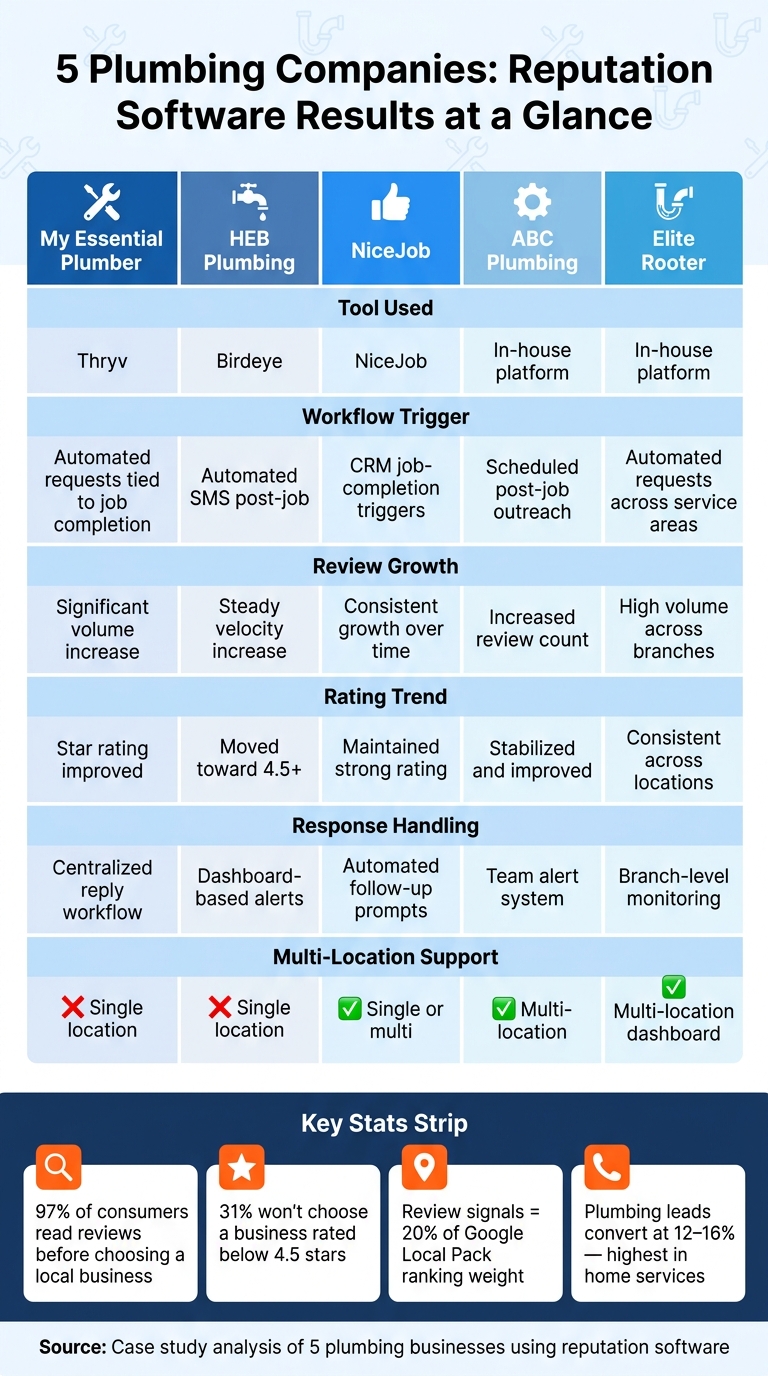
5 Plumbing Companies Using Reputation Software: Side-by-Side Results
Case Study Comparison Table
Those shared patterns show what matters most when you're picking software.
Here’s a tighter side-by-side look at what stood out across the five cases.
| Company | Tool Used | Workflow | Review Growth | Rating Change | Response Handling | Location Tracking |
|---|---|---|---|---|---|---|
| My Essential Plumber | Thryv | Automated requests tied to job completion | Significant increase in review volume | Improved star rating | Centralized reply workflow | Single location |
| HEB Plumbing | Birdeye | Automated SMS requests post-job | Steady increase in review velocity | Rating improved toward 4.5+ | Dashboard-based response alerts | Single location |
| NiceJob | NiceJob | Job-completion triggers via CRM integration | Consistent review growth over time | Maintained strong rating | Automated follow-up prompts | Single or multi-location |
| ABC Plumbing | ABC Plumbing platform | Scheduled post-job outreach | Increased review count | Rating stabilized and improved | Team alert system for new reviews | Multi-location tracking |
| Elite Rooter | Elite Rooter platform | Automated requests across service areas | High review volume across branches | Consistent rating across locations | Branch-level response monitoring | Multi-location dashboard |
Use the table above to narrow your options. Then match each system against the way your team already works day to day.
What to Look for Before Choosing a System
The best setup should fit your office process and your field process without creating extra steps. If a tech marks a job complete, the review request should go out without anyone chasing it down later.
Focus on a few things:
- Integration with scheduling or CRM tools so review requests send automatically when a job is marked complete
- SMS-first review requests
- Response workflows that alert your team when a new review comes in and make replies simple
- Multi-location reporting if you run more than one branch or service area
- Workflows that keep recent reviews coming in on a steady basis
That’s the gut check. If the tool lines up with your workflow, your team is far more likely to use it well.
Conclusion: Key Takeaways for Home Service Owners
Across all five cases, the pattern stayed the same: the best results came from making review collection part of the daily workflow. Reputation software works best when it's tied to completed jobs and handled the same way every time. That matters because 74% of consumers only care about reviews from the last 90 days.
Reviews also shape where you show up. Review signals account for 20% of Google Local Pack ranking weight. And 31% of consumers in 2026 will not consider a business rated below 4.5 stars. So this isn't just about looking good online. It affects whether people find you at all, and whether they trust you enough to call.
The link between reviews and booked jobs is hard to ignore. Businesses that respond to at least 32% of their reviews see an 80% higher conversion rate. In plain English, review volume, star rating, and response rate can all affect how many jobs you book.
What made the biggest difference in these cases? Automation. It turned review collection into something repeatable instead of something the team had to remember when things got busy. The strongest results came when reputation management was built into a repeatable growth process.
The plumbers in these examples didn't change their core service. They kept the same day-to-day operations and added a better review process. The formula was simple:
- Automate review requests
- Reply on a consistent basis
- Tie the process to completed jobs
FAQs
How soon should plumbers send review requests?
Plumbers should send a review request right after the job is done, while the visit is still fresh in the customer’s mind and satisfaction is at its highest.
The best way to avoid missed requests is to automate the process when a job is marked complete or when an invoice is sent. If the customer doesn’t respond, send a polite follow-up 48 hours later.
What features matter most in reputation software?
For plumbing companies, the most important features are the ones that make review management easier and help build trust, such as:
- Automated review requests after service
- Multi-channel monitoring in one dashboard
- Instant alerts for new or negative reviews
AI-powered sentiment analysis and CRM integration can also help teams spot patterns in feedback, tailor responses, and fix issues before they turn into bigger problems.
Can better reviews really increase plumbing calls?
Yes. Reviews have a huge effect on whether someone calls your plumbing business. 97% of consumers read reviews before choosing a local company.
And the gap can be massive. Businesses with 50 or more reviews can get up to 270% more calls than those with fewer than 10. Your star rating matters too: a 4+ star rating is often the minimum people want to see, and 70% of potential customers will not consider a contractor below that score.
Related Blog Posts

Sign up for the newsletter and be the first to read our articles.