Home service case studies work best when they show one problem, one fix, and one clear result. If you want more calls, more trust, or more sales, the strongest angles in this article focus on lead growth, local visibility, review growth, and business expansion - backed by numbers like cost per lead, booked jobs, revenue, star rating, and ROI.
You’ll find 10 usable case study ideas built around a simple flow: scenario, problem, proof, and takeaway. The examples cover things like urgent-search Local Service Ads, service-area pages, Google Business Profile updates, review request systems, neighbor mailers, and content publishing. The article also shows the kind of results that make these stories work, such as 5 to 42 leads per month, $15,000 to $55,000 in monthly revenue, 487% traffic growth, and 4.9 stars from 77 reviews.
If you need a fast way to sort the ideas, here’s the short version:
- Need more leads? Use paid search, neighborhood pages, or local SEO.
- Need more visibility? Use service pages, GBP work, or search-focused site updates.
- Need more trust? Use reviews, mailers, and customer feedback systems.
- Need growth proof? Show how leads turned into more staff, trucks, and revenue.
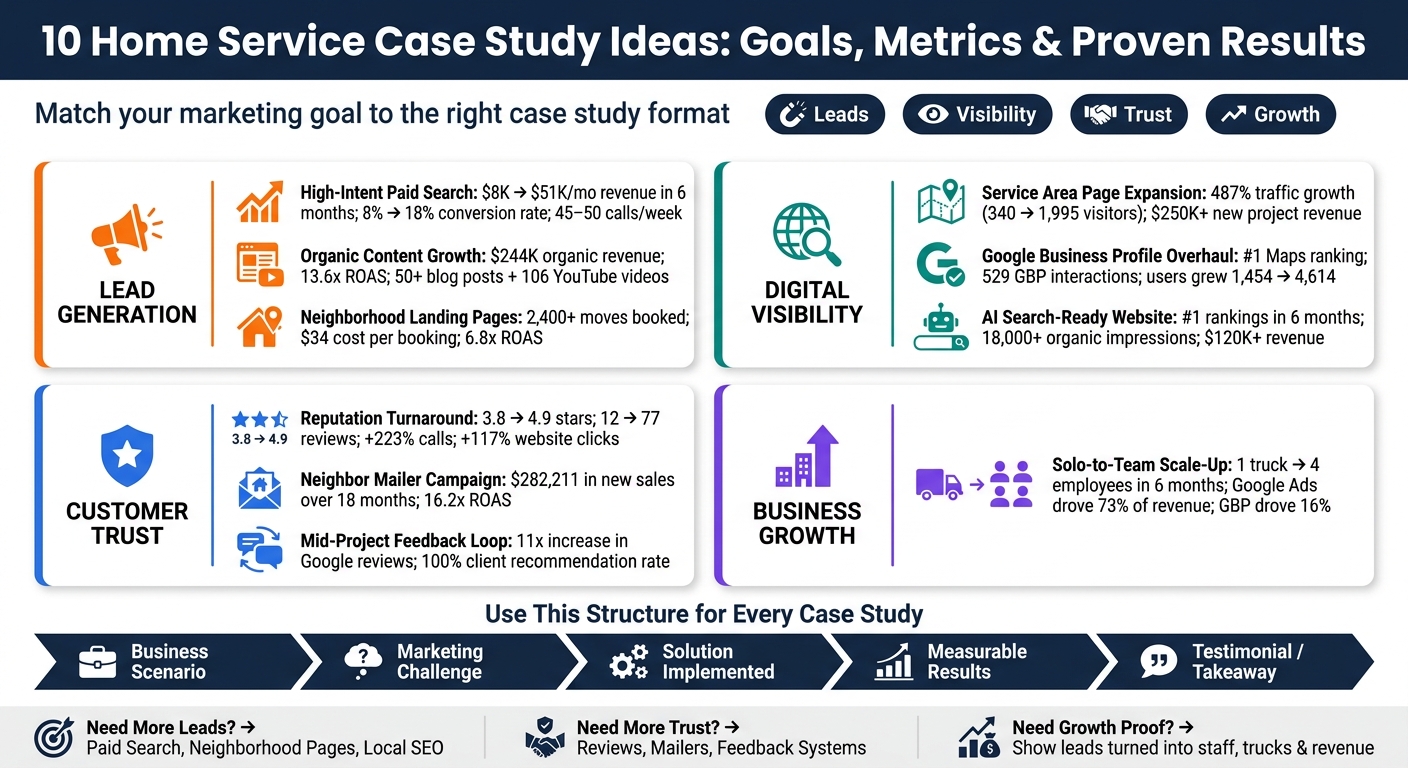
10 Home Service Case Study Ideas: Goals, Metrics & Proven Results
HVAC Google Ads Case Study | 121k In 30 Days
sbb-itb-2aa0348
Quick Comparison
| Case study idea | Best for | What to show |
|---|---|---|
| High-intent paid search | More calls fast | Call volume, landing page conversion rate, revenue |
| Organic content growth | Long-term lead flow | Posts published, video output, organic revenue, ROAS |
| Neighborhood landing pages | Hyperlocal demand | Bookings, cost per booking, ROAS |
| Service area page build-out | Local rankings | Traffic growth, project revenue |
| Google Business Profile overhaul | Map pack visibility | Rankings, GBP actions, site users |
| AI search-ready website launch | New market entry | Impressions, rankings, campaign revenue |
| Review system turnaround | Better trust signals | Star rating, review count, calls, clicks |
| Neighbor mail campaign | Local social proof | Sales from mailers, ROAS |
| Mid-project feedback loop | Better customer experience | Review growth, referral or recommendation rate |
| Solo-to-team growth story | Scale and hiring | Revenue mix, staff growth, trucks, capacity |
This article gives you a simple way to turn completed jobs into proof you can use in proposals, social posts, emails, and local listings.
How to Structure Each Home Service Case Study
Use the same structure for every case study: business scenario, marketing challenge, solution, results, and takeaway. That keeps each one easy to scan and much easier to compare.
Start with a clear business scenario. Say who the client is, where they operate, and what kind of service they offer. Then spell out the marketing challenge in plain terms: low lead volume, poor local search visibility, high cost per lead, or another specific problem.
Next, explain the solution. Show what changed, how long it took, and which channels were part of the work. This is where you connect the problem to the actions taken.
The results section should be all about hard numbers. Include the starting point, the outcome, and the timeframe. For example, in the Contractor Bear case, a solo plumber in Phoenix, AZ went from 5 to 42 leads per month. Monthly revenue grew from $15,000 to $55,000, and the business hit a 7.5x ROI by month six through Google Business Profile optimization, a 200+ page website, and targeted search campaigns.
Finish each case study with a testimonial or takeaway that shows why the result happened. If the client wants to stay unnamed, use the property type and general location instead. Estatehub can track leads from SEO, paid ads, websites, and CRM follow-up, which makes performance easier to document.
Use this template to keep every case study consistent and easy to scan.
| Case Study Element | What to Include | Example |
|---|---|---|
| Business Scenario | Client type, location, service area | Solo plumber, Phoenix, AZ |
| Marketing Challenge | Specific problem with measurable baseline | Low lead volume, poor visibility, high cost per lead |
| Solution Implemented | Channels used, timeline, key actions | Google Business Profile optimization, Google Ads, 200+ page website |
| Measurable Results | Hard numbers with timeframe | 5 to 42 leads per month, $15,000 to $55,000 in monthly revenue, 7.5x ROI by month six |
| Testimonial or Takeaway | Direct quote or key lesson learned | Customer quote or key takeaway |
1. Lead generation
Lead generation case studies work best when they show one simple thing: a marketing change led to more booked jobs. For this section, focus on three angles that local service businesses care about most: paid ads, organic content, and hyperlocal SEO.
The "High-Intent" Paid Search Win
Show what happened when ad spend moved toward urgent, ready-to-book searches. A solo plumbing business in Jacksonville, FL grew from $8,000 to $51,000 in monthly revenue in just six months by going after terms like "emergency plumber Jacksonville." Its landing page conversion rate climbed from 8% to 18%, which led to 45 to 50 calls per week.
That kind of case study lands because the link is easy to see. The business didn’t just spend more. It spent with more focus, aiming at people who needed help right now.
The Organic Content Compounding Story
This angle shows how steady publishing can build a lead pipeline over time. An agency-led campaign for a Florida luxury home services franchisee ran from January through December 2025. During that stretch, publishing 50+ blog posts and 106 YouTube videos brought in $244,000 in organic revenue with zero Google Ads spend, along with a 13.6x ROAS and a 50% consultation-to-job close rate.
"Organic search leads converted at 4.5x the rate of paid social leads in the same period." - The FS Agency
This is the kind of story that shows compounding in plain English: publish useful material again and again, and the lead flow can keep building without paid search carrying the load.
The Neighborhood-Level Landing Page Playbook
This case study angle is about being easier to find in the exact places that matter. Between 2024 and 2025, Good Guys Moving in Kansas City, MO built 12 neighborhood-specific landing pages and paired them with seasonal bidding. The campaign led to 2,400+ moves booked in 12 months at a $34 cost per booking and a 6.8x ROAS.
What makes this example hit home is how local it feels. Instead of trying to rank one broad page for an entire city, the business went block by block, neighborhood by neighborhood, and took on national players that way.
Once lead generation is documented, the next case studies should show how the business became easier to find.
2. Digital visibility
These case studies show how home service businesses improved local search visibility. Each one took a different route, but the goal was the same: show up when nearby customers search.
The Service Area Page Expansion
Dallas Premier Roofing added 15 neighborhood service pages and 24 blog posts over 12 months. Organic traffic grew 487%, from 340 to 1,995 monthly visitors. The campaign also brought in $250,000+ in new project revenue.
That matters because service-area pages can help a business rank for neighborhood-based searches. If someone looks for a roofer in a specific part of town, those pages give Google a clear match.
The Google Business Profile Overhaul
Albion Plumbing Rooter Inc. took a broader approach. The company built 6 service area pages, published 28+ blog posts, and added AI-assisted video content over 25 months. It reached #1 in the Google Maps local pack for "commercial plumbers near me", recorded 529 GBP interactions in a five-month window, and website users increased from 1,454 to 4,614.
"For a service area business, a direction request is one of the strongest buying signals." - Clixlogix
That quote says a lot. A direction request isn't casual interest. It's often a sign that someone is close to making contact.
The AI Search Readiness Build
Mainzer Roof & Gutter in Evergreen, Colorado launched in January 2026 and built its site and Google Business Profile for AI search and local visibility. Within six months, the company reached #1 rankings for "Gutter Repair Companies Evergreen", earned 18,000+ organic impressions, and generated more than $120,000 in revenue tied to the campaign.
Once a business is visible, the next step is proving it deserves the click.
3. Customer trust
After visibility, trust is what gets people to say yes. For home service brands, that often comes down to proof. Not promises. Not polished claims. Just plain signs that other homeowners had a good experience.
Here are three case study angles that show how trust can move the needle.
The Reputation Turnaround
A plumbing contractor in Lacey, Washington went from a 3.8-star rating with 12 reviews to a 4.9-star rating with 77 reviews between February and August 2025. The big change was simple: the business put an immediate post-job review request system in place. That one shift helped drive a 223% increase in calls and a 117% jump in website clicks.
The Neighbor Mailer
A garage floor refinishing franchise mailed 100+ postcards to neighbors every time a job wrapped up. The message was direct: we just refinished your neighbor's garage. That local, street-level proof paid off. Over 18 months, the campaign brought in $282,211 in new sales and produced a 16.2x ROAS.
The Mid-Project Feedback Loop
D.R. Domenichini Construction, a Bay Area remodeling company, used mid-project surveys to spot problems before they grew. Then, after the job was done, the company followed up with review requests. Over one year, that approach led to an 11x increase in Google reviews and a 100% client recommendation rate.
Once trust is on the record, the next set of case studies can show how that trust leads to growth.
4. Business growth
Once trust is there, growth should show up where it counts: revenue, capacity, and staffing.
The Solo-to-Team Scale-Up
This angle works well when you want to show how a small home service business can move past word-of-mouth and build a repeatable marketing system.
Reliable Plumbing, a Jacksonville-based solo operation, is a strong before-and-after example. Between June and November 2025, owner Mark grew from one truck to a team of four employees. That growth was driven by Google Ads (73% of revenue), Google Business Profile (16%), and SEO (3.5%).
When you tell this kind of story, don’t just say the business grew. Show the shift side by side:
- Revenue
- Call volume
- Capacity
That’s what makes the case study hit home. It connects marketing results to what changed inside the business. More leads didn’t just mean more phone calls. They meant the company had to add capacity to keep up.
The main idea is simple: more leads, more capacity, more revenue.
Conclusion
The best home service case studies are specific, measurable, and easy for prospects to picture in their own business. When people can see clear numbers, it becomes much easier for them to imagine what the same kind of result could look like for them.
Match the case study to the business problem already covered in this article.
Use this simple map:
| Goal | Case Study Focus | Key Metric |
|---|---|---|
| Local Leads | GBP & Urgent Search SEO | Booked calls per day |
| Customer Trust | Review Growth & Visual Proof | Star rating & review count |
| Scalable Growth | Organic Content (Blog/Video) | ROAS and revenue |
If you need more local leads, build the case study around GBP optimization and urgent-search SEO. If trust is the weak spot, focus on review velocity and before-and-after visuals. If you're ready to scale, show how organic content adds up over time.
Then use each case study across the places that help move deals forward:
- Proposals
- Social posts
- GBP updates
Pick the idea that matches where your business is today. Gather the data, tell the story with real numbers, and put it in front of the right audience. That's how completed jobs turn into sales proof you can use again and again.
FAQs
Which case study idea should I start with?
Start with a client who had a good experience, matches your target market, and got clear results you can measure.
A strong case study should show three things: the client’s problem, how your service fixed it, and what happened after that. Use hard numbers like revenue, cost savings, or lead growth so the result feels concrete, not vague.
You can also add:
- Before-and-after visuals
- A direct quote from the client
Those details make the case study feel more believable and easier to trust.
What numbers make a home service case study believable?
Use specific, measurable results instead of vague claims. The numbers people trust most tend to be revenue generated, average job value, return on ad spend, lead volume, cost per lead, and conversion rates.
Before-and-after comparisons help, too. They make the outcome easy to see at a glance. For example, you can show changes in monthly energy costs, job completion times, or lead growth.
Use standard U.S. formatting for dollar amounts and numbers, such as $12,500, 1,250 leads, or 3.8% conversion rate.
How can I turn a completed job into a case study?
Build this into your workflow. Take a before, during, and after photo. Write down the problem, the fix, and the result. Then ask the client for a short testimonial and permission to share the project.
From there, turn it into a simple story: the client’s challenge, your team’s action, the measurable result, and the customer quote. Once it’s done, you can use it again and again on your website, blog, social media, or email.
Related Blog Posts

Sign up for the newsletter and be the first to read our articles.