

Overview of Common Stains
Full overview of the most common stains, including how to identify them and treat them
If your contractor site does not work well on phones, you can lose leads and search traffic on both mobile and desktop.
For most contractors, mobile should come first. Home service traffic is mostly mobile, phone users often need help fast, and Google ranks sites based on the mobile version first. Desktop still matters, but it usually helps with research-heavy jobs, longer service pages, reviews, and quote forms.
Here’s the short answer:
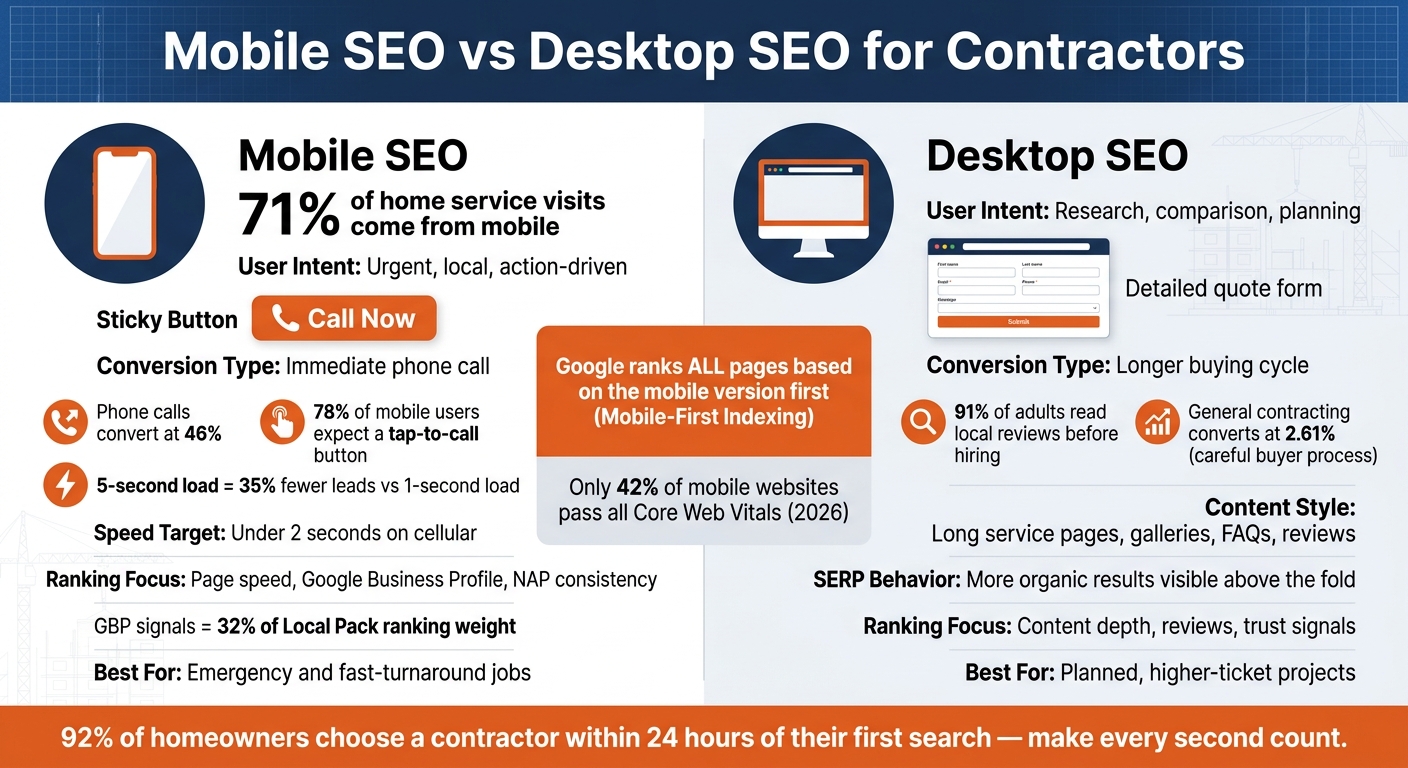
Mobile SEO vs Desktop SEO for Contractors: Key Differences & Stats
| Area | Mobile SEO | Desktop SEO |
|---|---|---|
| Main user goal | Fast action | Research and comparison |
| Common lead type | Phone calls | Quote requests |
| Best CTA | Sticky Call Now button | Detailed form |
| Page layout | Short, simple, easy to tap | More room for service details |
| Top ranking focus | Speed, GBP, NAP match | Content depth, reviews, trust signals |
| User behavior | Urgent, local, after-hours | Slower, more detailed |
| Best fit | Emergency and fast-turn jobs | Planned and higher-ticket jobs |
The core point is simple: your mobile site brings in the first click, and your desktop site often helps close the job.
For contractors, mobile search is often where the lead starts. And on a phone, the business that wins is usually the one that makes contact the easiest. That’s why speed and call access should come first.
Mobile users usually need help fast. They don’t sit around reading every word on the page. They scan for a few things right away: proof that you’re a real local contractor, a phone number they can see without hunting for it, and a site that loads fast. If one of those is missing, they’re gone.
A lot of service-related searches happen after hours, and most of that traffic comes from mobile. So if your site is slow, cluttered, or hard to use on a phone, you can lose the lead before the person even considers calling.
Speed comes first. A 5-second mobile load time loses about 35% of potential leads compared to a 1-second load. A good target is under 2 seconds on a cellular connection. That usually means compressing images, cutting unused scripts, and moving to better hosting.
Then comes layout. On mobile, people want the shortest path from problem to phone call. A sticky "call now" button that stays on screen while someone scrolls can make a big difference. 78% of mobile users expect a call button to be readily available, and in home services, phone calls convert at 46%.
Forms matter too, but shorter is better. Every extra field cuts submissions by about 4%. On mobile, ask only for what you need to start the conversation.
Core Web Vitals play a part here as well. Google uses page experience signals like LCP and INP as ranking factors. And as of 2026, only 42% of mobile websites pass all three Core Web Vitals metrics. That leaves room for a contractor site with better performance to outrank nearby competitors that still haven’t fixed these issues.
Once the site feels easy to use, the next step is getting seen.
If your mobile site leaves out content, that can hurt rankings on all devices. For local search, the fastest areas to clean up are:
Google Business Profile signals make up 32% of Local Pack ranking weight. So your GBP phone number, website, and directory listings should match exactly. No small differences. No old tracking number in one place and a main line in another.
That kind of consistency helps your local visibility and can decide whether a nearby homeowner sees your company first or calls someone else.
Mobile brings in urgent leads. Desktop tends to catch people who want more details before they choose.
Mobile brings in urgent calls. Desktop tends to bring in homeowners who are still weighing their options.
That changes the job of the page. On desktop, people usually want more detail, more proof, and a path that fits a slower sales cycle.
Desktop visitors often land on pages for higher-ticket, planned projects. They're not always ready to call on the spot. More often, they're comparing contractors, checking scope, and looking for signs they can trust.
That lines up with the numbers. Construction and remodeling leads often convert at lower rates than emergency trades, but the jobs can be worth more. General contracting averages just 2.61%, which shows how careful that buying process tends to be.
Desktop pages have more room to do the heavy lifting. You can give visitors the detail they need without making the page feel cramped.
That usually means things like:
Those pieces matter because 91% of adults read local reviews before hiring a service business. On desktop, it's much easier for someone to read those reviews, compare them with your services, and decide whether to reach out.
Skip vague testimonials. Use named reviews with the project type and date. That feels more grounded and gives people more to work with.
And once a form comes in, quick follow-up still matters.
That matters because desktop content only works when the mobile version is strong enough to rank.
Google ranks your site based on its mobile version first. So if your mobile site loads slowly or has weak Core Web Vitals, your desktop pages may not rank well enough to bring in that research-heavy traffic.
In plain English: desktop can help you close careful buyers, but mobile still sets the stage. Keep that mobile base in good shape so your desktop content has a shot to rank and convert.
Those differences show up most clearly in user intent, page design, and conversion paths.
The main gap isn’t the device itself. It’s what the person wants to do in that moment.
Mobile and desktop SEO tend to split at the point where a search turns into a lead for a contractor. And that matters, because some fixes help you get calls right now, while others support a longer path that ends with a quote request.
Mobile users are often in the middle of something and need a local fix fast. Desktop users usually have more time. They’re comparing contractors, reading service pages, and weighing options before they ask for a quote.
That shift changes how people click, how long they stay on a page, and how they convert. On mobile, SERPs show fewer results above the fold, so top rankings matter more. Mobile visibility also leans hard on local search signals.
For contractors, the difference looks like this:
| Factor | Mobile SEO | Desktop SEO |
|---|---|---|
| Primary intent | Urgent, local, action-driven | Research, comparison, planning |
| Key CTA | Persistent tap-to-call button | Detailed quote form |
| Conversion path | Immediate phone call | Longer buying cycle |
| SERP behavior | Fewer results above the fold; top positions matter more | More organic results visible |
That table makes the pecking order pretty clear.
Start with speed. Aim for under two seconds on a real cellular connection, not just a lab test. Compressed images and high-performance hosting will get you most of the way there.
Next comes the sticky call button. This one isn’t optional on mobile. 78% of mobile users expect a "call now" button to be immediately available - which means it should stay on screen as they scroll, not vanish into the header. Then comes the part many teams miss: once a lead comes in, fast follow-up is what helps close it.
Because Google uses the mobile version first, these fixes shape both rankings and leads across devices.
Mobile should get your first attention. It drives most contractor site visits and influences rankings across devices. Desktop still has a job to do, especially for planned projects where people spend more time reading, comparing options, and coming back later to convert.
That split shapes smart contractor SEO, the kind Estatehub builds into every site and campaign it runs for home service clients. Mobile catches urgent calls. A slow mobile page loses those calls before anyone picks up the phone, which is why speed and mobile-first structure sit at the center of a contractor SEO strategy. Desktop plays a different role. People here want to slow down, do their homework, and ask for quotes after a bit more research, and that longer path only converts if the contractor website is built to hold their attention through comparison and reviews.
Compare your mobile conversion rate with desktop.
If desktop converts well but mobile doesn’t, there’s a good chance your mobile experience or page speed is costing you leads. And that’s a big deal, because mobile often drives 70%+ of traffic for home services companies.
Look at common trouble spots like:
This kind of gap usually isn’t subtle. People land on your site, hit friction, and leave before they call or fill out a form.
Desktop SEO tends to matter most for contractor services with longer buying cycles and stronger research intent, especially construction and remodeling work like general contracting and renovations. These visitors are often in comparison mode, looking at options before they make a call.
For urgent or emergency repair services, mobile/local SEO matters more, along with fast click-to-call.
Start with the two biggest fixes: mobile load speed and easy contact access.
Your site should load in under 3 seconds. 1.5–2.5 seconds is an even better target, because slow pages can drag down conversions fast.
A few simple moves can help:
This isn’t fancy stuff. It’s the kind of basic cleanup that makes a site feel smooth instead of frustrating.
Sign up for the newsletter and be the first to read our articles.


Every single person on our agency team has spent a lot of time in the field either running their own business or working for larger marketing agencies. We have all put in the time responding to leads, helping customers, scheduling and doing services. This gives us a massive advantage when making decisions.
One thing that has always been very special to us, is the fact that (excluding spam / people that never used our services) we do not have any bad reviews. This absolutely does not mean we have never had unhappy clients, but if it happens, we make it right, and stand behind our promises.
We have seen, time and time again, other agencies using strategies and structuring campaigns the way that they are technically supposed to. Most of these "best practices" that are taught in our industry, simply do not transfer into local lead gen. This is partially because we do have a much different target audience, and are typically spending less, however optimizing for website traffic does not work here.
We have been there, jumping into starting a home service business, struggling, and doing everything wrong. It's humbling. Our team has all felt the highs and lows, which is why we get so excited for our clients to win, we know how good it feels.

Estatehub is not a normal agency, we know "clicks" don't get you sales. Let us show you how lead gen experts do it.

