If your social posts sound like every other home service company, people will compare prices and keep scrolling. I’d fix that by turning each post into a simple story: show the homeowner problem, show the work, and show the result.
Here’s the whole idea in plain English:
- Story posts beat generic promos because they give homeowners a clear problem and a clear fix.
-
I’d use 4 simple formats:
- Before-After-Bridge for visible changes
- Problem-Agitate-Solution for urgent issues
- Three-Act for short job walkthroughs
- Customer-as-Hero for reviews and testimonials
-
I’d post 3 main story types:
- problem-to-solution jobs
- before-and-after projects
- review or case-style posts
-
I’d match the post to the platform:
- Facebook for fuller job stories
- Instagram for visual proof
- Reels/TikTok for 15–60 second walkthroughs
- LinkedIn for commercial case posts
- I’d track leads, calls, DMs, form fills, and booked estimates - not just likes or views.
- I’d turn one finished job into many assets: a social post, ad, landing page, and follow-up campaign.
A short video of a drainage fix, a deck repair, or a same-day AC service call can stay in a homeowner’s mind far longer than “fast and friendly service.” And when that person needs help later, that memory can lead to a call.
Here’s a quick side-by-side view of the formats:
| Format | Best Use | Best Platforms | Main Goal |
|---|---|---|---|
| Before-After-Bridge | Visible home changes | Instagram, Facebook, TikTok | Show proof fast |
| Problem-Agitate-Solution | Urgent repairs | Facebook Ads, Instagram | Push action now |
| Three-Act | Process-heavy jobs | Reels, TikTok | Show how the work gets done |
| Customer-as-Hero | Reviews and testimonials | Facebook, Instagram, TikTok | Build trust through homeowner stories |
One stat stands out: the article points to replying within 60 seconds as a major factor in closing more leads. So even a strong story can lose value if follow-up is slow.
If I had to boil the full guide down to one line, it’d be this: post proof-based stories about problems you fix, pair them with a clear CTA, and track which stories turn into booked work.
Story Frameworks for Social Posts That Generate Leads
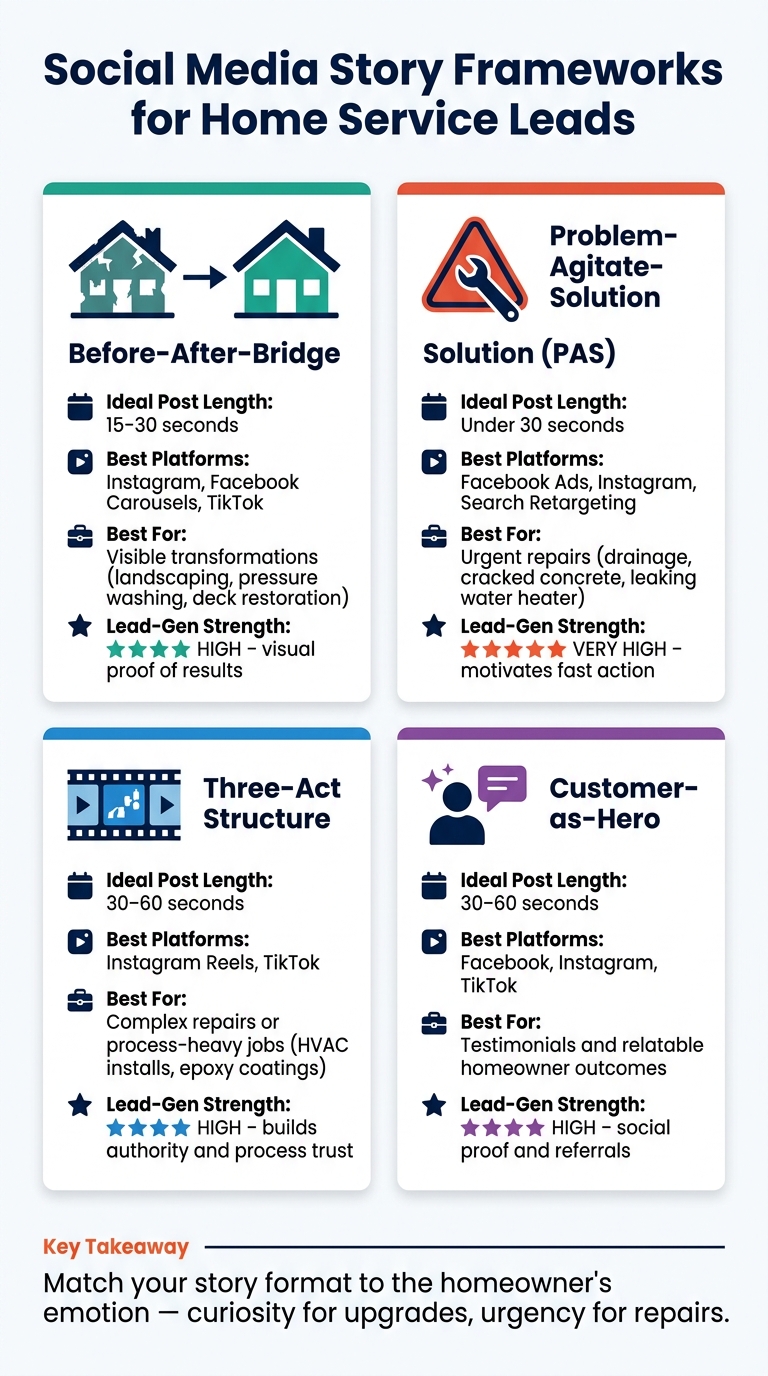
Social Media Story Frameworks for Home Service Leads: A Visual Guide
The right story structure helps turn attention into leads. Match the framework to what the homeowner is feeling: mild curiosity about an upgrade or clear urgency around a repair.
Before-After-Bridge for Visible Home Transformations
Before-After-Bridge (BAB) works best when people can see the result. Think of pressure washing a grimy driveway back to clean concrete, restoring a weathered deck, or turning an overgrown backyard into a finished outdoor space. The post starts with a problem the homeowner recognizes, shows the end result, then explains how you got there.
A before-and-after image is strong on its own. But when you also show the technician, truck, and work process, it becomes proof. It shows how the change happened, not just that it did. On Instagram and Facebook, a short clip or carousel is usually enough to carry the full story.
Problem-Agitate-Solution for Urgent Homeowner Concerns
Problem-Agitate-Solution (PAS) is built for urgency. It opens with a pain point the homeowner already feels - standing water near the foundation, a storm-damaged fence, cracked concrete on the front step - then pushes the risk of waiting before showing your service as the fix.
The agitate step is what makes this format work. A drainage post that only says "standing water is a problem" probably won't push someone to act. But a post that explains how water pooling near a foundation can lead to spreading water damage or safety risks gives the homeowner a clear reason to deal with it now instead of putting it off. This format tends to work best in urgent Facebook ads.
Three-Act and Customer-as-Hero Formats for Short Videos
For Instagram Reels and TikTok, three-act structure and customer-as-hero formats fit short video well.
Three-act structure keeps things simple:
- Setup: the problem
- Conflict: why it matters
- Resolution: your team fixes it
A 30–60 second Reel with a service manager walking through a repair or inspection on camera can help build trust. People get to see what failed and why, which makes the service feel more concrete.
The customer-as-hero format puts the homeowner front and center. They had a problem, your team helped solve it, and now they share the outcome in a way that feels personal and believable. This works especially well for testimonial-style videos and review-based carousels on Facebook and Instagram, where social proof can help drive the call.
Use the table below to match the format to the platform and the kind of lead you want.
| Framework | Ideal Post Length | Best-Fit Platform | Type of Home Service Problem | Lead-Gen Strength |
|---|---|---|---|---|
| Before-After-Bridge | 15–30 sec | Instagram, Facebook Carousels, TikTok | Visible transformations (landscaping, pressure washing, deck restoration) | High - visual proof of results |
| Problem-Agitate-Solution | Under 30 sec | Facebook Ads, Instagram, Search Retargeting | Urgent repairs (drainage, cracked concrete, leaking water heater) | Very high - motivates fast action |
| Three-Act Structure | 30–60 sec | Instagram Reels, TikTok | Complex repairs or process-heavy jobs (HVAC installs, epoxy coatings) | High - builds authority and process trust |
| Customer-as-Hero | 30–60 sec | Facebook, Instagram, TikTok | Testimonials and relatable homeowner outcomes | High - social proof and referrals |
These formats work because they make the homeowner's problem - and your fix - easy to grasp fast. Next, pair each framework with the story types that get the most responses.
sbb-itb-2aa0348
Story Types Home Service Businesses Should Post
Once you know the framework, pick the story type that lines up with what the homeowner wants. The goal isn't to get likes for the sake of likes. It's to post stories that lead to inquiries.
Customer Problem-to-Solution Stories and Before-and-After Jobs
This is one of the fastest ways to turn a post into an estimate request. Start with a real homeowner problem - a patio that holds standing water after rain, a fence with rotted posts, cracked concrete steps, or siding covered in mildew - and walk through the job step by step.
These posts work because they're specific. A location tag, a short timeline, and a clear end result help homeowners see whether your service fits their situation before they contact you. Add a short walkthrough clip, and you've often shown enough for someone to ask for an estimate.
Testimonial, Review, and Case-Style Stories
A review can become a short case story: problem, service, result, quote. Start with the homeowner's exact concern - clogged gutters, an unsafe deck, a yard that flooded every spring - then turn it into a short narrative, add a direct quote, and finish with a plain result, like no standing water after major storms or driveway cleanup taking much less time.
Reviews matter because homeowners look for proof before they hire. These posts tend to work best near a strong CTA like "Schedule a free inspection" since they answer the same doubts many people have right before they reach out.
Brand Values and Behind-the-Scenes Stories
Behind-the-scenes posts speak to trust in a direct way. Short clips of your crew putting down floor protection, talking through a drainage design, or doing a final walkthrough with the homeowner show that your team is organized, respectful, and worth hiring.
It also helps to show the people behind the work. A quick clip of your lead technician explaining what he checks during a fence post inspection can go a long way. Then spell out your on-site standards in plain English: no smoking on property, end-of-day cleanup, and a joint walkthrough before the crew leaves. That kind of content helps careful homeowners move from maybe to let me get a quote.
Use these story types to decide what to post and when.
| Story Type | Common Use Case | Emotional Angle | Proof Included | Hire Intent |
|---|---|---|---|---|
| Customer problem-to-solution | Drainage, fence repair, patio leveling, exterior cleaning | Relief, safety, "finally fixed" | Narrative with diagnosis, scope, and outcome | High - homeowners with the same problem often move straight to requesting an estimate |
| Before-and-after jobs | Visible transformations: pressure washing, deck restoration, remodel work | Pride, curb appeal, aspiration | Photos or video, plus a brief scope and timeline | Medium–High - strongest when paired with a location tag and a clear CTA |
| Testimonial/case-style | Recurring services and larger projects like roofing, drainage, or remodels | Trust, reassurance, reduced risk | Customer quotes, star ratings, measurable outcomes | High - third-party validation is often the final push for undecided homeowners |
| Brand values/behind-the-scenes | Showing standards, safety, and reliability | Confidence, safety, reliability | Certifications, crew behavior, process visuals, checklists | Medium - supports other story types and helps warm up hesitant homeowners |
Next, match each story type to the platform where it can bring in the most leads.
How to Match Stories to Platforms and Measure Leads
Each platform changes the way a story should be told. Length matters. Proof matters. And the CTA that works on one channel can fall flat on another. Once you have your core story formats, the next step is simple: match each one to the platform most likely to turn attention into leads.
Best Story Structure for Facebook, Instagram, Reels, TikTok, and LinkedIn
The table below shows how to adjust story length, proof, and CTA by platform.
| Platform | Best Length | Best Format | Proof to Show | Best CTA | Lead Stage |
|---|---|---|---|---|---|
| Medium (1–3 min) | Before/After Carousel | Before/after photos, location tag | "Book Free Inspection" | Awareness / Retargeting | |
| Instagram Feed | Short (captions) | High-res transformation | Visual result, brief scope | "Message for Quote" | Awareness |
| Instagram Stories | Very short (<15s) | Authentic "day in the life" | Quick process clip | "Book Free Inspection" | Consideration |
| Reels / TikTok | Short (15–60s) | Walkthrough videos | Jobsite footage, plain voiceover | "Learn More" | Awareness |
| Long (text-heavy) | Case study / B2B tips | ROI data, process detail | "Contact for Estimate" | Commercial / B2B |
Estatehub treats Facebook as the main platform for most home service campaigns. That makes sense. Social stories can reach homeowners before they start searching, which helps create demand earlier.
For Reels and TikTok, polished production usually isn't the move. A 60-second walkthrough of a finished project, paired with a plain voiceover, often beats anything that feels like a commercial. It looks more natural, and people tend to trust it more.
LinkedIn plays a different role. It's a better fit for commercial leads, especially property managers and general contractors. Longer, case-style posts tend to work best there, with more detail on process and ROI.
Your CTA should also change by platform. Awareness-stage Reels can stick with "Learn More." Retargeting ads and Stories should ask for more direct action, like "Book Free Inspection" or "Message for Quote."
Lead Metrics That Matter More Than Likes and Views
Once the story is live, the goal isn't engagement for its own sake. The real test is whether it leads to booked work.
The metrics that matter most are:
- Booked estimates - the clearest sign a story is driving revenue
- Tracked calls - use a separate phone number for each campaign so you can tie calls back to each story
- Direct messages - especially useful on Instagram and Facebook
- Form fills - native Facebook lead forms cut friction and keep the lead inside the app
- Response speed - replying within 60 seconds improves close rates
Connect all of it to a CRM so you can see which story led to which booked job. Then track the funnel in layers. Click-through rate shows whether the story got attention. Cost per lead shows whether it's worth spending more. Booked estimates show whether it's turning into revenue.
What Stronger Stories Look Like in Campaign Results
Use booked estimates, call volume, DMs, and form fills to figure out which story types deserve more budget and more repetition. Post-storm free-inspection stories are a good fit for the urgency-driven Before-After-Bridge approach.
Next, turn the top-performing story into a repeatable system across social posts, ads, and follow-up.
Building a Repeatable Storytelling System With Estatehub

Once you know which stories and platforms bring in leads, the next move is to turn that into a system you can run again and again. One real job can become social posts, ads, landing pages, and tracked leads. The point isn't to make more content for the sake of it. The point is to get more leads from the same story.
Using One Story Across Social Posts, Ads, and Landing Pages
Take one job and use it across social content, ads, and a landing page with the same proof, message, and CTA. For example, a roofing contractor can turn a storm-damage repair into a before-and-after carousel, a short walkthrough video, and a landing page case study with a homeowner quote and results. That way, the same story helps move people closer to booking.
Keep the core message the same in each version. Stick with one CTA across the campaign.
Estatehub can make this process more consistent by building a campaign kit for each featured job. That can include:
- a content brief
- social copy variants
- ad creative
- landing page layouts
It also uses Estatehub's CRM to tie each inbound lead back to its source campaign, ad name, and story theme. That gives you a clearer view of which stories are driving calls, form submissions, booked estimates, and revenue that matter most - not just likes or views.
When every asset carries the same story, it's much easier to track which version converts.
Tracking and Scaling Story-Based Campaigns With CRM Support
The next step is using CRM data to keep your best stories in play. That data shows which story themes lead to booked work. A water damage emergency story, for example, may get fewer likes than a general home upgrades post, but still bring in more high-value booked estimates.
Estatehub reviews account data every two days and runs bi-weekly check-ins with clients to compare ad performance with actual estimate outcomes. Estatehub guarantees a minimum of 30 incoming leads per month for clients who keep at least $50/day in ad spend. When a story theme starts working, scaling it can improve client results fast.
Key Takeaways for Turning Stories Into Booked Work
Use Before-After-Bridge or Problem-Agitate-Solution frameworks so your team can produce content on a steady basis, not just when someone has a good idea. Center each story on a real homeowner problem - a leak stopped, a system replaced before a heat wave, a roof secured before winter - and show a clear outcome.
Match the format to the platform. Visual transformations fit Instagram and TikTok. More detailed narratives work on Facebook. Process-focused case studies fit LinkedIn. Then measure what counts: leads, booked estimates, and revenue per campaign, not likes.
A simple monthly cycle can keep this moving:
- collect stories from the field
- produce content with proven frameworks
- run paid and organic distribution
- track results in a CRM
- put more budget and effort behind what's working
When each job turns into a repeatable lead asset, storytelling starts working like a system instead of a one-off effort.
FAQs
How often should I post story-based content?
There’s no one posting schedule that fits every business, but posting on a steady basis matters if you want to build trust and authority.
The goal is to stay top-of-mind while people decide who to hire or buy from. That process often takes 3 to 7 interactions. Steady organic posts connected to local events, seasonal problems, and community references can help your business stay relevant and trusted.
What if I don’t have video footage from every job?
You don’t need footage from every single job to build a strong social media presence. Sure, visuals help people feel more at ease. But they’re not the whole game.
You can also post educational content, maintenance tips, and expert advice to show that you know your stuff.
Keep the storytelling personal and tied to your area. Mention local landmarks, seasonal problems, or community events so the content feels familiar and relevant.
How long should I test a story before changing it?
Don’t pull the plug too soon. A lot of providers stop after 3 months, but storytelling for lead generation can take as long as 24 months to show its full ROI.
That stretch of time matters. It gives you room to build authority, gather data, and keep your storytelling tied to your business goals before you make big changes.
Related Blog Posts

Sign up for the newsletter and be the first to read our articles.