Testimonials help you win more estimates by showing clear proof from past customers at the moment people are deciding.
If you want more homeowners to contact your business through digital marketing for home service providers, focus on four steps: ask happy customers for feedback within 48 hours to 7 days, get written approval before posting, trim each quote so it stays clear and specific, and place those quotes on service pages, emails, and estimates. That matters even more now because 31% of consumers in 2026 said they will not contact a contractor without at least a 4.5-star rating.
Here’s the short version:
- Ask soon after the job ends
- Use the customer’s name and mention the exact service
- Get approval by text or email before publishing
- Use details like city, service, and result
- Match each testimonial to the right page or sales message
- Keep a simple system to track, post, and replace older quotes
A testimonial is not the same as a review or a case study. A review sits on Google or Yelp. A testimonial is a customer quote you select and place on your own marketing pages. A case study goes deeper into the full job story.
The quotes that work best are specific. A line like “great job” does little on its own. A better quote mentions what work was done, whether the crew showed up on time, how cleanup went, and whether the final price matched the estimate. Adding before-and-after photos or short video can help even more, especially for jobs people can see, like decks, fencing, landscaping, and remodeling.
You should also keep your process simple and repeat it after every finished job. One person should handle requests, approval, posting, and updates so nothing gets missed.
That’s the full idea of the article: use short, specific customer quotes as proof, place them where homeowners hesitate, and treat testimonial collection like part of your normal closeout process.
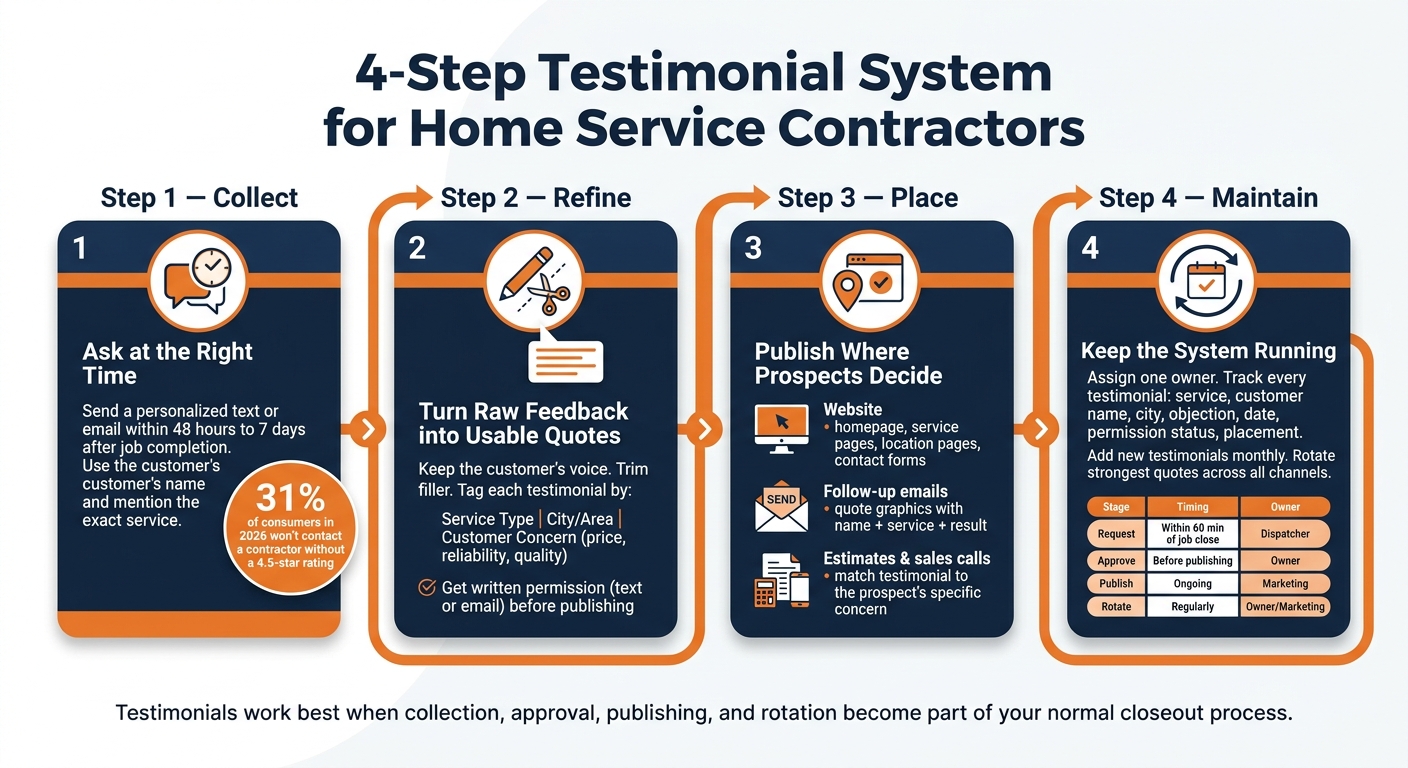
4-Step Testimonial System for Home Service Contractors
How to build trust quickly with potential clients
sbb-itb-2aa0348
Step 1: Collect Testimonials from the Right Customers at the Right Time
Once you know what makes a testimonial believable, the next move is simple: ask for it while the job is still top of mind. A basic repeatable process helps you collect testimonials on every closed job, instead of hoping someone remembers to follow up.
Ask Within 48 Hours to 7 Days After a Successful Job
Timing matters here. Ask within 48 hours to 7 days after the job is done, while the customer still remembers the service, the result, and how the whole visit felt.
A good way to handle this is to have the office manager or dispatcher send the request through your field service software as soon as the job is marked complete.
The best requests feel personal. They shouldn't read like a cold auto-send.
Use a Personalized Text Message
Use the customer's name and mention the exact service you completed. That small detail makes the message feel like it came from a person, not a system pushing out the same link to everyone.
Example text:
Hey [Name], glad we could get that [Service] handled today - if you have a minute, would you share a few words about the job? Would you share a few words about your experience? It helps other homeowners feel confident choosing us.
Before you post any testimonial, get approval in writing.
Get Written Permission Before Publishing
Get a written yes by text or email before you publish the quote. Once the customer approves it, you can use that quote on your website, in email follow-ups, on quote graphics, and inside printed or digital estimates.
Estatehub CRM workflows can automate the request and reminder after a job closes.
Step 2: Turn Raw Feedback into Clear, Usable Testimonials
Turn customer feedback into testimonials you can publish without stripping out the customer's voice.
Keep the Customer's Voice but Trim the Message
Most customers write the way they speak: warm, detailed, and a little all over the place. Your job is to find the sharpest part of what they said. That might be the service they got, the result they saw, or the problem they wanted fixed. Cut the rest.
Don't change the meaning. Clean up filler, fix obvious typos, and tighten the wording, but keep what the customer meant exactly the same. If your edit shifts the meaning at all, send it back for approval.
Sort Testimonials by Service, City, and Customer Concern
Once the quote is cleaned up, tag it so you can find it fast later. This makes life easier for sales too, because they can match the right quote to the right job.
Group each testimonial into three buckets:
- Service type like plumbing or gutter repair
- City or service area
- Common concern like price or reliability
Then, when you're building a sales page or adding a quote to an estimate, you can pull the one that fits the job in front of you.
Pick the Right Format for Each Use Case
The same testimonial shouldn't show up everywhere in the exact same form. Format matters. The right one can ease doubt faster, so match it to where it will appear.
| Testimonial Format | Best For |
|---|---|
| Short Quote Blocks | Website sidebars, social media graphics, and email footers |
| Mini Case Studies | High-ticket service pages (e.g., roofing, full remodels) |
| Smartphone Video | Landing pages for major projects - use video only where the extra effort matches the value of the job |
With your testimonials sorted, you're ready to place them where prospects are most likely to notice them.
Step 3: Publish Testimonials Where They Help Prospects Say Yes
Once your testimonials are approved, cleaned up, and ready to go, the next move is placement. That part matters more than many businesses think. A quote helps build trust only when a prospect sees it right as they're making a choice. So put those approved testimonials where buyers tend to pause: on your website, in follow-up emails, and during estimates.
Place Testimonials Across Key Website Pages
Add testimonials to the pages where prospects decide whether to call, ask for an estimate, or book. Start with the homepage. Then place matching quotes on service pages, location pages, and contact or estimate forms.
The closer a testimonial matches the topic of the page, the easier it is for a hesitant visitor to think, That sounds like my situation. A dedicated testimonials page, sorted by service type and location, also gives prospects a spot to browse when they want more proof before moving forward.
Use written quotes on service and location pages, and save video testimonials for high-intent pages.
Use Quote Graphics and Email Follow-Up to Reduce Hesitation
Quote graphics work well in follow-up emails because they're easy to scan. Keep each graphic personal and specific. Include the customer's name, the service, and one clear result.
That small bit of detail can make the quote feel less generic and more believable. Instead of sounding like filler, it sounds like a person talking about a job you handled.
Bring Testimonials into Estimates and Sales Conversations
Once a quote is ready, use it in live conversations as proof tied to the exact concern a prospect brings up. During a phone call or an in-home visit, share the testimonial that matches the objection in front of you.
If a prospect is worried about reliability, price, or quality, use a testimonial from a customer who had that same concern and a similar kind of job. Specific testimonials tend to feel more believable because they show you've already solved that problem for someone else.
The best testimonials are the ones you can keep using again and again, so the next step is tracking them and updating them over time.
Step 4: Keep Your Testimonial System Running Month After Month
Once testimonials are live, the job isn’t done. You need a simple system to keep everything organized and up to date. That only happens when one person clearly owns the request, approval, and publishing steps.
Track Each Testimonial from Request to Publish
Keep a record for every testimonial. Include the service completed, customer name, city, customer objection, date, permission status, and where the testimonial has been published. If you use a CRM, build this workflow into it. That way, when you need proof for a certain service or sales situation, you can find it fast.
Replace Outdated Quotes and Keep the Best Ones in Rotation
Add a few new testimonials each month so your library doesn’t go stale. If a quote is vague or no longer fits your current offers, swap it out. The same goes for times when you move into a new service area or launch a new service.
Your strongest testimonials shouldn’t just sit on one page. Rotate them across your website, emails, and estimates so prospects keep seeing your best proof.
Conclusion: Make Testimonials Part of Your Standard Process
The home service businesses that get the most from testimonials usually aren’t the ones with the most quotes. They’re the ones with a system they can repeat without having to think about it every time.
Use a simple workflow to keep requests, approvals, publishing, and rotation moving without gaps.
| Stage | Action | Timing | Responsible |
|---|---|---|---|
| Request | Send a personalized text or email after the job is marked complete | Within 60 minutes of completion | Dispatcher or office manager |
| Approve | Get written permission before publishing | Before publication | Owner |
| Publish | Add the testimonial to website pages, emails, and sales materials | Ongoing | Owner or marketing staff |
| Rotate | Replace outdated quotes and refresh the strongest ones regularly | Regularly | Owner or marketing staff |
Keep this table somewhere your team can access it. Testimonials work best when collection, approval, publishing, and rotation become part of the normal routine.
FAQs
How many testimonials do I need to start?
Start with enough testimonials to answer the doubts customers bring with them, then add more as you go. There’s no set number that works for everyone.
If you’re just getting started, try to get at least 10 verified testimonials or reviews. After that, push toward 25, then 50–100. And don’t stop once you hit those marks. Keep collecting feedback at a steady pace. Roughly 8–12 per month sends a strong signal that people are still buying, using, and talking about what you offer.
Can I edit a testimonial before posting it?
Yes. You can edit a testimonial to improve clarity and presentation, but don’t change what it means.
The key is to keep it accurate and believable. Don’t twist or overstate the customer’s experience just to make the quote sound better. And if you plan to include the customer’s name or location, get permission first.
Where should I place testimonials first?
Start with your homepage so visitors see proof right away. Then place testimonials on high-traffic service pages and near contact forms or other CTAs, where people are deciding whether to take the next step.
You can also add a dedicated testimonials page for people who want to dig deeper. Just don’t bury everything there. Put your strongest reviews front and center on the pages where new customers first arrive.
Related Blog Posts

Sign up for the newsletter and be the first to read our articles.